Microsoft's AI Spend Is Pressuring The Stock. Here's What That Signals For Managers
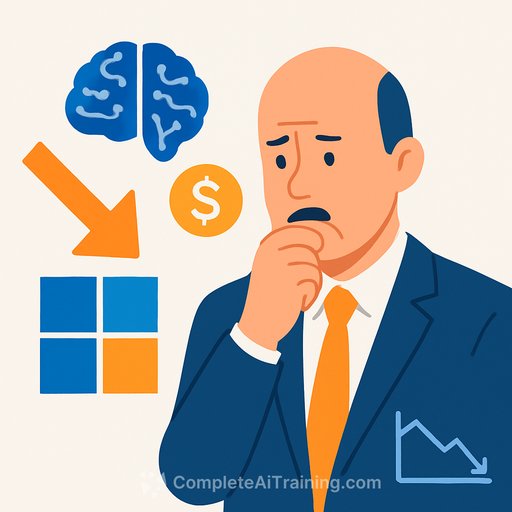
Jim Cramer didn't mince words on Microsoft: "Stock's been punished by the fact that management wants to spend a fortune on AI." Since the company's late-October report, he notes the shares slid from a $555 summer peak to near $485, even though the business is performing well.
His read: the market is wary of higher capital expenditures, cautious Azure guidance, and concentration risk tied to OpenAI - even as those same moves could extend Microsoft's lead. That tension is familiar to any leadership team funding long-term bets while living with short-term scrutiny.
Key points from Cramer's remarks
- Third-best Mag Seven performer last year, yet finished up just under 15% after failing to reclaim July highs.
- Azure guidance came in light, possibly due to supply constraints - which could imply demand remains healthy.
- Management reversed prior commentary and now expects higher capex growth in 2026.
- Microsoft owns 27% of OpenAI's for-profit business. Cramer floated a value north of $100B and cited a rumored $800B funding valuation.
- OpenAI has committed to spend $250B on Azure over several years, but there are worries it might struggle to pay, which would weigh on Microsoft if true.
- Despite the overhang, Cramer still feels good about Microsoft if OpenAI secures funding near the rumored valuation.
What managers can take from this
1) Big bets need a tight financial narrative. If you're pushing major AI or infrastructure spend, lead with the unit economics. Spell out expected ROI, payback windows, and gross margin impact. Tie capex to specific capacity constraints and revenue opportunities so stakeholders see the line from dollars to cash flow.
2) Treat "supply constraints" as a strategy signal. If guidance is soft because you can't get enough capacity (GPUs, data center space), make backlog and committed spend the headline KPIs. Investors and boards tolerate short-term pressure when there's proof of demand you're racing to fulfill.
3) Concentration risk is a board-level topic. A major customer or partner (like OpenAI for Microsoft) can supercharge growth - and add fragility. Put guardrails in place: customer credit checks, prepayment terms, SLAs with penalties, insurance where applicable, and contingency plans if a top partner stumbles.
4) Stage-gate your AI budget. Break spend into milestones tied to adoption and performance (e.g., GPU utilization targets, cost per 1K tokens, model latency, revenue per workload). Release the next tranche only when the metrics clear. This keeps ambition intact while reducing headline risk.
5) Communicate in plain numbers. Before the market punishes the spend, pre-empt with a simple model: "$X in capex adds Y capacity, supports Z in annualized revenue at A% margin by Q4 next year." Clear, repeatable math calms nerves better than vision statements.
6) Run three scenarios on key dependencies. Best case (partner fully funded), base case (partial funding), downside (funding stress). For each, list triggers, cash implications, and actions: procurement pacing, workload mix, pricing levers, and alternative suppliers.
A quick checklist for your next exec review
- Do we have a 12-24 month capex-to-revenue bridge with payback assumptions?
- Are backlog, committed spend, and capacity utilization reported monthly?
- What's our top-3 customer/partner concentration, and what credit protections are in place?
- Which KPIs unlock the next spend tranche? Who is the single owner?
- What's the plan if supply tightens or a key partner delays payments?
Microsoft's situation is a reminder: the market can punish the timeline, not the thesis. If the demand is real and the economics work, disciplined communication and phased execution close the gap between long-term value and short-term patience.
For primary updates on capital allocation and guidance, see Microsoft Investor Relations.
Building AI capability across teams? Managers can start with the AI Learning Path for Training & Development Managers.
Your membership also unlocks: