
AI news ·
Cross-functional governance gap stalls AI adoption in hiring
Nearly half of organizations using AI in hiring lack a formal governance framework. HR, IT, legal, and finance concerns stall progress without a unified approach.
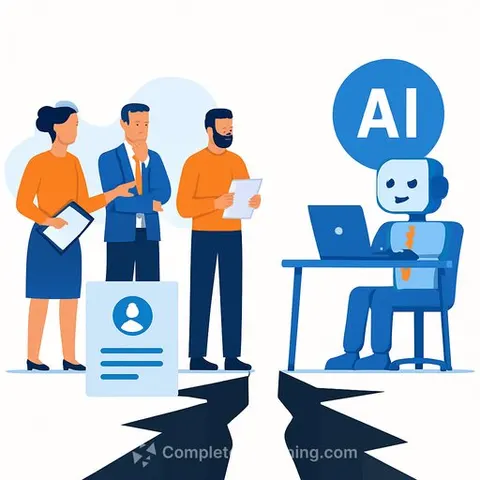
Nearly half of organizations using AI in hiring operate without a formal governance framework, according to ICIMS research. This coordination failure stalls adoption because HR, IT, legal, and finance leaders each manage different risks and balance different priorities. Unless those concerns are addressed as a single governance problem, AI conversations loop back to the same objections.
HR leaders worry about bias and losing human judgment
HR leaders own the candidate experience and often ask whether AI will replace human judgment or introduce bias. A Resume.com survey found that half of hiring managers fear AI could amplify bias. The answer depends heavily on design. Systems that surface candidates for human review-rather than making fully automated decisions-preserve recruiter judgment. When AI screens thousands of applications, it helps recruiters apply their expertise across the entire pool, not just the first few applicants.
To address bias, well-designed AI excludes characteristics the law shields from discrimination, such as race, gender, and age, along with proxies like zip codes or graduation years. Instead, these tools focus on job-related skills. When governed properly, AI can reduce inconsistencies in manual screening, including unconscious bias. Many HR teams are turning to AI for Human Resources training to understand how technology can support fair, efficient hiring practices.
IT leaders focus on security and explainability
CIOs grapple with two distinct demands: keeping candidate data secure and explaining how the AI arrives at its decisions. A Salesforce CIO AI Trends Report shows 61% feel expected to know more about AI than they actually do, with security threats topping their list of fears. IT teams look for concrete evidence:
- Relevant security certifications
- Documented privacy programs
- Clear contractual controls on candidate data
- AI that shows the reasoning behind its outputs
When a recruiter can see why a candidate ranked where they did-and can override that ranking-the system becomes auditable. This transparency addresses IT concerns and supports better decision-making.
Legal leaders want a defensible process
For many HR leaders, legal approval is the biggest hurdle to adopting AI. Legal teams are often brought in late and positioned as gatekeepers rather than strategic partners. Their role centers on building a defensible, well-documented process. That involves understanding what documentation exists, whether bias audits have been conducted, how the system approaches explainability, and whether a clear chain of human accountability exists at each decision point.
Fast-moving regulatory changes-particularly at the U.S. state level-add urgency. Ongoing litigation raises questions about where liability falls between vendors and employers. Regulators are scrutinizing governance, documentation, and oversight more than AI use alone.
Finance leaders model reputational and regulatory exposure
CFOs weigh the cost of AI adoption against the rising cost of inaction: open roles, weaker candidate pools, and slower hiring. Kyriba research found nearly 78% report significant concerns about AI, including information leaks, accuracy, and compliance. For finance leaders, the key question is whether those risks are actively managed and whether the organization can demonstrate oversight if challenged. They want to see a clear line from AI adoption to the business's KPIs. Once that link is visible, their support follows.
A cross-functional approach to AI governance
Many organizations treat AI adoption as a single decision when it actually involves stakeholders with different incentives and risk tolerances. Companies that succeed build cross-functional discipline early. They involve legal and compliance before buying or building anything. They give each department the specific evidence it needs, rather than a generic pitch. And they implement a living governance framework-reviewed at least annually and updated as laws, risks, and technology evolve. HR leaders who want to build this alignment can follow an AI Learning Path for CHROs that addresses governance and strategic adoption.
Why this matters for HR professionals
HR leaders sit at the center of these competing demands. They are accountable for filling roles while managing candidate experience and compliance risk. Instead of waiting for consensus to emerge, they can lead by convening the relevant stakeholders, demanding evidence specific to each function's concerns, and championing a governance framework that makes AI adoption both defensible and effective. The organizations that treat AI in hiring as a governance challenge, not just a technology choice, will scale its benefits without running into the same stalled conversations.