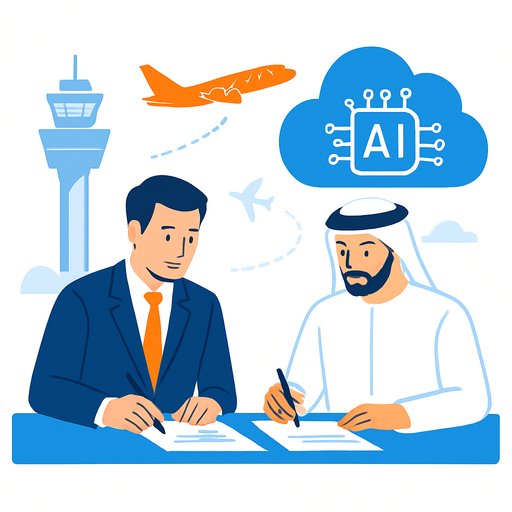
dans and Emirates Aviation University sign AI air traffic management research agreement
Dubai Air Navigation Services (dans) and Emirates Aviation University (EAU) have signed a research collaboration at Dubai Airshow 2025 to build AI-driven concepts and working prototypes for air traffic management. The focus is clear: bring operational expertise and academic research together to deliver tools that improve predictability, throughput, and decision quality across Dubai's airspace.
The initiative supports the newly approved "Aviation Talent 33" programme by the Executive Council of Dubai, which accelerates skills development and links specialised education with real operational use cases in aviation.
Systems in development
The project will develop a suite of intelligent systems designed for measurable operational impact:
- AI-based delay predictor
- Four-dimensional trajectory deviation analyser
- Sector congestion predictor
- Agent-based Ground Delay Programme (GDP) recommender
- Explainable AI (XAI) dashboard for transparent, auditable decisions
Together, these systems aim to improve planning accuracy, reduce unnecessary delays, and increase flexibility in constrained airspace. The inclusion of explainability is important for safety cases, regulator confidence, and controller trust.
Why this matters for managers, scientists, and researchers
- Data foundations: Success relies on access to high-quality historical and live operational data (traffic, weather, constraints, incidents). Establish data-sharing agreements early and define data lineage.
- Integration: Plan technical integration with existing ATM systems and processes from day one-think interoperability, latency, and failover paths.
- Governance and assurance: Set up model risk management, validation protocols, and bias checks. XAI should feed safety assessments and post-ops reviews.
- Human-in-the-loop: Design interfaces that support controller workflow without cognitive overload. Provide scenario-based training before live deployment.
- KPIs that matter: Track delay minutes, sector occupancy, predictability of trajectories, and recommendation acceptance rates-not just model accuracy.
- Iterative rollout: Use simulation and shadow-mode trials, then phased operational trials with clear stop/go criteria.
Empowering students and building a pipeline
The collaboration brings academics, research scientists, and both PhD and undergraduate students into high-impact industry projects. EAU will provide the research environment and talent pool; dans contributes operational context and data, ensuring research outcomes translate into deployable tools.
This model supports the goals of "Aviation Talent 33," which targets more than 4,000 advanced training opportunities and a stronger pipeline of AI-savvy aviation professionals. It's a practical step toward a workforce that can build, validate, and operate AI safely at scale.
Operational impact to watch
- Accuracy of delay and congestion predictions across seasons and atypical events.
- Effectiveness of GDP recommendations under mixed constraints (weather, staffing, airspace limits).
- Controller and supervisor trust in recommendations, informed by the XAI dashboard.
- Time-to-integration with live operations and observed impact on delay minutes.
- Reusability of models for adjacent use cases (flow management, runway sequencing, turnaround efficiency).
Part of a broader ecosystem
The agreement reinforces Dubai's commitment to a data-driven aviation ecosystem anchored in collaboration between operators, academia, and future talent. Announced at the Dubai Airshow, the effort positions EAU and dans to test and scale AI where it matters most-inside daily operations and decision cycles.
For background on the academic partner, visit Emirates Aviation University.
Next steps for industry leaders
- Define a shared roadmap with clear milestones for datasets, simulation, and live trials.
- Stand up a joint governance board (ops, safety, IT, legal) with decision rights for deployment.
- Invest in targeted upskilling for controllers, flow managers, and analysts who will use or audit these systems.
- Plan for continuous improvement: post-ops analytics, model drift monitoring, and rapid retraining cycles.
If you're building similar capability inside your team, explore curated AI learning paths by role at Complete AI Training.
Your membership also unlocks: