
AI news ·
Databricks' Genie ZeroOps shifts engineers from firefighting data issues to reviewing AI-generated fixes
Databricks launched Genie ZeroOps to automate monitoring and remediation for data and AI workloads. It shifts platform teams from firefighting to reviewing AI-generated fixes.
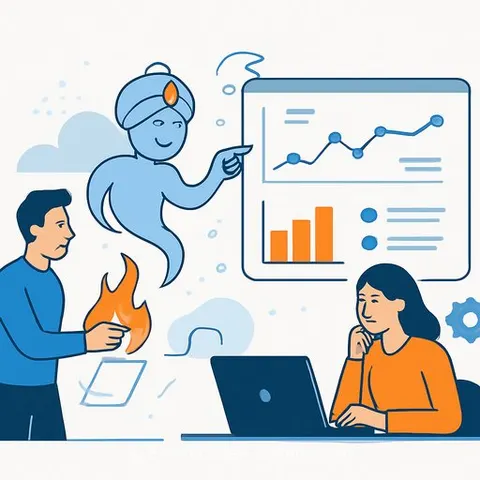
Databricks launched Genie ZeroOps at its Data + AI Summit, a new agentic operations capability that automates monitoring, investigation, and remediation across data and AI workloads. The move targets the operational toil that consumes engineering time as data estates and AI pipelines expand, and it shifts the role of platform teams from firefighting to reviewing AI-generated fixes.
What the agent actually does
Genie ZeroOps is currently in private preview. It uses an AI agent to identify anomalies, trace root causes through metadata and lineage information in Unity Catalog, and generate proposed fixes. Those fixes are tested in an isolated environment before being surfaced for human review and production deployment.
The offering addresses a familiar pain point. "Most data teams spend more time keeping pipelines and models alive than building new ones," said Amit Chandak, chief analytics officer at IT consulting firm Kanerika. Independent consultant David Linthicum said enterprises continue to grapple with deployment drift, incident response, compliance checks, and root-cause analysis across fragmented data and AI estates.
Victor Coimbra, CTO of Artefact, pointed to the compounding effect of agentic coding tools that accelerate development but produce more assets that need "babysitting." That maintenance burden carries a direct productivity cost, according to Robert Kramer, managing partner at KramerERP, because activities like managing infrastructure, deployment environments, and support processes create no direct business value.
Shifting the role of platform teams
The shift from monitoring tools that alert humans to an agent that diagnoses, proposes fixes, and validates them in a governed environment represents a meaningful change, said Stephanie Walter, practice leader of AI stack at HyperFRAME Research. For operations teams, this could reshape daily work.
"Skilled engineers spend the majority of their time on toil. If the ZeroOps agent, in the background, handles monitoring, investigation, and fix-proposal, engineers shift from doing the operational work to reviewing it," said Ashish Chaturvedi, leader of executive research at HFS Research. "Additionally, this would also mean that platform teams can focus on genuinely novel failures rather than the repetitive ones."
Coimbra added that the same team could cover more pipelines, which changes how enterprises scale platform headcount. However, because the capability is still in preview, Chandak cautioned that headcount reduction claims may be overstated.
There is a risk of skill atrophy. "If engineers stop debugging because the agent does it, the team's ability to handle the cases the agent cannot handle becomes a real exposure," Coimbra said. The growing reliance on agentic operations in AI for IT & Development means organizations must track how often engineers approve fixes without editing.
What CIOs should measure
The appeal for CIOs is straightforward: reduce operational drag, shorten deployment cycles, improve service resilience, and enforce governance without scaling headcount at the same rate as workloads, Linthicum said. But he urged calculated skepticism and a demand for metrics that validate the claims.
Chandak said the headline metrics to track are mean time to detect and mean time to resolve, plus the share of incidents the agent closes without human intervention. "Underneath these metrics, CIOs should track the accuracy of root cause calls, the false positive rate on proposed fixes, and the proportion of fixes engineers approve without editing, because that last number is the real trust signal," he said. Cost per incident handled against the human baseline, net of agent compute, should also be measured.
Databricks is entering a less crowded category. "Most vendor agent announcements target the build and use layers, helping people write code or ask questions of their data. ZeroOps targets the operate layer," Chandak said. That focus on operations aligns with the priorities of AI for Operations in environments where maintenance consumes the bulk of engineering budgets.
Why this matters for operations
For operations engineers, Genie ZeroOps signals a shift in job scope. Hours spent on repetitive incident response could move toward reviewing and approving AI-generated fixes, with the agent handling the heavy lifting of root-cause analysis and sandbox testing. The result is less time on toil and more focus on novel failures. However, the preview nature of the tool means teams must deliberately build the muscle to debug when the agent can't, or risk skill atrophy. The metrics that matter are not just uptime improvements, but the trust signal: how many proposed fixes get approved without edits.