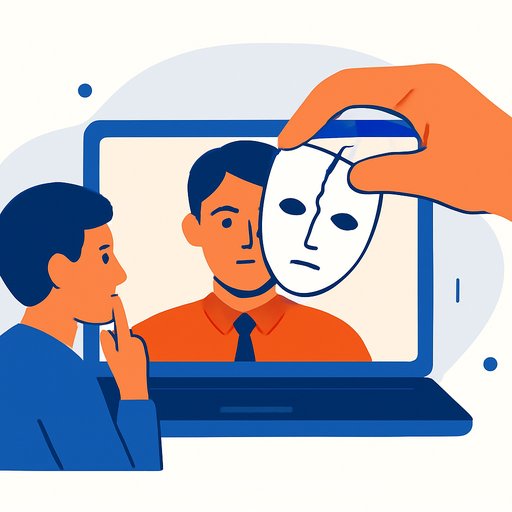
Truth Decay Is Here: Detection Isn't Enough to Restore Trust
The moment many warned about has arrived. AI-made and AI-edited visuals-often called Generative Video-are shaping opinions, even after people learn they're fake. That's the real problem: influence survives exposure.
Consider two recent threads. The US Department of Homeland Security is using AI video tools from Google and Adobe for public-facing content while immigration agencies flood social channels with supportive posts, including pieces that look AI-made (like a "Christmas after mass deportations" video). Around the same time, the White House posted a digitally altered photo of a woman arrested at an ICE protest, and a senior official brushed off questions with, "The memes will continue."
Then there's the media angle. MS Now aired an AI-edited photo of Alex Pretti that appeared to make him look more attractive, igniting viral commentary. The outlet said it didn't realize the image was edited. These are not equivalent cases-but both show how fragile our information checks have become.
Why the authenticity stack is failing
- Labels aren't default. The much-hyped content authenticity efforts apply automatic labels only to fully AI-generated assets. Mixed or edited content often relies on opt-in tags from creators-an obvious gap. See the open standard efforts at C2PA.
- Platforms strip or ignore labels. Even when provenance data exists, platforms like X can remove it or choose not to display it. That breaks the "trust at a glance" promise.
- Official channels aren't consistent. The Pentagon's DVIDS hub was supposed to show authenticity labels; current pages don't consistently surface them.
- Facts don't reset feelings. A study in Communications Psychology found that people still relied on a deepfake "confession" even after being told it was fake. Transparency helps-but it doesn't undo the initial emotional hit. Source: Communications Psychology.
What this means: confusion isn't the main threat-persistence is
We prepared for a world where the issue was not knowing what's real. But even when falsehoods are exposed, they keep working on us. Doubt is easy to weaponize. A correction is not a clean slate.
Practical moves for IT, engineering, and product teams
- Default to provenance at capture. Turn on C2PA/CAI signing in cameras, graphic tools, and editing apps. Require a signed, verifiable chain for official content and public posts.
- Verify, don't assume. Don't rely on platforms to display labels. On your own properties, surface provenance receipts, hashes, and edit histories next to media.
- Fail closed. Auto-flag or block assets that lack provenance or have broken chains. Make "no receipt, no publish" the standard for official comms.
- Detection is triage, not truth. Run deepfake/media forensics to prioritize review, but pair it with human checks and provenance. Track false positives and false negatives.
- Add distribution friction. For high-risk topics (elections, public safety, immigration), hold content for extra review, limit auto-amplification, and require context captions.
- Keep receipts. Store originals, edit logs, and model prompts. If you use AI to generate or enhance assets, disclose the scope and keep a paper trail you can publish.
- Red-team your pipeline. Test how AI edits could slip through your stack. Include watermark removal, upscaling, frame interpolation, and voice cloning scenarios.
- Vendor hygiene. If you pay for AI tools, document their default labeling behavior, export metadata policies, and how they handle mixed media. Disable features that hide edits.
- Incident playbook. Prewrite responses for "we used AI," "we aired a fake," and "our asset was altered." Include takedown steps, retractions, receipts, and an internal review path.
- Metrics that matter. Track provenance coverage (% of media with valid receipts), mean time to verify, correction reach vs. original reach, and retraction latency.
Policy and comms standards that actually help
- Label scope, not just presence. Say exactly what was AI-edited (lighting, background cleanup, facial features) and what was not (subjects, expressions).
- Separate satire and official messaging. If you publish memes or stylized content from official accounts, tag them clearly on the asset and in the caption.
- Make corrections bigger than the mistake. When something is wrong, update the asset, pin the correction, and push it through the same channels that spread the original.
For teams that consume as well as produce
- Treat viral visuals as opinion until proven otherwise. Look for provenance, source, and context before sharing.
- Prefer first-party posts with receipts over screenshots. Screenshots lose metadata and are easy to manipulate.
- Beware "too perfect" media in hot-button topics. Pause, then verify.
The bottom line
AI content is cheaper, faster, and everywhere. We won't audit our way out with labels alone. The fix is a system: sign at capture, verify on publish, add friction for high-risk content, keep receipts, and make corrections loud.
We were promised that better detection would restore trust. Instead, we need better defaults, clearer disclosures, and a culture that rewards receipts over vibes.
Update (Feb 2): Adobe applies automatic labels when content is fully AI-generated; otherwise, creator opt-in is required. That gap is exactly why verification must be enforced at the point of creation and again at distribution.
If your team needs to level up on practical AI tooling and risk controls, see our curated tracks by role: AI courses by job. Video teams can follow the AI Learning Path for Video Editors for hands-on guidance on provenance, signing, and verification.
Your membership also unlocks: