
AI news ·
Dementia care exposes whether healthcare AI is built for complexity or optimized for easy users
Dementia care may be healthcare AI's hardest test - and its most important one. Three-quarters of WHO member states have no national dementia plan, and most AI tools aren't built for patients whose needs shift by the hour.
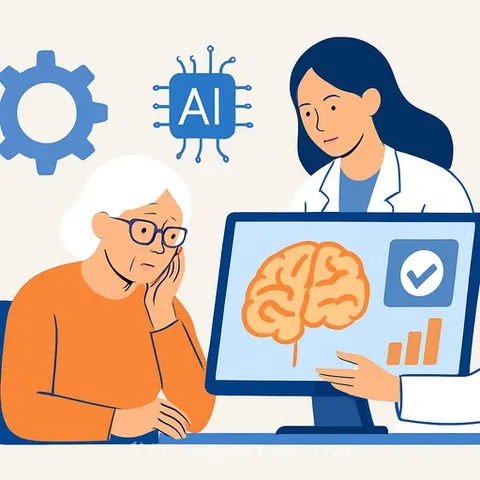
Dementia Care Is Where Healthcare AI Will Prove Its Worth
Healthcare AI has moved past documentation and triage. The real question now is whether it can handle the messy, fluctuating reality of dementia care-where patient needs change by the hour and caregiver stress is constant.
The World Alzheimer Report 2025 exposes how far the field still lags. Seventy-five percent of WHO member states have no national dementia plan. Even where plans exist, 65% mention rehabilitation, yet people living with dementia rarely receive it. Cognitive rehabilitation has been shown to lower disability and allow people to remain at home six months longer before moving into residential care.
The stakes are larger than care delivery. Informal caregiving accounts for roughly half of global dementia costs. This is a systems problem, not just a staffing one.
Why Dementia Breaks Standard Healthcare AI
Most healthcare systems assume a user who can articulate symptoms, follow prompts, tolerate friction, and recover from a poorly designed interaction. Dementia invalidates all of that.
Mood and behavior changes can appear before memory problems. The condition affects emotional control, motivation, orientation, and decision-making alongside cognition. A system that works well for an articulate, digitally fluent patient will fail when memory is unstable, language is inconsistent, or distress rises without warning.
The interface problem is not just cognitive. It is emotional, perceptual, and relational. A system that cannot respond to confusion, agitation, repetition, sensory overload, or caregiver stress is not personalized. It is optimized for stability-enough for billing workflows, not enough for one of medicine's most complex care environments.
What Works: Continuity and Low Friction
A 2025 study in Scientific Reports found that AI care calls delivered to community-dwelling individuals with dementia were associated with significantly lower depression scores and improved memory scores. The system succeeded because it was designed for continuity, repetition, and low-burden interaction.
The World Alzheimer Report 2025 reinforces this finding: tailored, goal-oriented rehabilitation approaches help maintain function, independence, and participation across settings and stages. The lesson for AI builders is clear. The answer is not a single chatbot. It is a layer of support that fits into long-term rehabilitation, daily function, and caregiver reality.
The Gap Between Promise and Design
A 2026 JMIR review on mental health support for Alzheimer's caregivers found that real-time monitoring was rare, personalization was inconsistently defined, and transparency around data use remained weak.
A 2025 systematic review in Frontiers in Public Health found that dementia care depends heavily on informal caregivers and fragmented systems that fail to meet needs. Demand is strong for psychosocial support, education, training, and interdisciplinary coordination. If caregiver distress is dynamic, patient needs change by stage, and service delivery is fragmented, then static AI experiences will not hold up.
Emotionally Adaptive AI: What It Would Look Like
A useful system would notice when a person is becoming frustrated and simplify its language, slow its pace, or switch from verbal prompts to environmental cues. It would distinguish between repetition that reflects forgetfulness and repetition that signals rising anxiety.
Support for caregivers would shift based on context. During routine periods, the system offers reminders and practical guidance. When behavior changes, it shifts toward reassurance, triage advice, or escalation. Emotionally adaptive AI in this context is not about sounding warm. It is about responding safely to fluctuating human conditions.
Relational AI, Not Transactional
The industry needs to move from transactional healthcare AI to relational systems. Unlike standard chatbots, relational AI maintains longitudinal context across fluctuating cognitive states and supports the care triad of patient, caregiver, and provider.
This requires a human-in-the-loop approach, where the AI identifies emotional or behavioral shifts and flags them for a professional before a crisis occurs. People living with dementia need help with memory, but also with confidence, orientation, routine, and the emotional meaning of what is happening around them.
Caregivers need far more than alerts. They need training, context, relief, and support that respects exhaustion. The Alzheimer's Association reports that caregivers of people with dementia experience greater emotional, financial, and physical difficulty than caregivers of people without dementia. Direct care workforce shortages are already severe. In that context, AI has to prove it reduces burden rather than adding one more layer of monitoring.
The Real Test
Winners in healthcare AI will not be companies with the most human-sounding avatars or polished demos. They will be those that understand dementia as a systems challenge.
That means stage-sensitive design, caregiver co-pilots rather than caregiver replacement, transparent personalization, and clear escalation when distress, wandering risk, medication failure, or behavioral change moves beyond what software should handle alone.
Dementia is where healthcare AI will either mature into something genuinely humane or reveal that it still confuses convenience with care.