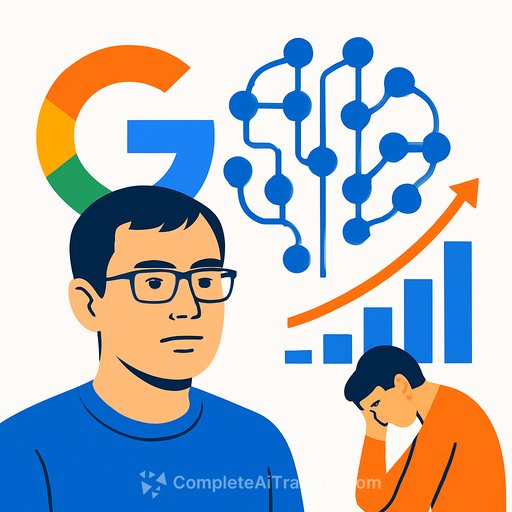
AI's quiet power shift: lessons for executives from Demis Hassabis, rising burnout, and the latest market signals
Ten years ago, a decision set today's AI race in motion: Demis Hassabis sold DeepMind to Google. It pushed other founders to launch competing labs and reset the pecking order in big tech. Today, Hassabis oversees Google's AI efforts and Gemini-a direct challenge to OpenAI-while his earlier team's protein-folding breakthrough earned global recognition across science and industry.
What matters for executives: his approach is less about hype and more about operating rigor. He's rebuilding Google's shipping cadence, instilling intensity, and forcing focus. If you run a P&L, there's a playbook here you can use this quarter.
Inside Hassabis's operating system: four moves worth copying
- Model quality as the nucleus. Nothing works without state-of-the-art models. Invest where your advantage compounds-core tech, proprietary data, and model deployment (e.g., Gemini, Nano, Veo).
- Rewire processes to ship faster. Redesign workflows so product teams can plug into models quickly. Expect 12-18 months of org changes before velocity feels natural.
- Enforce ruthless focus. Cut side quests. Concentrate resources on the few bets that can change your trajectory.
- Make consistently good decisions. Remove drama. Standardize how decisions get made, who owns them, and when they're revisited. Small, rational calls compound.
Turn it into an operating plan for your company
- Define your nucleus. Choose one to two AI use cases tied to cost takeout or revenue expansion. Assign a single executive owner and write a 90-day scorecard.
- Redesign for delivery. Co-locate data, engineering, and product. Create a "model interface team" that productizes internal models and vendor APIs for the rest of the org.
- Set a kill cadence. Monthly "stop list" to cut low-leverage projects and free headcount. No exceptions.
- Institutionalize decision hygiene. One-page decision memos, DRI named, deadline set, post-mortem logged. Leaders coach the process, not the politics.
- Protect maker time. Time-block your own calendar. Some leaders split the day into two work blocks-including late-night deep work-to keep output high without bloating meeting load.
Productivity is up-and so is burnout
New research out of UC Berkeley points to a tradeoff: AI boosts throughput, but prompts and micro-tasks are filling the natural breaks workers used to get. The result is fatigue that sneaks up on your best people; see related options like AI Research Courses for deeper exploration of the research and mitigation strategies.
- Redesign the workflow, not just the toolset. Batch prompts into focused blocks; avoid always-on nudges.
- Set AI usage norms. Define when to use agents vs. deep work, and cap after-hours notifications.
- Measure cognitive load. Track context switches per hour, not only output. Reward fewer, larger releases.
- Train for leverage. Upskill managers and ICs on prompt patterns, review practices, and task automation. See curated options by role at AI Productivity Courses.
Talent anxiety is high, but the layoff data is mixed
Employees fear AI-driven cuts, yet recent data shows AI accounts for a small slice of layoffs so far. Many companies are opting for a slow, ongoing trim instead of headline rounds-likely an echo of the post-COVID labor market.
- Be explicit about where AI will replace, reshape, or augment roles. Uncertainty drains performance faster than change.
- Put reskilling on rails. Tie training to job architecture and promotion paths. Consider team-wide tracks and certifications-see an example role-specific path at AI Learning Path for UX Designers.
- Budget by skill, not headcount. Shift spend from low-leverage tasks to high-impact skills and automations.
Customer strategy: follow the money (Chipotle's move)
Chipotle plans to lean into higher-income buyers who keep spending through price hikes. That's a clear read on a K-shaped economy.
- Segment pricing and experience. Premium tiers and faster lanes for your most elastic customers; value bundles for the rest.
- Localize the mix. Match assortment by ZIP-level income and trip frequency data.
- Protect unit economics. If price is your lever, pair it with throughput gains and shrink control.
Markets at a glance
- S&P 500 futures: +0.11% (last close: -0.33%).
- STOXX Europe 600: -0.25% early.
- FTSE 100: +0.23% early.
- Nikkei 225: +2.28%.
- CSI 300: -0.22%.
- KOSPI: +1.0%.
- NIFTY 50: +0.05%.
- Bitcoin: ~$67K.
One notable ripple: an AI tax-planning tool sparked a selloff in financial advisory stocks. If AI can compress advisory margins, expect more fee transparency, product unbundling, and a premium on human-led planning for complex cases.
Around the watercooler (and what to do about it)
- U.S. borrowing pace is steep. America added ~$43.5B per week in the first four months of the fiscal year; interest could top $1T by 2026. Plan for higher term premiums and refinance risk in your debt stack.
- Oil export hubs approved, but tepid interest. Greenlit projects lack builders-capital discipline is real. Treat permits as optionality, not inevitability, in your energy planning.
- AI agents won't kill SaaS overnight. Incumbents aren't safe, but they have distribution. If you're a SaaS exec, ship agent integrations now and price on outcome, not seat.
- Red Lobster cleanup continues. More closures and menu simplification are on the table. If traffic is volatile, fewer SKUs and tighter ops beat discounting every time.
The takeaway for leaders
The edge right now is operational: better models, tighter process, fewer priorities, cleaner decisions. Copy what works from the AI frontrunners, protect your people from burnout, and go where your customers still spend. Everything else is noise.
Your membership also unlocks: