
AI news ·
Democrats split on how hard to push AI regulation as super PAC money looms over 2026 races
Democrats are split over AI regulation, with party leaders focused narrowly on energy costs while progressives push to ban new data centers entirely. Tech-funded super PACs are now spending against candidates who back stricter rules.
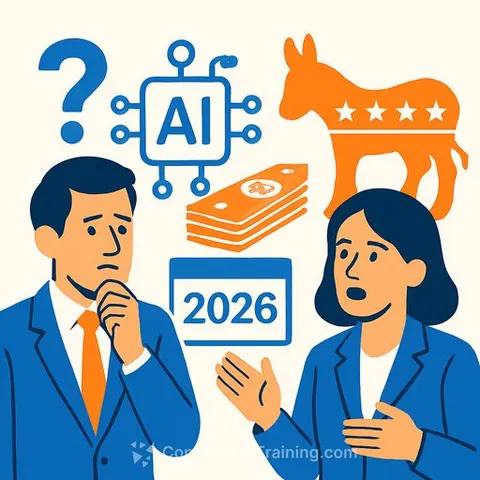
Democrats Split on AI Regulation as Tech Money Floods Political Races
Democratic leaders are taking a narrow approach to AI regulation - focusing on protecting voters from rising energy costs tied to data centers - while progressives push for a broader crackdown on the technology itself. The divide threatens to undermine what polling shows is a winning issue for the party.
House Minority Leader Hakeem Jeffries told reporters this week that Democrats must "protect the American homeowner" and "protect the American ratepayer from some of the downsides" of data center expansion. He framed the goal as ensuring American companies "can continue to lead the world in this transformative technology."
That cautious stance contrasts sharply with proposals from Sen. Bernie Sanders and Rep. Alexandria Ocasio-Cortez, who introduced legislation to ban new data center construction until Congress passes laws guaranteeing AI safety, affordable power, and worker protections. Sanders' bill cites warnings from tech leaders, including Elon Musk's past comments about "summoning the demon" with artificial intelligence.
Sen. Mark Warner dismissed the moratorium idea as "idiocy" during a recent event, arguing it would give China a competitive advantage. Other Democrats have introduced competing bills focused on workforce tracking and AI standards rather than restrictions.
Public Backs Regulation, But Democrats Fear Tech Spending
Polling shows voters want government action. A POLITICO survey found 46 percent of Americans would prioritize ensuring AI is safe and well-regulated even if it means China develops the technology faster. Among Democrats, that number rises to 57 percent.
Yet Democratic leadership is warning vulnerable House members about the political cost of attacking the AI industry. According to three people familiar with internal guidance, the Democratic Congressional Campaign Committee has advised candidates about which groups would spend against them if they embraced tougher regulation.
"If you do this, this is who will try to destroy you," described one swing-state Democrat granted anonymity to discuss internal party strategy. The guidance amounts to a "choose your own adventure" of political consequences.
Dueling Super PACs Shape the Debate
Two competing super PACs are now shaping the AI regulation fight. Leading the Future, backed by executives at OpenAI, holds more than $100 million and is spending against candidates who favor strict AI rules. Public First, funded by executives at OpenAI rival Anthropic, is pushing for stronger regulation and state-level protections.
The groups are actively competing for Democratic support. Leading the Future co-head Josh Vlasto said Public First was "intimidating members" to back Anthropic's agenda. Public First founder Brad Carson said his group simply wants Democrats to "follow the intuitions of their constituents" rather than get "boxed in" before forming their own views.
This battle mirrors the 2024 defeat of then-Sen. Sherrod Brown, who lost his seat after a cryptocurrency-funded super PAC spent $40 million against him. Many of the operatives who ran that campaign now work for Leading the Future.
Why Democrats May Be Underestimating the Issue
Some Democratic strategists argue the party is making a strategic error by avoiding the AI fight. Democratic consultant Jesse Ferguson said AI differs from crypto because voters already hold strong personal concerns about it.
"Crypto was abstract," Ferguson said. "AI is personal - your job, your kids, your privacy. You can't outspend fear."
Local governments and voters from Wisconsin to Missouri to the Phoenix suburbs have already rejected major data center projects. Progressive consultants say Democrats are missing a clear opportunity to position themselves against corporate overreach.
"It's very clear that many Democrats are missing the boat on a clear proof point that they can fight corporate power," said Tommy McDonald, a strategist at Fight Agency, which focuses on anti-establishment candidates.
Democratic leadership has received pushback from within its own ranks. Rep. Greg Landsman, facing a competitive race in Ohio, said he received no guidance from party leadership on discussing AI beyond protecting households from cost increases.
The party faces a choice: follow constituent concerns about AI's risks to jobs and privacy, or maintain the goodwill of tech executives and their super PACs. Polling suggests voters are ready for Democrats to choose the former.