
AI news ·
DeSantis signs bill shielding Florida utility customers from data center electricity costs
Florida utility customers won't pay for data center infrastructure costs after Gov. DeSantis signed SB 484 on Thursday. The law requires data center operators to cover their own grid connection and power expenses.
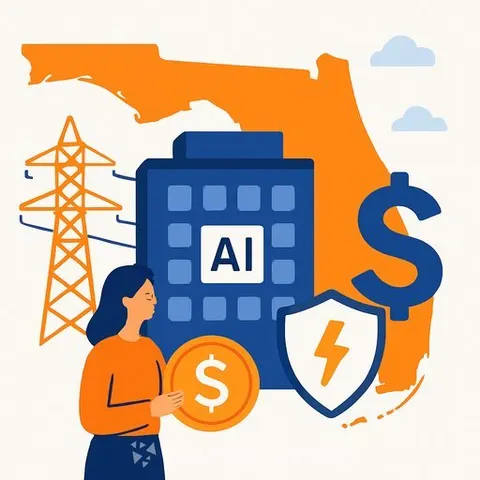
Florida law shields utility customers from data center costs
Florida utility customers will not bear the infrastructure costs of large-scale data centers that power artificial intelligence systems. Gov. Ron DeSantis signed the measure into law Thursday, marking the first legislative victory in his push to regulate AI development in the state.
The bill (SB 484) requires the Florida Public Service Commission to establish pricing rules ensuring that data center operators pay the full cost of connecting to electric systems and covering increased power transmission and generation expenses. The costs cannot be passed to residential ratepayers.
"You should not pay one more red cent for electricity because of a hyper-scale data center as an individual," DeSantis said at the signing event in Lakeland. "That's just not right for the most wealthy companies in the history of the world to come in and have individual Floridians or Americans subsidize these hyper-scale data centers."
What the law does
The measure reinforces local governments' ability to reject data center projects in their jurisdictions. It also permits cities and counties to sign non-disclosure agreements with tech companies for up to 12 months, allowing proposals to remain hidden from the public during that period.
The bill addresses concerns about data centers' consumption of vast amounts of water and their strain on electric grids. Sen. Bryan Avila, the bill's sponsor, cited projections that global data center capacity will triple by 2030, with U.S. capacity growing 20 to 25 percent annually.
Virginia has already experienced what other states face: ratepayers saw "dramatic increases" after massive data centers arrived, Avila noted during committee testimony.
Regulatory skepticism
DeSantis has described the bill as both "watered down" and "a pretty strong first step." His administration has already questioned major data center projects. After Fort Meade approved a 4.4 million square-foot facility expected to use 50,000 gallons of water daily, Commerce Secretary Alex Kelly called it "fundamentally flawed."
Kelly said Thursday that water resources "should never be at the mercy of what sounds like a quick deal."
The broader AI regulation effort
The data center bill passed the Legislature, but a companion measure called the AI Bill of Rights did not. That stricter proposal, which would have imposed additional consumer protections against AI harms, failed to gain full support in DeSantis' final regular session and a recent special session.
House Speaker Daniel Perez argued that individual protections should be addressed at the federal level rather than by the state.
DeSantis expressed mixed views about AI's future. While optimistic about defense, robotics, and medical research applications, he criticized much current AI use. "A lot of the power that it is being used is for consumer-facing slop," he said.
Business concerns
Industry groups raised concerns during legislative hearings that data centers face stricter permitting requirements than other large industrial users. They warned this could offset any economic benefits the facilities might bring to Florida.
For legal professionals tracking AI regulation and corporate responsibility, AI for Legal resources address how emerging rules affect compliance and contract obligations. Understanding the underlying technology - Generative AI and LLM systems that power these data centers - helps lawyers advise clients on regulatory risk.