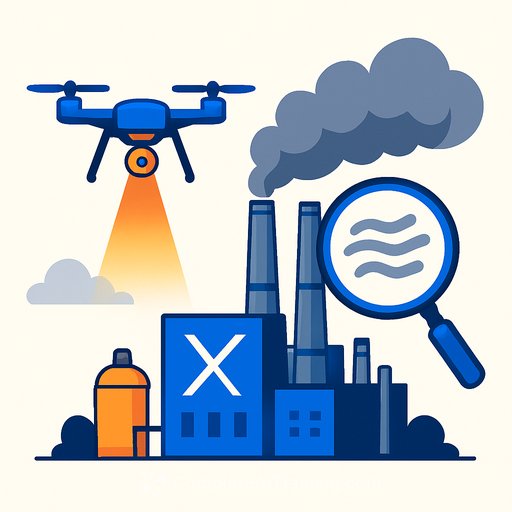
"A Different Set of Rules?" Thermal Drone Footage Raises Clean Air Questions Around Elon Musk's AI-Linked Power Facility
Thermal drone footage allegedly showing sustained high-heat emissions from a gas-powered plant tied to xAI has kicked off a new environmental dispute. Advocates say the activity looks like large-scale generation that could push, or even exceed, clean air limits. Supporters counter that on-site turbines are a stopgap while renewable capacity catches up. Either way, operations leaders now face a clear signal: AI growth brings physical, regulatory, and community risks that can't be ignored.
What the Thermal Footage Reportedly Shows
- Continuous high-heat signatures from multiple gas turbines
- Sustained exhaust plumes consistent with ongoing combustion
- Activity patterns that suggest large-scale generation
Thermal imaging doesn't measure pollutants, but experts use it to infer combustion intensity and operating cadence. Critics claim the patterns point to elevated NOx and particulates-both tied to respiratory issues and smog. The facility is reportedly supporting compute for AI training and inference, which demands round-the-clock energy.
Why AI Data Centers Pull So Much Energy
- GPU clusters running at high utilization for training and inference
- 24/7 server uptime with redundancy and failover
- Cooling systems that often draw 30-40% of site load
- Network, storage, and facility overhead that compounds total demand
Where grids are constrained, operators turn to on-site gas turbines to meet near-term capacity needs. Temporary often becomes semi-permanent if demand outpaces grid upgrades. That's where compliance and perception risk grow fast.
Clean Air Compliance: The Gray Areas
Under the Clean Air Act, facilities typically need permits, emissions controls, and inspections. Some sites run under temporary or emergency allowances meant for short-term reliability support. If an AI-linked plant operates beyond those conditions, it may be legal on paper but misaligned with the spirit of the law.
For context on permits and obligations, see the EPA's overview of clean air permit programs (EPA resource). For health impacts tied to nitrogen oxides, see the EPA's NO2 page (EPA NO2).
Optics Matter When the Face Is Elon Musk
Musk's companies have long promoted EVs, storage, and solar. That history makes alleged reliance on fossil-fuel turbines for AI infrastructure more contentious. Supporters argue pragmatism; critics see mismatch. Operations teams sit in the middle, where plans, permits, and dashboards either build trust-or invite scrutiny.
Community Concerns You Can't Ignore
- Air quality and potential long-term health impacts
- Noise, traffic, and visible plumes
- Industrialization creep near residential areas
Communities already bearing industrial load often feel they're paying the externalities for someone else's growth. If your site fuels advanced AI, the expectation is simple: prove you're minimizing harm and report it openly.
The Carbon Problem Behind AI
AI is often pitched as a tool for efficiency and climate modeling. But the compute stack behind it can carry a sizable carbon footprint if powered by fossil fuels. The International Energy Agency has tracked rising data center electricity use, and the trendline is clear: more compute, more load (IEA overview).
What Operations Leaders Should Do Now
1) Run a permit and controls audit. Confirm permit type (temporary, emergency, or standard), limits, reporting cadence, and any Best Available Control Technology (BACT) requirements. Verify that SCR/oxidation catalysts and continuous emissions monitoring (CEMS) match the permit's letter and intent.
2) Stand up a real monitoring stack. Instrument turbines and stacks with CEMS or near-source monitoring. Publish a public-facing dashboard with monthly emissions, uptime, starts/stops, and exceedances. Transparency buys you breathing room when footage goes viral.
3) Lock in procurement standards. Bake emissions limits, PUE targets, and renewable sourcing into supplier SLAs. Require documented curtailment plans for peak smog days. Tie vendor bonuses to reductions in NOx, particulates, and carbon intensity.
4) Source cleaner electrons, faster. Pursue PPAs, VPPAs, and on-site solar plus storage where siting allows. If turbines are unavoidable, favor lower-NOx configurations and verified offsets. Set a date to retire "temporary" generation and publish it.
5) Engage the community like a partner. Hold quarterly town halls, share monitoring data, and publish mitigation timelines. Budget for local air quality programs and noise abatement. Treat complaints as input to ops sprints, not PR issues.
6) Stress-test the grid path. Coordinate with the utility on interconnection timing, grid upgrades, and curtailment rules. Model load growth by phase and lock contingency plans that don't default to open-ended turbine use.
Practical KPIs and Controls to Track
- PUE and WUE: Energy and water efficiency targets by quarter
- Emissions intensity: NOx, SO2, PM2.5 per MWh delivered
- Runtime profile: Starts, runtime hours, ramp rates, and maintenance windows
- Controls health: SCR efficiency, ammonia slip, catalyst lifecycle, CEMS uptime
- Renewables share: % load served by contracted clean energy
- Incident log: Any exceedances, root cause, corrective action, and closure date
Decision Guide: On-Site Generation or Wait for the Grid?
- If time-to-compute is critical and grid interconnection is >18 months away: consider limited-duration turbines with firm sunset dates and published emissions caps.
- If interconnection is <12 months: bridge with demand management, phased GPU activation, temporary battery systems, and aggressive cooling optimization.
- In all cases: set a public decommission plan for fossil units, backed by contracts that make delay expensive.
Policy Is Catching Up
Lawmakers are starting to tie data center growth to energy sourcing and emissions transparency. Expect tighter reporting rules, caps on fossil backup, and closer alignment with climate targets. If no violation is found at the site in question, the bigger issue remains: current rules weren't written for AI-scale demand.
The Bottom Line for Operations
Whether this facility crossed a legal line is up to regulators. What's squarely in your lane is risk reduction: clean permits, credible monitoring, clear timelines, and visible community benefit. AI growth can continue, but only with disciplined energy decisions and proof-visible to neighbors, regulators, and your own board.
Want your team fluent in running efficient AI stacks? Explore role-based training that links AI strategy with real operational constraints: AI Learning Path for Technology Managers, AI Learning Path for CIOs, and AI Learning Path for VPs of Strategy.
Your membership also unlocks: