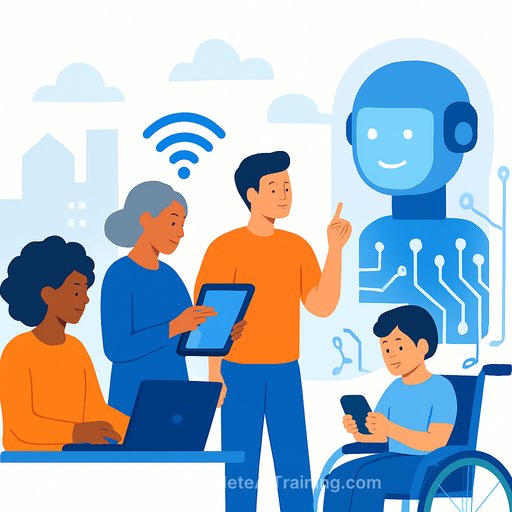
Digital inclusion in the age of AI: a practical agenda for government
Digital inclusion is not "done." Connectivity is high, but exclusion persists and shifts shape as services move to data-driven and AI-enabled models. As Gita Singham-Willis notes, the question has changed from "get people online" to "help people take part."
That shift raises the stakes for public services. If we want fair access to healthcare, benefits, work and learning, inclusion has to be designed in - not bolted on.
Digital exclusion: more than being offline
Exclusion is a stack of barriers that block everyday tasks and essential services. It is not just a missing connection.
- Access: No suitable device or a patchy connection
- Affordability: Data poverty and bills people cannot sustain
- Skills and confidence: Lacking essential skills to use services safely
- Trust and motivation: Fear of scams, low confidence, or feeling "this isn't for me"
The UK still has an estimated 1.8 million adults completely offline. Around 5-6 percent of households have no home internet. About 16 percent of adults lack "Foundation Level" digital skills.
These gaps are uneven. Older adults, low-income households, disabled people, social housing tenants, people living alone and those outside work are over-represented. Digital exclusion mirrors broader inequality - and makes it worse.
What is being done
The government's Digital Inclusion Action Plan: First Steps (2025) set a more coordinated path. It recognised that no single department can fix this; it needs industry, local government, charities and communities pulling together.
- Digital Inclusion Innovation Fund to back local solutions that work
- Stronger Essential Digital Skills framework
- Pilot device donation scheme across departments
- Better usability of digital government services, including GOV.UK One Login
- Better evidence on what works and the economic case for investment
Banks, telcos and tech firms have added affordability measures and training. The UK has also expanded AI skills initiatives, such as the AI Skills Boost, with a goal to upskill 10 million workers by 2030. Progress is real, but the gap stays open because this is a structural issue, not just a tech upgrade.
AI: widening or closing the divide?
AI can cut both ways. If services assume new skills with no support, people get left behind - especially those already at risk.
Used well, AI can help:
- Improve accessibility with speech-to-text, translation and adaptive interfaces
- Guide users through complex tasks step by step
- Personalise learning and skills growth
- Equip frontline teams to give more tailored support
But if systems are opaque, biased, or mandatory with no alternative, trust breaks and uptake falls. Inclusion has to be built in from the start.
What needs to happen next
- 1) Treat AI literacy as foundational
People need to know how to question outputs, spot errors and use tools safely. Build AI topics into essential skills, workplace training and community learning - with a focus on low-confidence groups. Programmes like AI Skills Boost should be activated where exclusion is highest. - 2) Invest in the fundamentals
Devices, affordable connectivity and local support still matter most. AI will not fix a missing connection. Fund trusted, community-based help that people can walk into. - 3) Embed participatory service design
Co-design with older adults, disabled people, carers, low-income households and minority communities. Test on older devices, low bandwidth and shared access. Offer assisted digital and non-digital options. Close the loop with real user feedback. - 4) Prioritise trust, transparency and accountability
Be open about bias, errors and misuse. Provide clear explanations, simple redress routes and human escalation. Without trust, even good services won't be used. - 5) Make inclusion a shared accountability
Treat inclusion as core public infrastructure. Align policy, procurement, industry investment, skills systems and service standards to the same goal.
From ambition to delivery: actions for government
- Next 90 days (central and local):
Map exclusion hotspots using existing data; align funding with those areas. Set a minimum inclusion standard for every AI or digital change (devices tested, readability, assisted channels, human review). Require user research with at-risk groups before go-live. - Next 6-12 months (central):
Bake AI literacy into the national essential skills offer and adult learning. Expand the device donation pilot into a cross-government scheme with secure wipe and distribution through local partners. Update service assessment criteria to include AI explainability and human-in-the-loop for high-impact decisions. - Next 6-12 months (local):
Build a place-based coalition (councils, NHS, colleges, libraries, VCS, housing providers, employers). Fund "no wrong door" community support hubs. Commission assisted digital as a default for priority services. - Procurement levers:
Mandate inclusive design evidence in bids. Require testing on low-spec devices and low bandwidth. For AI features, require bias testing, clear user messaging, opt-outs where feasible and named human escalation. - Data and measurement:
Track: access (devices/connection), affordability, skills confidence, assisted channel use, completion rates by cohort, and complaints/redress. Publish progress to build trust and accountability.
System enablers to make this stick
- Align digital, data and inclusion goals in one transformation plan
- Use shared evidence on what works; stop funding isolated pilots
- Embed responsible AI governance into every programme, not as an add-on
- Fund local partners who already have trust and reach
Useful resources
AI will keep changing how services work. Our choice is simple: let gaps grow, or make inclusion the starting point. With clear standards, shared accountability and real community partnership, we can bring people in - and keep them there.
Your membership also unlocks: