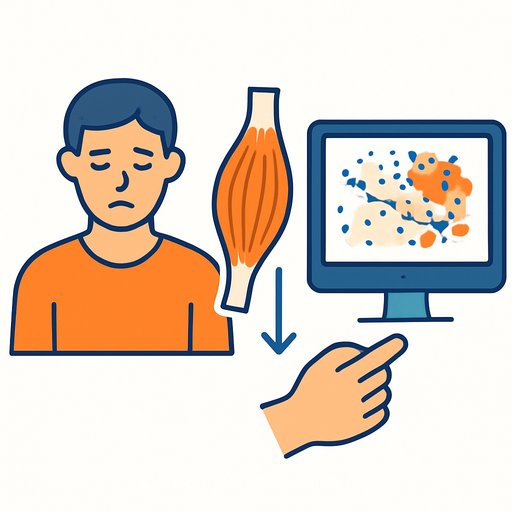
A new AI tool from Nagoya University can estimate the speed of ALS progression by analyzing data from patient follow-up studies. DiSPAH, the tool's name, identifies patterns of muscle decline that could help clinicians make more informed treatment decisions.
The tool works by processing longitudinal data-information collected from patients over multiple visits-to detect subtle changes in muscle strength and function. "DiSPAH is an AI tool that uses data from patient follow-up studies to estimate the speed of disease progression and identify patterns of muscle decline," said Kano Okada of Nagoya University. The system does not require new tests; it reinterprets existing clinical data.
How DiSPAH detects progression patterns
ALS, or amyotrophic lateral sclerosis, attacks motor neurons and leads to progressive muscle weakness. Clinical assessments typically rely on standardized rating scales, but these can miss early shifts in specific muscle groups. DiSPAH applies a computational model to patient records, revealing which muscles are declining fastest and in what sequence. This departs from a one-size-fits-all progression timeline.
The model's output is a personalized trajectory. Researchers can use it to group patients by similar decline patterns, potentially uncovering subtypes of the disease. That kind of stratification is often missing in clinical trials, where a treatment's effect might be masked by averaging results across patients with different progression speeds. AI for Healthcare applications like this are moving beyond diagnostics into longitudinal disease monitoring.
Data-driven insights without new tests
DiSPAH's approach sidesteps the need for additional biomarkers or imaging. It uses the data clinics already collect-strength measurements, respiratory function, and functional scores. The algorithm then estimates an underlying rate of change, smoothing out the noise that can come from day-to-day variability in a patient's condition or differences in how tests are administered.
Because the tool works with existing records, it could be deployed quickly in research settings. Retrospective studies might use it to re-analyze past trial data, looking for signals that were previously missed. For AI for Science & Research teams, the tool represents a template for mining long-term patient datasets without requiring new data collection infrastructure.
Why this matters for science and research professionals
DiSPAH demonstrates a practical use of AI that doesn't demand exotic data inputs. For researchers in neurodegenerative disease, the ability to estimate progression speed from routine clinical notes could tighten trial inclusion criteria and reduce sample sizes needed to detect a treatment effect. It also points to a broader pattern: AI is starting to extract actionable insights from the data that labs and hospitals already generate, turning follow-up studies into richer sources of hypothesis generation.
Your membership also unlocks: