
AI news ·
Doctor-lawmakers see AI reshaping medical diagnosis, drug discovery and health records
Physician members of Congress say AI could cut doctors' administrative workload by 40% and handle most diagnoses within a decade. Rep. Andy Harris is pushing agencies to open Medicare and Medicaid records to AI analysis sooner.
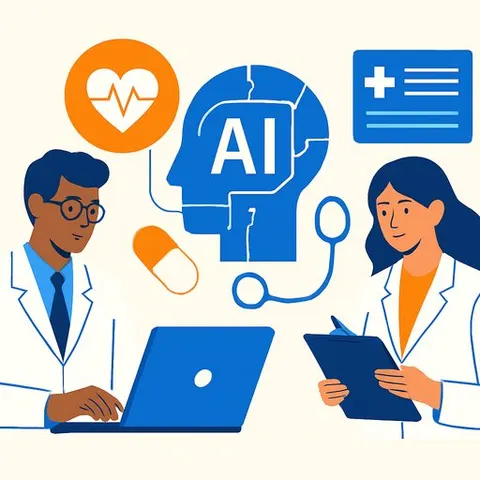
Doctors in Congress outline AI's role in medical practice, drug discovery
Physician members of Congress see artificial intelligence reducing administrative burden on doctors by up to 40%, freeing time for patient care. They also envision AI analyzing anonymized health records to improve diagnosis, drug discovery, and FDA approval timelines.
Rep. Andy Harris (R-MD), a board-certified anesthesiologist, said AI could handle "most of" medical diagnoses within a decade. AI already reads radiology images and speeds up insurance prior authorizations, he noted. Harris is discussing with government agencies how to give AI systems access to tens of millions of anonymized Medicare and Medicaid records.
"I would urge them that, if it's truly anonymized data, to allow that access sooner rather than later, so that Americans get the benefit of this large database," Harris said. "That information is very useful in terms of long-term public health."
How large databases could change diagnosis
Harris described how AI could improve prescribing decisions. When a doctor sees a patient with slightly elevated blood pressure and recommends a medication, the doctor has seen perhaps thousands of patients. But when that patient's information enters an AI system connected to a 100-million-person database, the AI could identify 10,000 similar patients and show how many responded to the same medication over time.
"You can answer that relatively instantaneously from a database that is just huge," Harris said.
Rep. Ami Bera (D-CA), also a physician, envisions AI modeling cancer at the genetic level over time. A genetic-level cancer registry could track tumor evolution, allowing researchers to forecast disease progression and identify where it began. This could enable genetic testing to predict cancer predisposition.
Major medical organizations recognize the potential. The American Academy of Family Physicians, with 124,000 members, sees AI as a capacity enhancer that could let doctors see more patients per day by embedding AI agents into electronic health records. The American College of Physicians, with 163,000 members, views AI as a tool to reduce burnout by handling administrative tasks.
Patient relationship concerns remain
Both organizations stress that AI should not replace physicians. Jan Carney, president of the American College of Physicians, said the patient-physician relationship is "relational. It's not simply between an individual and a computer."
Shawn Martin, CEO of the American Academy of Family Physicians, said: "I still think there's a humanism all about family medicine and primary care, that it's going to be a one-to-one relationship for a long time, hopefully forever."
Medical professionals also worry about AI errors, including so-called hallucinations where systems generate false information.
Drug approval and post-market tracking
Harris said AI could accelerate FDA drug approvals, particularly for rare diseases. FDA applications run 100,000 pages long, and the agency already uses AI to summarize them and pull targeted answers for reviewers.
After approval, AI could track drug effectiveness in real-world use through anonymized health records, potentially replacing some expensive pre-market testing like randomized controlled trials. Patients with rare conditions could access treatments sooner while AI agents embedded in their records monitor outcomes.
Bera noted that Microsoft recently deployed a diagnostic tool with 85% efficiency, with OpenAI announcing a similar system. These tools could reduce diagnosis timelines and unnecessary testing.
"It could improve efficiency, it could speed up the rapidity of diagnosis. It could reduce the administrative burden. It can save lives," Bera said of AI in medicine.
Learn more about AI for Healthcare and AI Data Analysis.