
AI news ·
Doctors warn AI health advice leads to misdiagnosis and delayed care
Doctors warn that AI tools like ChatGPT frequently miss critical symptoms, leading to wrong diagnoses. One patient's shoulder pain-flagged as arthritis-turned out to be heart disease.
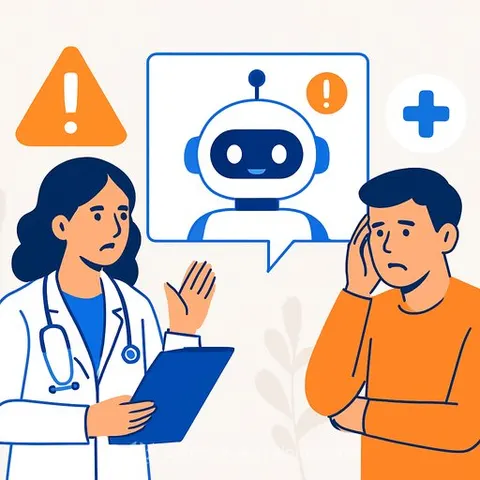
Doctors warn against relying on AI for medical diagnosis
ChatGPT fields 40 million health-related questions daily, according to ChatGPT parent company OpenAI. But healthcare professionals say the tool frequently misses critical details that lead to wrong diagnoses.
John Cecil, a primary care doctor at Baptist Health Paducah, treated a patient who used AI to investigate left shoulder pain. The tool suggested trauma or arthritis. Neither was correct - the pain stemmed from heart disease.
"If they had put shortness of breath, difficulty walking up steps, and left arm or shoulder pain, then yeah, you would have gotten a message that says heart attack," Cecil said. "But they didn't put that in, so there was a delay there in care."
The case illustrates a core problem: patients often don't know which symptoms matter. A trained physician catches subtle clues that AI systems overlook.
What doctors can do that AI cannot
Differential diagnosis - the process of narrowing possibilities by comparing symptoms - requires experience. A sore throat could indicate strep, mononucleosis, allergies, or several other conditions. A doctor weighs minor details to distinguish between them.
Cecil uses AI for healthcare functions in his office, such as tracking patient visits and research. He does not recommend it for clinical decision-making.
"Don't make any critical decisions based on it," Cecil said.
Patient experience mirrors doctor concerns
Keith Hoffman, a western Kentucky resident, researched gastric bypass and gastric sleeve surgery using multiple AI chatbots. The information seemed comprehensive but conflicted with guidance from his wife's surgeon and physician.
"Some of the information, especially about the pre-surgery, was inaccurate," Hoffman said. "AI told us to do certain things that were allowed when they were not allowed."
Hoffman concluded that ChatGPT and similar tools have limits in medical contexts. "For some things it can be good, but for medical advice, it is not," he said.
The gap between speed and accuracy
AI responds quickly to health questions. That speed creates a false sense of reliability. Medical diagnosis demands time - time to gather a complete symptom history, perform physical exams, and order tests.
Cecil's advice is straightforward: see a healthcare professional before making decisions based on AI responses. The cost of a wrong diagnosis outweighs the convenience of instant answers.