
AI news ·
Driving Business Value with AI Agents: Insights from Dr. Walter Sun on SAP’s 3Rs Framework and the Future of Enterprise AI
Dr. Walter Sun leads SAP’s AI efforts with a focus on relevant, reliable, and responsible solutions. SAP’s Joule assistant streamlines workflows by integrating AI across business functions.
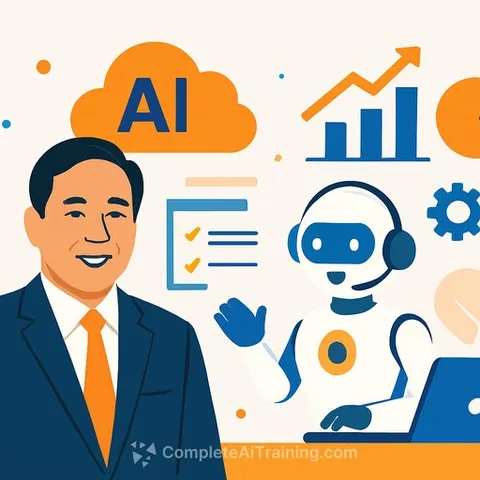
Driving Business Value with AI Agents: Insights from Dr. Walter Sun
Dr. Walter Sun leads a centralized AI unit at SAP, focusing on engineering AI products for broad implementation across SAP applications. Before SAP, he was Vice President of Copilot Applied Artificial Intelligence at Microsoft and has held roles at BlackRock and Apple. His extensive experience shapes SAP’s approach to AI integration in business.
SAP’s AI Strategy: The 3Rs Framework
SAP structures its AI efforts around three core principles:
- Relevant: AI solutions meet specific business needs by incorporating industry context. For example, AI models adapt to regional differences, such as varying supply chain requirements between the US and UK.
- Reliable: Outputs are accurate and fact-based, ensuring dependable assistance.
- Responsible: Transparency is key. Users understand the logic behind AI decisions, and SAP emphasizes ethics, explainability, and regulatory compliance.
AI is integrated in three main areas:
- Native AI integration: Embedded within SAP applications like SuccessFactors, enabling natural language features such as job description generation.
- Joule (AI copilot): A digital assistant that helps users perform tasks across SAP applications efficiently.
- AI foundation on Business Technology Platform (BTP): A generative AI hub offering over 30 large language models (LLMs) for businesses to create custom AI applications. Techniques like grounding and provenance checks reduce inaccuracies and ensure trustworthy AI outputs.
How Joule, SAP’s Digital Assistant, Works
Joule acts as an AI copilot across SAP’s ecosystem, enabling natural language interactions that span multiple business functions. For example, to schedule a business trip, Joule:
- Checks the user’s and customers’ calendars via CRM integration to find suitable times.
- Books flights and hotels through SAP’s Concur travel agent, respecting constraints.
- Updates CRM records to notify stakeholders and log meetings.
Unlike standalone AI agents, Joule’s deep integration connects finance, supply chain, HR, and customer relations, streamlining cross-department workflows. With Joule Studio, businesses can also extend AI capabilities beyond SAP.
Drivers and Challenges of AI Adoption
Organizations adopt AI primarily to boost efficiency, improve decision-making, and automate repetitive work. Customer expectations for intelligent, seamless interactions also push AI adoption. Much like earlier technology shifts—such as the rise of PCs and the internet—companies see AI as essential for staying competitive.
Challenges include data security and privacy concerns, trust in AI decision-making, and data quality. Businesses need transparency to build confidence, often starting with AI providing recommendations while humans retain final control. Addressing bias in AI models is also critical to ensure fairness.
The Evolution of Trust in AI
Trust in AI will grow gradually. For instance, online shopping once faced reluctance but is now routine. Similarly, AI systems like travel planners currently require user review but may gain autonomy over time. Organizations typically set thresholds for AI autonomy—like automatic approvals under a certain amount—balancing efficiency and oversight.
In sensitive fields such as healthcare and aerospace, AI remains a supportive tool rather than a decision-maker. Human experts continue to oversee critical decisions, with AI providing data analysis and recommendations.
The Rise of Multi-Agent AI Systems
Multi-agent AI systems involve different AI agents collaborating to handle complex workflows. Take dispute management: agents across finance, supply chain, and customer service coordinate to resolve issues quickly. This reduces delays caused by manual handoffs and boosts customer satisfaction.
SAP works with early adopters testing AI-driven procurement, HR, and other workflows. Controlled experiments help build confidence before scaling AI automation across industries.
AI Investment and Return on Investment (ROI)
Investment varies by company size and needs. Large enterprises may develop custom AI with dedicated teams, while others use SaaS platforms like SAP’s Joule for faster deployment. Costs include software subscriptions, system integration, and employee training.
ROI depends on use cases. High-volume automation in areas like customer service or financial reconciliation often delivers quick payback. Efficiency gains from handling more work without adding staff can offset initial costs within months.
Sustainability and AI
SAP addresses AI’s environmental impact with tools like the Sustainability Control Tower, which helps organizations monitor and reduce their carbon footprint. AI can identify energy inefficiencies, such as unnecessary lighting or air conditioning usage.
The Generative AI Hub optimizes energy use by selecting appropriate AI models for each task—using lighter models for simple queries and reserving high-compute models for demanding needs. This approach balances performance and sustainability.
Looking Ahead: AI and Human Collaboration
Future workflows will blend AI agents handling operational tasks with humans focusing on strategy. AI will act like an assistant, managing schedules, drafting reports, and optimizing processes to boost productivity.
IT and HR roles will evolve rather than disappear. IT teams will manage AI workflows and ensure alignment with business goals, while HR will train employees on AI tools and oversee ethical use and governance.
AI’s next phase includes industry-specific models for sectors like finance and healthcare, plus highly personalized assistants aware of individual preferences and workflows. This will make AI an essential daily partner for management professionals.
Dr. Walter Sun
Head of AI | SAP