Duolingo’s Shift to an ‘AI-First’ Strategy
Duolingo is moving towards an 'AI-first' model that will reduce its dependence on human contractors as artificial intelligence takes on a larger role in its operations. CEO Luis von Ahn has communicated this strategic pivot both internally and publicly, emphasizing the need to rethink workflows instead of merely adjusting human-centered systems.
Von Ahn highlighted that minor tweaks to existing processes won’t suffice for the company’s ambitions. Instead, a fundamental redesign is necessary to fully leverage AI's capabilities and improve efficiency across the platform.
What ‘AI-First’ Means for Duolingo's Workforce
The company plans to implement "constructive constraints" that will reshape how teams operate. This includes reducing contractor involvement where AI can perform tasks, integrating AI into recruitment and performance evaluations, and restricting new hires to cases where automation cannot cover the workload.
Despite these changes, von Ahn reassures stakeholders that Duolingo remains committed to its employees. The focus is on eliminating repetitive tasks to allow staff to concentrate on creative and complex challenges rather than replacing human roles outright.
AI Drives Content Creation and Scalability
AI is more than a productivity tool for Duolingo; it aligns directly with their mission to deliver language education at scale. Von Ahn pointed out that manual content creation is a bottleneck that AI helps overcome, enabling rapid scaling that would otherwise take decades.
One recent example is the shift from a slow, manual process to an AI-powered content system. This change accelerates course development and allows Duolingo to meet the needs of a growing learner base much faster.
Rapid Expansion of AI-Powered Language Courses
Duolingo has launched 148 new courses in less than a year, more than doubling its course offerings. This expansion is largely possible due to AI technology that automates much of the content creation process.
The new courses cover seven popular non-English languages—Spanish, French, German, Italian, Japanese, Korean, and Mandarin—across 28 user interface languages. This broadens access to language education for over a billion potential learners globally.
Von Ahn contrasted this rapid development with the company's early years, noting that creating the first 100 courses took around 12 years, whereas AI has significantly compressed this timeline.
The new offerings primarily target beginners and include features like interactive stories to enhance reading skills and DuoRadio for listening practice. Duolingo plans to roll out more advanced content in the near future.
User Backlash and Quality Concerns
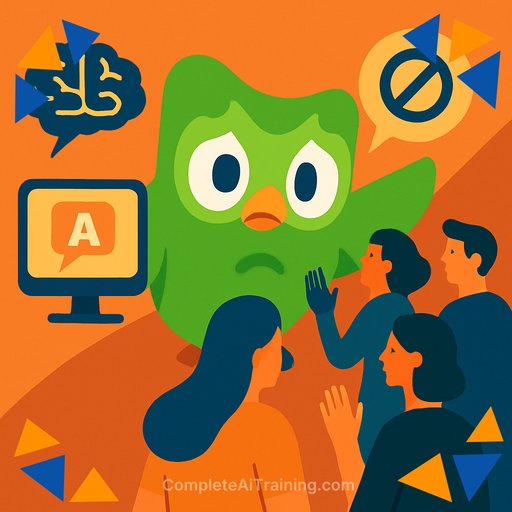
Despite the clear benefits AI brings to scaling and efficiency, the move has sparked criticism from parts of Duolingo’s user base. Some learners have expressed concerns on social media about the quality of AI-generated content, claiming it can be inaccurate or lower in standard compared to human-produced material.
This dissatisfaction has led some users to uninstall the app and discourage others from using it, posing a challenge to Duolingo’s reputation and user retention as it integrates AI deeper into its platform.
The company faces a critical balancing act between leveraging AI for growth and maintaining the educational quality that users expect.
Conclusion
Duolingo’s 'AI-first' strategy represents a significant operational shift that prioritizes automation and efficiency, aiming to accelerate content delivery and reduce manual workload. For executives and strategists, this case underscores how AI can transform product development and workforce management.
However, the user response highlights the importance of managing quality and user trust when deploying AI solutions in customer-facing products. Success will depend on striking the right balance between automation and the human element in education.
For leaders looking to understand how AI can reshape organizational workflows and product scaling, Duolingo’s approach offers both lessons and caution points worth examining.
Your membership also unlocks: