
AI news ·
Educators use agentic AI to create interactive STEM simulations
Agentic AI lets teachers build custom STEM simulations in hours instead of weeks. Students test variables and verify code, turning passive classes into active labs.
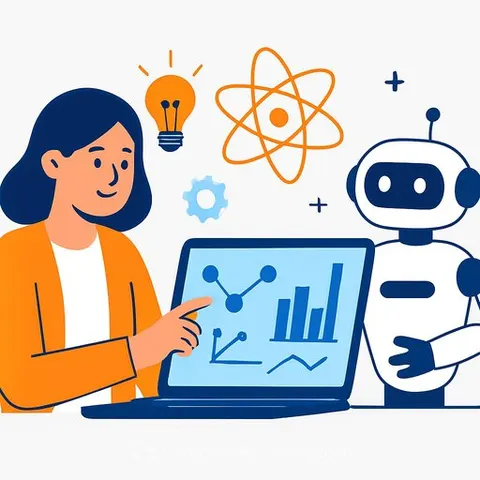
Agentic AI - systems that can plan, reason, generate code or simulations, and refine outputs without constant human direction - is giving educators new ways to turn abstract STEM concepts into interactive experiences. The tools allow instructors to build bespoke visualizations that let students manipulate parameters and instantly see results, moving classrooms from passive information absorption to active exploration of complex systems.
For years, teachers have relied on static diagrams and rigid simulations to explain electromagnetism, wave propagation, or signal processing. While rigorous, those methods often fail to build intuition. Agentic AI changes that by responding to natural-language instructions, iterating quickly, and producing working code that can be adapted on the fly. This shift is part of a wider movement toward AI for education that prioritizes interaction over information delivery.
From static diagrams to interactive exploration
In fields like electromagnetism, students must reason about forces they cannot observe directly. An instructor teaching the Lorentz force, for example, can use an agentic AI to generate a simulation showing how a charged particle moves through combined electric and magnetic fields. By adjusting field strength or particle velocity in real time, students connect mathematical expressions to physical behavior. YouTube channels such as Veritasium and 3Blue1Brown have popularized this kind of dynamic STEM media, and agentic AI lets educators bring similar interactivity into their own classrooms.
Rapid prototyping for teaching
One of the most powerful aspects of agentic AI is the speed with which an idea turns into a working tool. An instructor can outline a learning objective - such as visualizing electric field lines around multiple charges - and the AI agent will generate the underlying code. The educator then refines parameters, adds interactive controls, or adjusts the visual representation. This iterative process encourages experimentation: if a concept proves difficult, instructors can quickly create alternative demonstrations. For educators looking to develop these skills, structured resources like an AI learning path for teachers can provide practical guidance.
Ensuring accuracy and pedagogical integrity
AI-generated simulations are not immune to errors. Code may contain bugs, physics models may be oversimplified, and unexpected behaviors can surface. Instructors must validate the underlying physics, debug and test the code across parameter ranges, and ensure the simulation reinforces the intended learning objectives. The best results come from treating the human as director and the AI as a competent worker, with clear instructions and iterative refinement based on student and colleague feedback.
- Validate that equations, boundary conditions, and interactions align with the concepts being taught.
- Debug and test code thoroughly, reviewing AI-generated output for reliable performance.
- Confirm that simulations serve clear learning objectives, not just visual appeal.
- Refine iteratively using feedback from students and peers to improve accuracy and clarity.
Teaching students to work with AI
Agentic AI also shifts how students engage with computational tools. Instead of getting stuck on syntax, learners can use AI to generate working code for a simulation of wave interference or signal processing. Their task then becomes analyzing the model, verifying its correctness, and experimenting with different parameters. This approach builds computational thinking while teaching students to critically evaluate AI-generated outputs. The responsibility for interpreting and validating results remains with the human user.
The evolving role of the instructor
Instructors remain central to designing meaningful learning experiences. They guide students in interpreting results, questioning assumptions, and understanding when AI outputs cannot be trusted. Agentic AI expands the possible, but it does not replace the need for human judgment. The integration of these tools is part of a broader effort to use AI for education in ways that support curiosity and critical thinking rather than automation.
Why this matters for educators
Agentic AI gives instructors the ability to create interactive, tailored simulations in hours rather than weeks, making abstract STEM concepts accessible and engaging. But the technology demands careful oversight: validating physics, debugging code, and ensuring that simulations align with learning goals. The real payoff is not faster production of visuals, but a classroom where students move from passive consumers of information to active investigators who question models, test hypotheses, and learn to direct intelligent systems - skills that will define their future work in science and engineering.