Egypt's Second-Generation Irrigation System 2.0: A Practical Model for Data-Driven Water Management
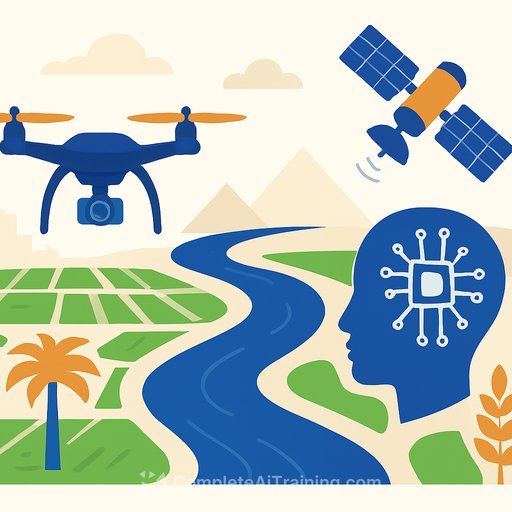
Egypt is scaling drones, satellite monitoring, and artificial intelligence to run a tighter, more transparent water system. The Second-Generation Egyptian Irrigation System (2.0) links field operations with a national digital platform-so decisions move faster and waste drops.
Speaking at the 19th World Water Congress in Morocco on Tuesday, Dec. 2, 2025, Minister of Water Resources and Irrigation Hani Sewilam outlined how the ministry is applying advanced tech to deliver on Sustainable Development Goal 6 (clean water and sanitation) amid rising pressure on water supply and demand.
What's being deployed
- Drones and satellite data to track aquatic weeds, flag violations along waterways, and analyze shoreline changes.
- 3D models of hydraulic structures to support design, maintenance, and risk scenarios.
- AI-based forecasting to predict Nile River levels and optimize distribution across competing needs.
All of this runs on a digital platform that houses electronic groundwater licensing, national water databases, and integrated monitoring and maintenance systems. Coverage spans more than 55,000 km of canals and drains-turning fragmented data into a single operating picture.
Management outcomes the system targets
- Better allocation: Forecasts and real-time monitoring tighten distribution and cut losses.
- Governance and integrity: Digitized licensing, clear audit trails, and violation tracking curb corruption risks.
- Capacity and uptime: Technical skill-building plus 3D and remote sensing tools reduce downtime and rework.
- Transparency: Shared data improves cross-agency coordination and public accountability.
Core components of Irrigation System 2.0
- Water treatment and desalination tied directly to food production targets.
- Digital transformation and smart water management across assets and workflows.
- Infrastructure rehabilitation and climate adaptation.
- Nile regulation, governance, and capacity-building.
- Public awareness and international cooperation.
Capacity added and where it comes from
The system sits at the center of Egypt's water security strategy. Expansion in treatment and reuse through projects such as Al-Mahsamma, Bahr El-Baqar, and New Delta contributes about 4.80 billion cubic meters of water annually to the national balance.
Egypt is also studying decentralized treatment units, applying modern irrigation methods in sandy areas, and expanding rainwater harvesting and flood-protection projects. More than 1,600 structures are now in place to support climate resilience and agricultural productivity.
Cooperation and financing
Egypt positions the Second-Generation System as both a national tool and a model other African countries can adapt. The call to action: stronger international cooperation, fair and innovative financing, and a united African voice on global water priorities.
For context on global targets, see SDG 6 (Clean Water and Sanitation).
What leaders can apply now
- Build a single source of truth: Unify licensing, asset data, sensor streams, and work orders on one platform.
- Instrument high-leverage assets first: Start with critical canals, pumping stations, and choke points.
- Automate compliance: Use remote sensing for violation alerts and AI for anomaly detection.
- Tie funding to outcomes: Link budgets to measurable gains in allocation efficiency and service reliability.
- Upskill teams: Pair tech rollout with targeted training for operators, planners, and data analysts.
- Plan for reuse: Treat and reuse where it offsets new supply or stabilizes agricultural output.
KPIs to track
- Forecast accuracy for river and canal levels.
- Non-revenue water and conveyance losses.
- Response time from alert to field action.
- Percentage of assets covered by remote monitoring.
- Volume added via treatment and reuse (bcm/year).
- Violation detection-to-resolution cycle time.
- Maintenance backlog and mean time to repair.
If your team is building AI literacy to support projects like this-data ops, forecasting, and automation-consider these resources: AI courses by job.
Your membership also unlocks: