
AI news ·
Eight AI trends reshaping industrial operations in 2026
AI has moved from pilot projects into core industrial operations, with manufacturers embedding algorithms across production, quality control and maintenance. Eight trends for 2026 show how quickly the shift is accelerating.
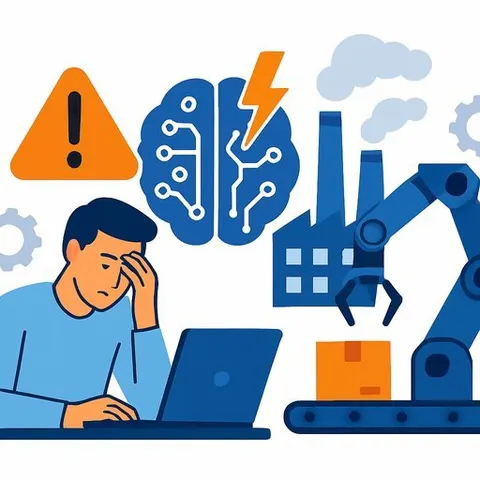
Eight AI Trends Reshaping Industrial Operations in 2026
AI has moved beyond experimental pilots into core industrial operations. Manufacturing, process industries and energy sectors now embed algorithms across production optimization, quality control, procurement and incident management rather than confining AI to isolated analytics projects.
This shift reflects a fundamental change in how industrial organizations compete. The question is no longer whether to adopt AI - it's how quickly they can scale it across operations.
1. AI becomes infrastructure, not a tool
Algorithms continuously inform decisions across enterprises rather than functioning as standalone applications. AI now operates as a foundational layer supporting multiple workflows simultaneously.
2. Edge AI accelerates real-time decision-making
AI deployed closer to machines, sensors and control systems reduces latency and improves reliability. Processing data at the source matters most for time-sensitive applications like predictive maintenance and process control.
3. Predictive maintenance moves from pilot to standard practice
AI-driven predictive maintenance has matured from experimental use case to widespread adoption. Organizations shift from reactive and scheduled maintenance toward condition-based strategies that minimize downtime and extend asset life.
4. Industrial AI and cybersecurity converge
As cyber threats targeting operational technology and industrial control systems grow, AI strengthens defenses through penetration testing, forensic analysis and identity protection. AI protects operations while optimizing them.
5. Data integration becomes the enabler
Successful AI deployment depends on unified data ecosystems. Organizations integrate operational technology, enterprise IT and cloud data to support machine learning models that operate seamlessly across systems.
Industrial companies invest in robust data foundations - datacenter and edge computing hardware - to enable AI to deliver value at scale. Connected-vehicle and large-scale telemetry applications depend on these integrated systems.
6. AI powers the shift toward Industry 5.0
The next phase of industrial transformation focuses on human-centric systems and enterprise-wide intelligence. AI enables intelligent collaboration between humans and machines rather than automation alone.
7. Robotics, vision and AI converge on the factory floor
Integration of AI with robotics and machine vision accelerates innovation across manufacturing. Collaborative robots paired with AI and visual intelligence drive greater autonomy, precision and flexibility in operations.
8. Generative AI expands into industrial knowledge work
Beyond physical operations, AI augments knowledge-based tasks. Generative AI closes skills gaps in documentation, training and engineering insights, becoming a force multiplier for industrial workforces.
What this means for operations leaders
These trends signal a clear evolution: AI moves from isolated innovation to enterprise-critical infrastructure spanning operational efficiency, workforce productivity, cybersecurity and strategic decision-making.
For operations professionals, AI for Operations covers practical applications in supply chain optimization, logistics automation and process improvement. Operations managers can explore the AI Learning Path for Operations Managers, which addresses process optimization, workflow automation and operational excellence directly tied to these industrial trends.
The competitive advantage goes to organizations that scale AI quickly across their operations. The foundational work - integrating data systems, establishing cybersecurity protocols, training teams - starts now.