
AI news ·
EU delays AI Act HR compliance deadline to December 2027 as CEO survey finds near-universal expectation of AI-driven layoffs
The EU pushed back AI hiring and firing rules to December 2027, a 16-month delay from the original August 2026 deadline. Only 8 of 27 member states had set up enforcement bodies when the extension passed.
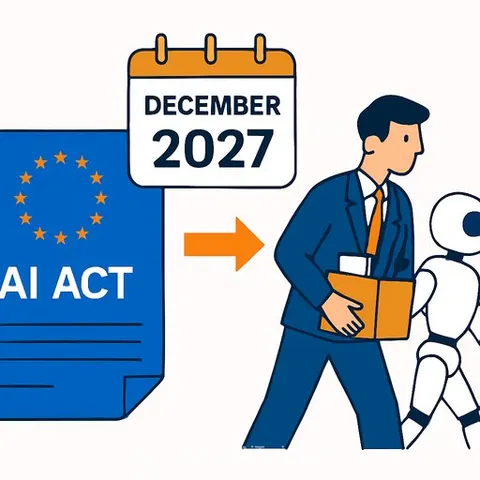
EU delays HR AI rules by 16 months as job cuts loom
The European Union postponed requirements for AI systems used in hiring, firing, and performance monitoring until December 2027, pushing back the original August 2026 deadline by 16 months. The delay gives HR departments and data protection officers more time to comply with the bloc's AI Act, which classifies these HR uses as high-risk.
The European Parliament and Council reached the compromise on May 7, 2026, as part of the Digital Omnibus package. Lawmakers approved the delay with a vote of 569 in favor and 45 against on March 26, 2026.
Why the delay happened
The postponement reflects practical obstacles to compliance. Only 8 of the 27 EU Member States had designated their competent national authorities by March 2026-a prerequisite for enforcing the rules.
Industry groups, national governments, and consumer organizations argued that completing compliance work within the original timeline was impossible. The infrastructure simply wasn't in place.
What the delay covers
The postponement affects Annex III point 4 of the AI Act, which covers two categories of HR AI systems:
- Recruitment and candidate selection, including targeted job ads, application screening, and candidate evaluation
- Employment decisions: promotion, termination, task allocation, and performance monitoring
All these uses are classified as high-risk. The delay pushes back requirements for risk management, compliance assessments, technical documentation, transparency, human oversight, and post-market surveillance.
The timing raises concerns
The delay arrives as 99% of executives surveyed by Mercer expect AI to trigger layoffs within two years. Among nearly 1,000 executives polled in May 2026, only 1% ruled out short-term job cuts.
Employee satisfaction has dropped sharply. The share of workers reporting fulfillment at work fell from 66% in 2024 to 44% in 2026, according to the same survey.
The Federal Reserve Bank of New York reported an underemployment rate of 41.5% among recent graduates in the first quarter of 2026, with an overall unemployment rate of 5.7%. The problem is no longer access to jobs but the quality of available positions.
Former Google CEO Eric Schmidt was booed at the University of Arizona's graduation ceremony in May 2026 when discussing graduates' role in building AI. He acknowledged that student concerns about job security and a compromised future were "founded." Similar incidents occurred at the University of Central Florida and Middle Tennessee State University.
What protection remains
The delay does not eliminate all safeguards. Article 22 of the GDPR still applies to any HR AI system that makes a final automated decision with legal or significant effects on a person-including hiring, firing, or performance evaluations.
The Court of Justice of the European Union clarified the standard in its SCHUFA Holding judgment of December 7, 2023. Nominal human involvement doesn't satisfy the requirement. A human decision-maker must have real discretionary power, not rubber-stamp authority.
The court reinforced this in 2025, requiring that workers receive useful information about the logic behind automated decisions.
The gap that remains
HR AI systems that don't produce a strictly automated decision-such as scoring tools that feed into a committee with genuine discretionary power-fall outside Article 22's direct scope. These systems would have faced Annex III obligations starting August 2026 under the original timeline.
The 16-month postponement further delays the EU's response to this category of HR tools, which companies are already deploying.
The European Trade Union Confederation and industriAll Europe criticized another change buried in the Digital Omnibus. The requirement for AI literacy shifted from "ensure a sufficient level of AI proficiency" to the vaguer "support the improvement of AI proficiency." The unions said this weakens workplace protections in the AI Act.
For HR departments, the practical takeaway is clear: compliance deadlines have moved, but the requirements themselves remain intact. December 2027 is now the target date for meeting Annex III obligations. Learning the regulatory framework for HR AI systems can help leadership prepare for that deadline.