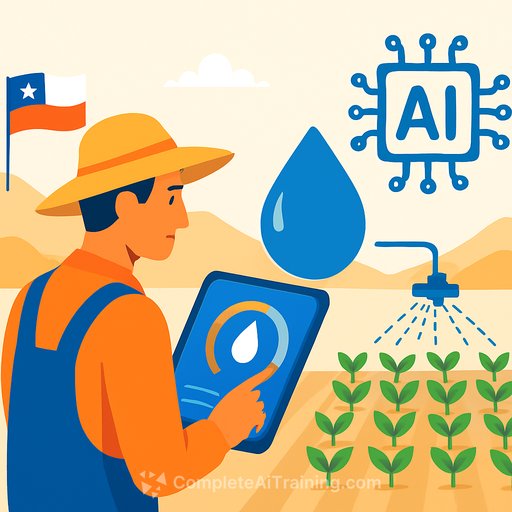
Data-driven farming and AI are transforming water management in Chile
Chile sits at the intersection of drought pressure, export-driven agriculture, and rising regulatory scrutiny. That mix forces managers to do more with less water-without putting yields or margins at risk.
AI and data give you what manual scheduling can't: real-time visibility, predictive irrigation plans, and faster decisions. The upside is straightforward-lower water costs, steadier yields, and proof you're running a disciplined operation.
Why this matters for management
- Lower operating costs: precise irrigation cuts wasted pumping and labor.
- Yield stability: water goes where it matters most, when it matters.
- Compliance and reputation: auditable usage data for authorities and ESG reports.
- Decision speed: field-level insights roll up into clear farm and portfolio views.
How the systems work (plain English)
- Sensors track soil moisture, flow rates, pressure, and pump status.
- Satellites and drones add crop health indicators (e.g., canopy vigor) to the picture.
- Weather forecasts feed models that predict crop water needs for the next 3-7 days.
- Algorithms translate all that into irrigation setpoints by block or valve.
- Control systems execute automatically or send work orders to field teams.
- Dashboards show usage vs. rights, anomalies, and expected yield impact.
Context matters in Chile: water allocations and local rules vary by basin. For background on national water use and policy, see FAO AQUASTAT and OECD water resources.
A 90-day rollout plan
- Days 0-30: Baseline and design
Pick 1-2 pilot blocks with different soil and crop profiles. Measure current water use, yield, and energy. Map valves, pumps, and connectivity. Define KPIs and reporting cadence. - Days 31-60: Deploy and connect
Install flow/pressure meters and soil probes; connect to gateways (LoRaWAN/NB-IoT). Pull in weather and satellite data. Stand up a secure cloud data store. Configure dashboards for field and management views. - Days 61-90: Model and operate
Calibrate irrigation recommendations. Run A/B schedules on small plots. Train field teams. Set alerts for leaks, over-irrigation, and pump anomalies. Start weekly reviews on KPI trends.
KPIs that move the P&L
- Water use per hectare (m³/ha) and per ton produced (m³/ton).
- Energy per m³ pumped and pump runtime per week.
- Leak detection to repair time (hours).
- Irrigation forecast accuracy (actual vs. plan, %).
- Yield variability across blocks (standard deviation, %).
- Compliance: usage vs. allocation, variance by period.
- Payback period and annualized ROI from water and energy savings.
Quick ROI math you can share with finance
Annual savings ≈ (Baseline m³ - Post-AI m³) × Cost per m³ + Energy savings - Added OPEX.
Example: If a 500-ha operation cuts 15% from a 6,000 m³/ha baseline at $0.45 per m³, that's ~$202,500 in water savings, plus energy reductions. If total annual OPEX for the system is $90,000, payback often lands inside 12-18 months. Your exact numbers will vary-run this with your actual tariffs and pump curves.
Data, compliance, and auditability
- Write down data ownership and access rights with growers and water user associations.
- Keep raw telemetry immutable; separate "source of truth" from analytics layers.
- Version every model and recommendation; store the inputs used to make each call.
- Automate compliance reports by basin and season; include usage vs. rights and exceptions.
- Secure device identities, rotate keys, and segment networks for pumps and valves.
Procurement checklist
- Open data standards (CSV/Parquet/JSON), API access, and easy export.
- Works with your existing meters, probes, and controllers.
- Offline/low-signal operation with local buffering.
- Granular role-based access for farm managers, agronomists, and auditors.
- Total cost clarity: hardware, connectivity, platform, support, and training.
- References from Chile or similar water regimes.
Common risks and how to reduce them
- Data gaps: Place probes carefully; validate against manual readings for 2-3 weeks.
- Change resistance: Pair recommendations with agronomist sign-off until trust builds.
- Over-automation: Keep a manual override; start with decision support, then automate.
- Vendor lock-in: Require raw data portability and documented APIs in contracts.
- Model drift: Recalibrate at key crop stages and after unusual weather events.
Operating rhythm that works
- Daily: check alerts, approve or auto-apply setpoints, confirm pump health.
- Weekly: review water use vs. plan, adjust thresholds, schedule maintenance.
- Monthly: report KPIs to leadership, track ROI, and update allocation forecasts.
- Seasonal: post-harvest review-what saved water, what boosted yield, what to scale next.
Build skills without stalling the season
You don't need a lab-just managers who can read dashboards, ask the right questions, and act fast. If you want a focused path to upskill your team by role, explore AI courses by job or scan the latest AI courses.
The goal is simple: use data to deliver water precisely, prove it with numbers, and protect margins. Start small, measure honestly, and scale what pays.
Your membership also unlocks: