
AI news ·
FAA tests AI system to manage air traffic flow before flights reach controllers
The FAA is testing AI to predict air traffic congestion and adjust departure times before planes ever reach controllers. Three firms-Thales, Air Space Intelligence, and Palantir-are competing for the contract, with a demo set for September 2026.
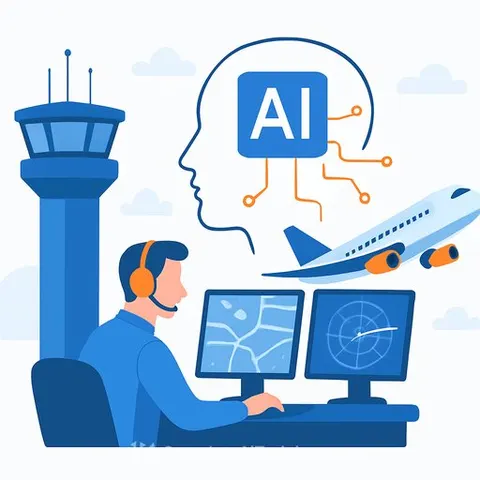
FAA Tests AI to Manage Flight Demand Before Controllers See Planes
The Federal Aviation Administration is running a competition among three technology firms to develop an AI system that predicts air traffic congestion and adjusts departure times to prevent conflicts before planes reach controllers. The initiative, called SMART (Strategic Management of Airspace Routing Trajectories), represents a shift toward managing demand across the airspace rather than relying solely on controllers to separate aircraft in real time.
Thales, Air Space Intelligence, and Palantir are competing to lead the project. The FAA plans to award a contract "soon," with an operational demonstration targeted for September 2026.
What SMART Actually Does
SMART focuses on the broader problem of airspace capacity, not the split-second decisions controllers make. Todd Donovan, vice president for airspace mobility solutions at Thales, said the system is "not aimed at separating aircraft or doing any of those kind of safety critical functions."
Instead, SMART would work months in advance, analyzing carrier schedules and forecasted weather to predict disruptions. If a storm threatens an airport, the system would recommend spacing out flights a day or more in advance rather than waiting for congestion to happen.
Donovan described the concept: "How do we think about it a day in advance and work with the airlines to say, 'OK, can we space things out a little bit, can we anticipate some of it' so that collectively we're not all just reacting to something happening, we're actually planning for it."
Phillip Buckendorf, CEO of Air Space Intelligence, said the system would "predict the flight trajectories based on the schedules that are out there," then adjust "flight by flight through AI" as travel day approaches.
The Controller's Workload Question
Donovan said SMART could prevent some cases where controllers need to intervene to keep planes safely apart. Small adjustments made before a flight reaches a controller-slowing an aircraft by 30 minutes or minor routing changes-could eliminate conflicts entirely.
"The job doesn't change, but the idea is that the workload should be lower," Donovan said.
Transportation Secretary Sean Duffy rejected the premise that AI would replace controllers. "Am I gonna replace a controller and have AI manage the airspace? The answer to that is hell no, that's not gonna happen," he said in a recent CBS News interview.
The National Air Traffic Controllers Association, which represents nearly 11,000 FAA controllers, acknowledged a request for comment but did not provide a statement.
Why This Matters Now
The initiative comes as Duffy oversees a multibillion-dollar effort to modernize the FAA's aging technology and facilities. The project gained urgency after the January 2024 airline-helicopter collision near Ronald Reagan Washington National Airport-the worst aviation disaster in the United States in nearly 25 years-exposed strain on the air traffic system.
Controllers manage the immediate separation of aircraft. An FAA command center outside Washington handles broader capacity planning across regions. SMART targets that second function, treating the airspace like a traffic flow problem rather than a safety one.
Timeline and Funding Uncertainty
Each of the three competing companies has a lab at FAA headquarters in Washington. The proof-of-concept phase is ending, with operational demonstration planned for September 2026, followed by validation work through the rest of the year.
How the FAA will fund the eventual winner remains unclear. Donovan said the project "as far as I know, has a budget line item," and the agency is currently scrounging together money to pay for the current work.
For managers overseeing operations or technology deployment, SMART illustrates how AI agents and automation can reduce reactive firefighting by shifting work upstream. The system doesn't replace decision-makers-it changes what decisions they face by preventing problems before they arrive.
Understanding how organizations implement AI for executives and strategy helps managers evaluate similar initiatives in their own domains.