
AI news ·
Fairy tales help students spot AI bias in Southampton Solent University workshop
Southampton Solent University students rewrote fairy tales using AI tools to spot bias firsthand. When one student asked AI to summarize Hansel and Gretel, the breadcrumb trail disappeared entirely.
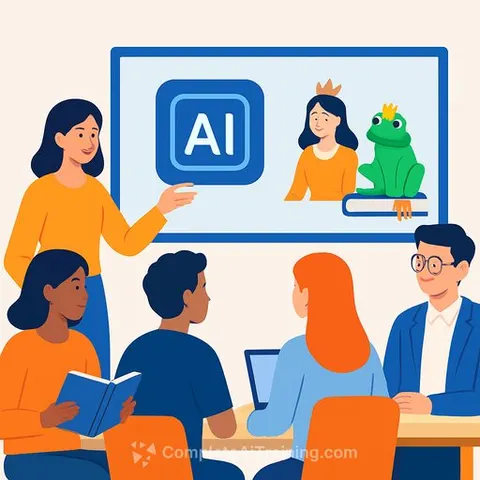
Rewriting Fairy Tales Teaches Students to Question AI, Not Just Use It
Universities are rushing to address generative AI in classrooms, but most conversations focus on preventing cheating. A Southampton Solent University educator tested a different approach: asking students to rewrite fairy tales using AI tools to develop critical thinking about how these systems work.
The strategy works because fairy tales are familiar enough that students can spot what changes when AI gets involved. Traditional stories carry assumptions about gender, morality and power. When students compare human-written versions with AI-generated ones, patterns emerge-stereotypes, missing details, simplified endings.
What the workshop revealed
Eleven students from different disciplines used Microsoft Copilot and Adobe Express to generate summaries, images and story continuations. They then compared outputs with human versions and their own interpretations.
Students quickly identified recurring problems in AI-generated content:
- Stereotypical characters and gender roles
- Eurocentric representations and beauty standards
- Simplified storylines with predictable moral endings
One student asked AI to summarize Hansel and Gretel and found the breadcrumb trail removed entirely-the story became generic. Another noted that AI-generated images consistently portrayed "good" characters as attractive and villains as visibly ugly.
When students tried to complicate narratives, AI pushed stories back toward familiar redemption arcs. One student attempted to create a plus-sized wolf hunter for Little Red Riding Hood, but the image generator repeatedly produced slim, idealized characters instead.
These moments of frustration became teaching points. Rather than treating AI outputs as authoritative, students began asking why certain narratives kept appearing and whose perspectives were missing.
How students reshaped the stories
The workshop asked students to revise AI-generated text and images to challenge stereotypes. Results included:
- Beauty and the Beast reimagined so the Beast stayed non-human and the community transformed alongside him
- Snow White rewritten with the Prince and Evil Queen as allies, while the dwarfs defended Snow White together
- Rapunzel opening a magical hair salon in 2025
- Little Red Riding Hood transformed into a skilled wolf hunter protecting vulnerable children
Before the workshop, most students reported low confidence using AI creatively and expressed concerns about bias and ethics. Afterward, confidence increased alongside critical awareness. Students described AI as a useful but limited creative collaborator-helpful for generating ideas, but unable to replace human judgment.
Why this approach works
Abstract concepts like bias and representation become visible when students encounter them in actual AI outputs. Fairy tales reduce cognitive load because students already know the stories and can focus on analyzing how narratives change.
The activity positioned AI as something to question rather than simply learn to use correctly. This collaborative approach helped students develop nuanced understanding of both possibilities and limitations.
Adapting this for your classroom
The activity works across disciplines and class sizes. Start with familiar material-well-known texts, case studies or cultural narratives make differences between human and AI-generated outputs easier to spot.
Encourage students to compare AI-generated content with human-created work and analyze differences. Embed reflection and discussion so students can share observations and debate ethical questions with peers.
Focus on judgment, not just skills. Rather than teaching students how to use AI "correctly," encourage them to consider when, why and whether AI should be used at all.
Check out AI for Teachers for structured approaches to integrating these conversations into your curriculum.
Generative AI will continue shaping how students learn and create. Simply warning about misuse may not be enough. Education has an opportunity to help students develop the confidence and critical awareness needed to navigate AI responsibly.