
AI news ·
Fastbreak AI powers scheduling for more than 50 pro leagues as the task shifts from calendar work to governed optimization
Fastbreak AI now schedules for over 50 pro sports leagues, shifting manual calendar work to a constrained optimization system. The 60-person startup gained traction when the NBA needed its in-season tournament scheduled around 1,230 existing games.
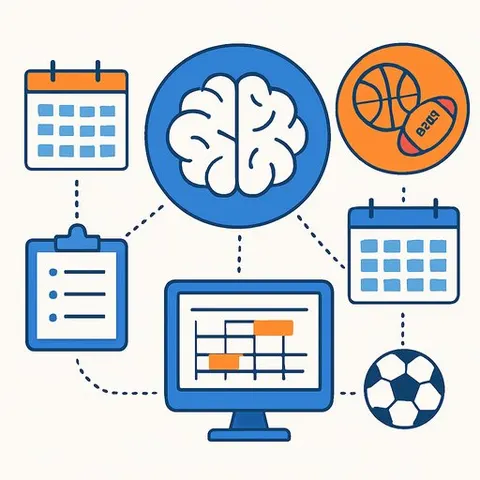
Fastbreak AI now handles scheduling for more than 50 professional sports leagues worldwide, moving a critical back-office function from manual calendar work to a constrained optimization system. The shift affects travel logistics, venue utilization, broadcast inventory, and in-season change control across the organizations that rely on these schedules to run their operations.
The company, a roughly 60-person startup based in North Carolina, started in June 2022 and gained early traction when the NBA needed help scheduling its new in-season tournament around the existing calendar. Key contributors who had built the NBA's scheduling system at KPMG were already part of Fastbreak, positioning the firm to take the work quickly.
The NBA schedule is a constraint stack, not a template
The NBA must place 1,230 games for 30 teams over roughly six months while satisfying requirements from TV partners, player-safety rules, arena operators, and competitive fairness mandates. The combinatorics are so large that possible schedule combinations exceed the number of atoms in the sun.
This framing changes what "better scheduling" means operationally. It is less about finding a single perfect calendar and more about being explicit on tradeoffs: which constraints are hard stops, such as arena availability, and which are tunable preferences, such as travel smoothing. A league's schedule becomes a live, governed optimization model rather than a file that gets emailed around.
Front Office Sports described the shift plainly in a May 2026 episode: the software balances broadcast needs with travel constraints while streamlining league operations. The schedule incorporates input from many stakeholders instead of being produced solely by one scheduling office.
Why leagues are buying now: new events and tighter windows
New event inventory, additional media windows, and changes to travel and rest policies tend to break older scheduling processes first. When a league adds formats, it forces rule changes, and rule changes force tooling upgrades. Fastbreak's timing with the NBA was tied directly to the in-season tournament, a new competition format that existing processes could not accommodate.
The company's scale is notable for procurement teams. Customers are betting on a focused team that can encode league rules quickly and iterate as policies change, rather than a large suite vendor that might treat scheduling as a small module. Fast Company reports that CEO John Stewart previously ran MapAnything, acquired by Salesforce in 2019 for $250 million, and the mathematical principles from field-service optimization now power Fastbreak's approach.
The hidden integration work: data, rule ownership, and change control
AI scheduling is only as automatic as the inputs are clean. The platform must ingest accurate venue availability, travel constraints, broadcast commitments, and league policy rules, then reconcile them into a runnable model. That reconciliation is where projects succeed or stall.
When schedules are built inside optimization software, the organization must decide who can change constraints, who signs off on exceptions, and how late-breaking changes flow through the system without breaking downstream operations like ticketing, staffing, and charter planning. The software is the easy part. The hard part is deciding which rules are allowed to bend.
A 2025 review in Intelligent Sports and Health surveyed AI applications across sports including competition management and time series analysis, reinforcing that operational workloads are becoming data-driven across the sector. Scheduling is being pulled into the same modernization wave.
Where this lands in procurement and ops planning
Map the constraint owners before the RFP. List every rule source that will become an input - broadcast contracts, venue holds, travel policies, rest and safety rules - and assign a business owner for each before vendors start encoding logic.
Ask how late changes are handled. Confirm what happens when an arena date moves, a TV window shifts, or a new event is added mid-cycle. The evaluation metric is not just schedule quality; it is how exceptions propagate to ticketing, staffing, and travel workflows.
Validate integration expectations early. Even if a scheduling platform is standalone, the project will touch venue management, travel providers, and internal analytics. Define required exports, APIs, and audit logs up front so schedule approval is not trapped in email threads.
Use a fairness benchmark you can explain. Fast Company's reporting highlights competitive fairness as a core constraint. Procurement should require vendors to show how fairness is measured and audited, and how the organization can tune it without rewriting the model.
Why this matters for operations leaders
Schedule creation is becoming a software integration problem, with data ownership and rule governance as the real differentiators. For league operations leaders, venue managers, and the vendors who serve them, the signal is clear: the schedule is no longer a static document produced by one office. It is a governed model that touches ticketing, staffing, travel, and broadcast workflows. The organizations that define their constraint owners and change-control processes before adopting optimization tools will avoid the integration failures that stall these projects. For operations managers building AI for Operations capabilities, the scheduling use case mirrors enterprise dispatch and routing - structured inputs, constraint hierarchies, optimization runs, and continuous exception handling. The AI Learning Path for Operations Managers addresses this exact pattern of moving from manual workflows to governed optimization models.