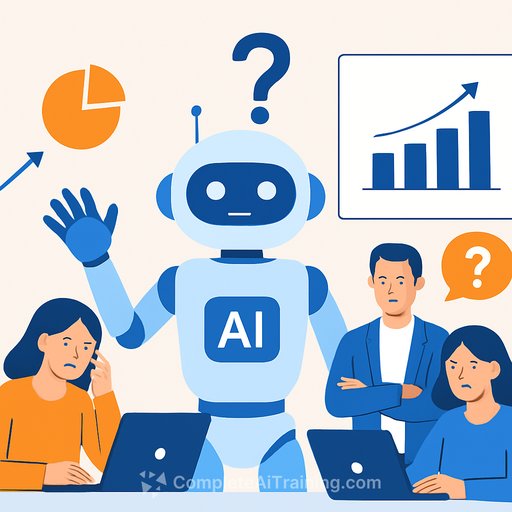
Companies are rolling out AI without clear strategy, frustrating staff and wasting money
Executives are pushing AI adoption across their organisations without agreement on why they're doing it or what they expect to gain. The result: failed investments, confused employees, and technology decisions that don't make business sense.
At a data analysis firm, an AI engineer advised against using generative AI to categorise customer data. A traditional machine learning model would have been cheaper, more accurate, and produced consistent results. Management chose generative AI anyway - largely to say the company was embracing the technology.
This pattern is repeating across sectors. In February, Accenture told staff that promotions to senior roles would require regular use of its AI tools, with the firm tracking usage. KPMG launched a dashboard in May to monitor whether US employees met a 75% usage target for its AI systems.
The problem runs deeper than forced adoption metrics. A senior consultant at a large consulting firm said the wreckage is clear: "organisations not getting the ROI from it that they were expecting and not getting their people engaging with it."
Leadership can't agree on the goal
Dan Boyles, CEO of consultancy Hello AI Collective, sat with the C-suite of an oil and gas company and asked a basic question: what's the reason for using AI? None of them could agree.
The CEO wanted to keep up with competitors. The head of sales wanted to make more money. Marketing wanted to stop using outside contractors. Without alignment at the top, AI investments scatter across competing priorities and fail to deliver.
The situation improved only when the company president stated a clear objective: increase operating earnings to prepare the business for sale. With that anchor point, Boyles' team could identify where AI actually solved problems.
Civil servants doubt their managers can lead the change
The UK government is betting on AI to improve efficiency across Whitehall. But research by the civil servant union, the FDA, found that less than a third of civil servants were consulted on how the technology would be rolled out.
Dave Penman, FDA general secretary, said the rollout was "inconsistent across departments which limits the productivity gains" and described it as "change is being done to workers, not with them".
While civil servants were open to using AI to boost productivity, they doubted management could handle the transformation.
Organisational culture determines success or failure
Caroline Rawlinson, CEO of Culture Amp, which tracks employee feedback, said pre-existing culture can make or break an AI rollout. AI tends to accelerate things - for better or worse.
"If you're putting AI technology on top of a fragmented culture or a fear-based culture, it is not going to succeed," Rawlinson said. "At best, it becomes a very slow roll out as people don't understand what they're being asked to achieve or the tools that they're being provided with. At worst, it ends up as quite a big, wasted effort."
While nine out of 10 HR professionals expect to increase their use of generative AI, a third said no one currently owns AI strategy at their companies.
The basics matter: training, access control, and clear purpose
At the consulting firm, everyone has access to two AI tools. Those whose roles demand it can request specialist tools for coding or other tasks - some staff have access to four or five tools.
Before anyone gets access, they complete mandatory training covering AI ethics and risks such as bias. The training also explains that AI tools can be sycophantic and hallucinate.
The senior consultant said organisations need to consider the people side. "There are generational differences in terms of confidence levels with regards to this. There are potentially gender differences."
For executives developing AI strategy, the lesson is straightforward: clarity of purpose comes first. Agreement on why you're adopting AI - not just that you are - determines whether staff engage with it or whether the investment becomes expensive window dressing.
Read more about AI for Executives & Strategy and AI for Management.
Your membership also unlocks: