
AI news ·
First AI hotel booking delivers 20x return on ad spend
A single hotel booking through conversational AI achieved a 20x return on ad spend, marking the first time a reservation was traced entirely to an AI interaction.
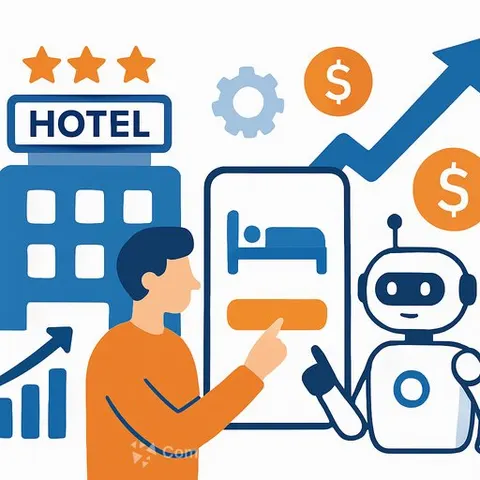
Simone Puorto, Head of Emerging Trends at Hospitality Net, booked a hotel room through conversational AI advertising for a client this week. The single booking generated a 20x return on ad spend, equivalent to a 5% cost of acquisition.
Statistically, one booking means almost nothing. Commercially, Puorto said, it marks the first time he could trace an entire reservation journey to an AI interaction rather than Google Search, an OTA, or social media.
"It's a single booking, so statistically it means almost nothing," Puorto wrote. "Commercially, though, it's interesting: a 20x ROAS, equivalent to a 5% cost of acquisition."
The channel works by exposing hotel availability rates and inventory directly to AI assistants. When someone asks for a boutique hotel in Paris with a rooftop terrace, participating hotels show live pricing within the conversation, letting users book without leaving the chat.
Volume is tiny but the precedent exists
Across all clients where Puorto is running AI advertising campaigns, this is the first booking. He draws a direct parallel to hotel metasearch in its early days, when many hoteliers dismissed it for lack of volume. A few years later, Google Hotel Ads became one of the highest-ROI direct acquisition channels in hospitality.
For professionals exploring AI for Marketing, the first booking is less important than the attribution. Puorto connected the travel reservation from the initial conversation to the completed purchase, an end-to-end path that very few marketers have ever documented.
Conversational AI as a transaction engine
Today, most AI conversations remain upper- and mid-funnel touchpoints. Bookings happen elsewhere. This single transaction suggests that could change.
"This feels like the first small piece of evidence that conversational interfaces may eventually evolve from answer engines into transaction engines," Puorto said.
Why this matters for marketers
Metasearch started with a handful of bookings and became a core acquisition channel. If AI advertising follows that path, marketers who run experiments now will have data and workflow experience that their peers lack two years from now. The single booking has no statistical significance, but it has strategic significance: it proves the attribution model works and the booking pipeline is real.