First AI-Powered Self-Monitoring Satellite Launched into Space
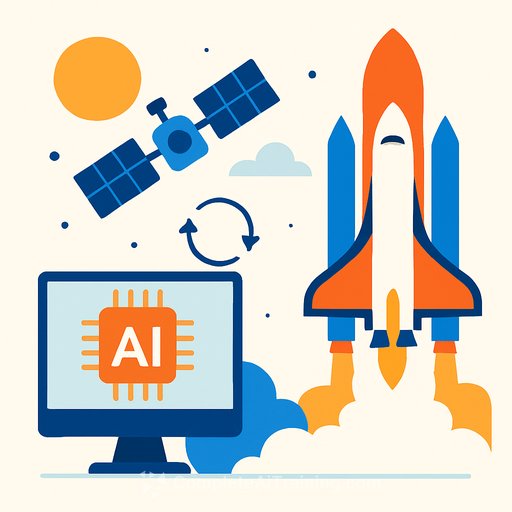
A new satellite launching in 2025 will use onboard AI to monitor and predict the health of its power system in real time. This marks the first time a spacecraft has been equipped with a digital brain that operates independently while in orbit. Notably, the project from concept to launch will be completed in just 13 months, an exceptionally fast timeline for space missions.
A Faster Path to Space
Typical satellite projects often require several years to develop and deploy. However, this mission, scheduled for liftoff in October 2025 from California, has shortened that timeline dramatically. The success comes from a collaboration between UC Davis researchers and Proteus Space, establishing what is described as the first rapid design-to-deployment satellite system of this kind.
Graduate students Ayush Patnaik and Adam Zufall from UC Davis are developing a payload that will journey to space this fall. This payload acts as a digital twin, using AI software to track and forecast the battery’s future condition.
A Smart Brain for the Satellite
The core innovation lies in the custom payload, a package inside the satellite created by the research team. This payload contains a digital twin—a computer model mirroring the satellite’s power system. Unlike previous digital twins that rely on updates from Earth, this one functions autonomously onboard. This independence eliminates the need for constant data transmission back to ground stations.
The satellite uses sensors and AI software to continuously assess battery health, monitor power levels, and predict future performance.
"The spacecraft itself can let us know how it’s doing, which is all done by humans now," explained Adam Zufall, a key graduate researcher. The AI doesn’t just gather data; it learns from it, improving its predictions over time. This allows the satellite to adjust operations proactively, even before issues arise.
Professor Stephen Robinson, who leads the lab behind this payload, added, "It should get smarter as it goes and be able to predict how it’s going to perform in the near future. Current satellites do not have this capability."
Working Together Across Disciplines
Developing this technology required collaboration across robotics, space systems, computer science, and battery research. Along with Robinson and Zufall, the team includes a mechanical engineering professor specializing in battery management. His lab investigates battery behavior under various conditions, including space environments.
Graduate students contribute significantly, designing software and refining AI prediction models that respond to power fluctuations. The payload monitors voltage and other metrics to evaluate energy storage and usage. While the satellite will carry multiple payloads, both scientific and commercial, the AI-powered system that monitors itself remains the centerpiece.
What Happens After Launch
Launching from Vandenberg Space Force Base, the satellite will enter low Earth orbit, approximately a few hundred miles above the surface. It is designed to operate for up to 12 months, testing its AI-powered self-monitoring capabilities under space conditions.
After the mission, the satellite will continue orbiting for an additional two years. Gradual orbital decay will bring it back into the atmosphere, where it will safely burn up. This planned end-of-life strategy helps reduce space debris and collision risks.
This mission demonstrates how future space projects might be executed faster and more flexibly. Instead of taking years, satellites could be designed, launched, and operated within months, paving the way for more frequent and smarter space missions.
Changing the Future of Spacecraft
Currently, spacecraft operations depend heavily on ground teams to manage system checks, respond to issues, and make adjustments. This approach introduces delays, raises costs, and increases risks.
Integrating real-time digital twins onboard allows satellites to self-manage. They could isolate malfunctioning components, optimize power usage, or alert engineers days in advance about potential problems. This reduces the burden on ground control and enhances mission safety and longevity.
The team views this satellite as a starting point. With continued AI advances and streamlined development, space technology could become more responsive and reliable. While the satellite is small, it may initiate a shift in how space systems are designed and managed.
Research findings and updates are available on the UC Davis website.
Your membership also unlocks: