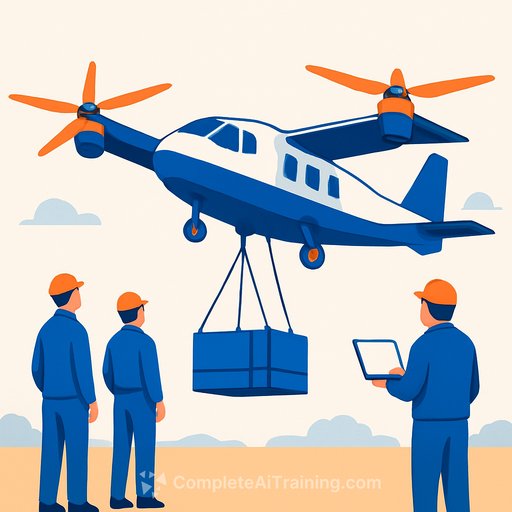
Florida Atlantic University's Center for Connected Autonomy and Artificial Intelligence (CA-AI) has been selected to compete in the DARPA Lift Challenge, a national competition focused on advancing autonomous aerial logistics. The team is building a heavy-lift autonomous tiltrotor aircraft designed to achieve a 4-to-1 payload-to-weight ratio-a benchmark that exceeds the capabilities of existing aircraft systems and represents a key milestone for future autonomous logistics platforms.
DARPA has a long history of using competitions to accelerate technology. Its Grand Challenge and Urban Challenge helped lay the groundwork for self-driving vehicles years before commercial systems emerged. The Lift Challenge extends that model to autonomous aviation, pushing teams to significantly improve payload efficiency in vertical-lift aircraft.
"DARPA competitions have historically served as catalysts for technological breakthroughs, particularly in autonomous systems," said Dimitris Pados, Ph.D., director of CA-AI and Charles E. Schmidt Eminent Scholar Professor in the Department of Electrical Engineering and Computer Science. "For our students, participating in the Lift Challenge is an opportunity to engage with a problem at the forefront of aerospace innovation while applying the principles of autonomy, artificial intelligence, and engineering design that are central to CA-AI's research."
The CA-AI team and its aircraft
The project is fully funded and organized by CA-AI, bringing together seven student researchers from FAU's College of Engineering and Computer Science under faculty guidance. They handle the entire development cycle: design, simulation, fabrication, and flight testing of the autonomous tiltrotor aircraft.
Work began with computer-aided design and aerodynamic simulations to validate performance before building. The team then assembled a full prototype, integrating propulsion systems, flight control hardware, and a composite airframe. The aircraft is now undergoing flight testing and iterative refinement ahead of the competition in Dayton, Ohio, this August.
Bridging research and hands-on engineering
The initiative reflects CA-AI's broader mission to advance research and education in networked AI, connected robotics, and autonomous systems. It also aligns with the college's focus on integrating research with experiential learning, giving students a chance to tackle nationally significant engineering challenges. The team is exploring partnerships with industry to further optimize the aircraft.
The project provides direct experience in aircraft systems, autonomy, controls, and advanced manufacturing while contributing to ongoing research in intelligent and autonomous systems.
Why this matters for science and research professionals
The DARPA Lift Challenge offers a real-world testbed for AI and autonomy algorithms under demanding physical constraints. Achieving a 4:1 payload ratio in a vertical-lift aircraft requires advances in control systems, sensor integration, and lightweight materials-areas that spill over into broader robotics and autonomous systems research. For scientists and engineers, competitions like this show how academic teams can drive progress on problems with direct national security and logistics applications, while training the next generation of researchers in rigorous, project-based environments.
Your membership also unlocks: