AI Implementation in Organizations: Four Key Components for Executives
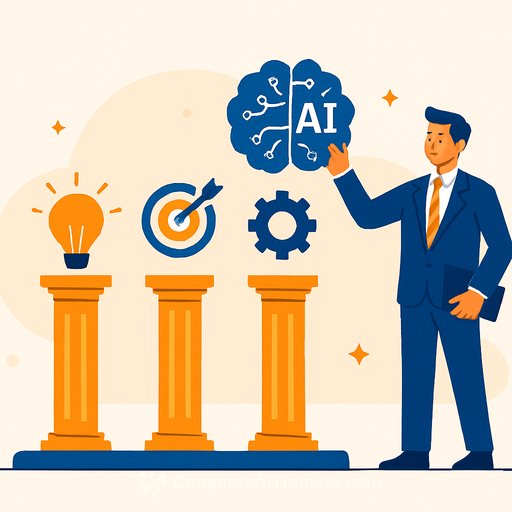
AI, especially Generative AI, has become a fundamental way organizations operate. It adds layers of operational complexity that require careful management. To implement AI successfully, executives must focus on four interconnected areas: aligning AI with business value, establishing solid technology capabilities, redesigning the operating model, and fostering AI adoption among people.
Strategic Alignment and Target Application
Aligning AI initiatives with business goals is essential. Without clear alignment, AI projects risk becoming costly exercises with little return. Start by identifying specific use cases where AI can create measurable impact—whether it’s optimizing resource allocation, enhancing predictive maintenance, or improving customer experience through reimagined workflows.
Breaking down problems into manageable parts—what can be called “thin slicing”—helps focus efforts on high-value, solvable challenges. This approach ensures tech and AI teams stay closely connected to business units and operators, balancing short-term wins with long-term strategy.
Prioritizing use cases requires weighing business value against technological readiness, quality, and risk. Many initiatives fail to scale due to technical debt, model bias, skill shortages, or regulatory hurdles. Planning should include both what AI can do now (horizon 1) and what it might enable in the near future (horizon 2), encouraging collaboration and innovation.
Technology Capability – Data is the Foundation
High-quality data is the backbone of any AI implementation. Organizations must evaluate their data quality, security, architecture, and integration capabilities. Effective AI depends not on volume but on relevant, diverse, and reliable data.
Managing technical debt is critical. Fragmented data and outdated systems can slow progress and increase risk. Implementing strong governance frameworks and integrating AI with existing infrastructure—often through APIs or cloud solutions—helps reduce complexity.
Adopting a culture of experimentation enables organizations to test AI solutions on targeted problems, measure outcomes, and scale what works. Recognize when AI approaches outperform rule-based systems, such as in prediction or natural language understanding.
As Ruben Ortega, a tech and venture capital expert, notes, reframing success and failure as control and experiment creates a safer environment for innovation and continuous learning.
Operating Model
AI implementation is not just a technical project; it requires a well-designed operating model. This means defining the structure, resources, and processes that support AI delivery.
Many organizations start with distributed AI teams, which offer agility but can lead to duplicated efforts and inconsistent maturity. Centralized models bring governance and efficiency but may lack responsiveness.
The hub-and-spoke model strikes a balance. It combines centralized oversight with decentralized agility, featuring a lean Center of Excellence that sets standards and promotes advanced capabilities. Board-level AI expertise is also crucial for guiding strategy and managing risks.
Serial entrepreneur Natalie Gaveau emphasizes that dedicated data management teams with strong governance ensure data remains relevant and actionable, which is vital for AI success. Preparing for hybrid workforces that combine human and machine strengths is part of this model.
AI Adoption and Managing Change
People and culture play as significant a role as technology in AI success. A culture open to change and continuous learning is necessary to empower teams and foster better decision-making.
Introducing AI without user involvement often leads to slow adoption. Users need ownership and trust in AI tools, which requires their active participation during development.
Amr Awadallah, CEO of Vectara, points out that those who effectively use AI-driven tools will greatly increase productivity, while others risk falling behind. Continuous monitoring through impact metrics and feedback loops helps organizations quickly address unintended consequences.
Looking Ahead
AI implementation demands collaboration across departments and skill sets. No single function can drive this transformation alone. Learning from diverse industries reveals common patterns and best practices.
Oz Krakowski of Deepdub highlights that delay in adopting AI due to uncertainty poses a risk. Hesitation can cost organizations valuable ground in a swiftly changing environment.
Executives aiming to guide their organizations through AI adoption can benefit from structured learning resources. For practical AI training tailored to business leaders and strategy professionals, explore Complete AI Training's courses for executives.
Your membership also unlocks: