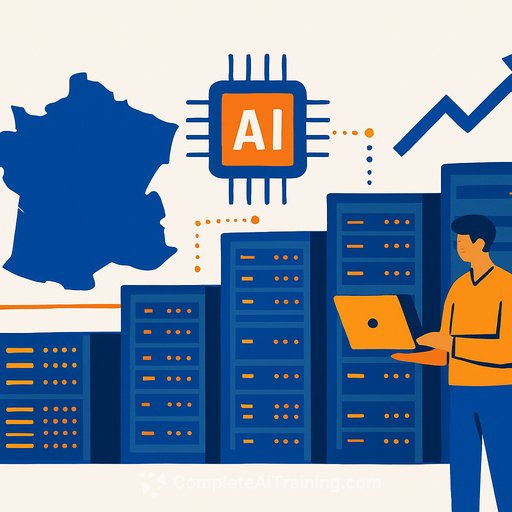
Jean Zay Supercomputer: France Quadruples AI Computing Resources
The Jean Zay supercomputer has undergone its fourth upgrade, increasing its computing power fourfold. This enhancement makes it one of the most powerful and heavily utilized supercomputers dedicated to artificial intelligence in France and Europe. The expanded capacity supports a broad range of strategic scientific and industrial projects.
Open research across various fields—such as biomedical studies, astronomy, autonomous vehicles, material science, renewable energy, agriculture, decision support, and cultural initiatives—will benefit from these resources at no cost.
A Growing Legacy Since 2019
Commissioned in 2019, Jean Zay replaced the Turing supercomputer, boosting computing power ten times over its predecessor. To meet increasing AI demands, Jean Zay has been continuously upgraded, with the latest extension announced in June 2023 by President Emmanuel Macron during the VivaTech trade show.
Jean Zay 4 now delivers 125.9 petaflops of 64-bit computing power—equivalent to 125.9 million billion operations per second. To put this in perspective, if every person on Earth performed one operation per second, it would still take 182 days to match one second of Jean Zay's output. Storage capacity has also expanded to around 100 petabytes, supporting thousands of research projects across academia, startups, and industry.
Showcasing Scientific Innovation
At the inauguration, three key projects highlighted how Jean Zay’s capabilities are applied:
- Polymathic: Led by François Lanusse from CNRS, this project uses deep learning and generative AI to analyze large-scale astronomical data, enhancing our understanding of the Universe.
- Owkin Start-up: Under Jean-Baptiste Schiratti, Owkin develops AI models to detect pathologies in microscope images, improving both accuracy and generalizability.
- Pleias Start-up: Co-founded by Pierre-Carl Langlais, Pleias focuses on offline applications of large language models with traceability, ensuring compliance with the new EU AI Act.
Eco-Efficiency and Technological Strength
Produced by Eviden (Atos Group), a French and European manufacturer, Jean Zay 4 combines high-performance computing with energy-efficient design. It uses Nvidia GPUs and advanced warm-water cooling systems. The system’s residual heat is repurposed to warm approximately 1,500 households on the Plateau de Saclay, demonstrating sustainable operation.
Accelerating AI Research and Collaboration
Jean Zay’s resources are available free for open research projects in diverse fields including language processing, multimodal computing, physics, climatology, and agriculture. The supercomputer is particularly valuable for training and running AI foundation models.
Over the past five years, the number of AI projects supported annually by Jean Zay has surged from 72 in 2019 to over 1,400 in 2024. It ranks among Europe’s most successful machines for AI research.
Looking ahead, Jean Zay will play a central role in AI Factory France, a collaborative initiative involving GENCI, CNRS, Inria, CEA, and other partners. This project will provide infrastructure, support, training, and expertise to strengthen the French and European AI communities.
A Tribute and a Symbol
The supercomputer is named after Jean Zay, who served as France’s Minister of National Education and Fine Arts from 1936 to 1939. A pioneer in science policy, he took early steps toward creating the CNRS in 1939. Tragically killed in 1944, Jean Zay was honored by being interred in the Panthéon in 2015.
Jean Zay 4’s design features artwork by the French collective Obvious, known for AI-generated art. The inauguration was attended by key figures including Antoine Petit (CNRS Chairman & CEO), Philippe Lavocat (GENCI CEO), Bruno Bonnell (General Secretary for Investments), and Hélène Mouchard-Zay, Jean Zay’s daughter.
Antoine Petit emphasized the importance of the supercomputer for addressing major scientific challenges, while Philippe Lavocat underscored the dual investment in advanced technology and human resources to maintain national and European competitiveness in AI.
For those interested in expanding their AI expertise and exploring practical applications, consider browsing comprehensive AI training resources available at Complete AI Training.
Your membership also unlocks: