AI in project management: Building the future
November 13, 2025
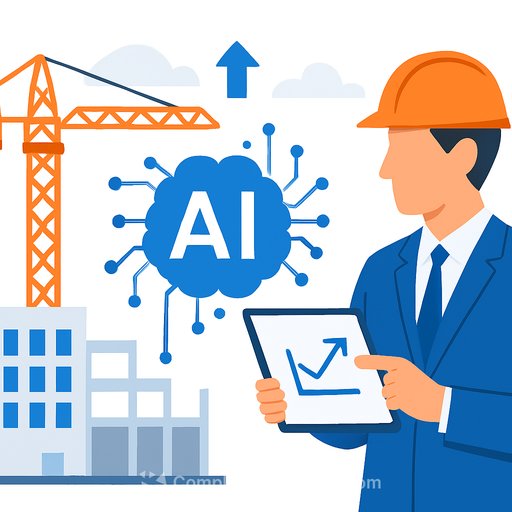
AI is moving from experiment to execution. New research from the project management community shows adoption in construction has jumped from 15% to 75% in two years. By 2025, no respondents said their organisation wasn't using AI at all - a sharp pivot from 2023, when 63% said they had no usage and no plans.
Key findings at a glance
- 75% of construction projects now use AI, up from 15% two years ago.
- 25% of project managers say their organisation plans to introduce AI into project management functions.
- Sentiment has flipped: "very positive" views on AI's impact rose from 6% (2023) to 62% (2025).
- 82% are using AI more than they expected five years ago.
Where AI is paying off
Teams aren't using AI for novelty - they're using it for outcomes. The most cited benefits are practical and measurable.
- Better decision-making and faster analysis of large datasets
- Stronger risk identification and mitigation
- More accurate planning, forecasting and reporting
- Improved resource allocation and utilisation
- Clearer, timelier stakeholder communications
What leading firms are doing right now
Case studies from APM corporate partners show real deployment, not theory. Gleeds, MIGSO-PCUBED and Network Rail are building AI into everyday delivery.
Gleeds has rolled out AI, machine learning and analytics across predictive scheduling, resource planning and client value demonstrations - moving beyond a small digital team to organisation-wide use. As James Garner, global head of data and AI at Gleeds, puts it: having AI skills will soon be as common as using Word or Excel.
The blockers managers must solve
- Training and technical knowledge (49%) - many teams lack practical, tool-level fluency.
- Security and data privacy (56%) - compliance, data access and supplier risk need clear controls.
- Workflow integration (41%) - tools work in silos without process redesign.
- Quality concerns (46%) - inaccuracy and untrustworthy outputs require validation steps.
A practical playbook for managers
- Start with one high-friction use case (schedule risk, cost forecasting, reporting). Define a baseline and a clear success metric.
- Create a simple governance framework: data access, approval flows, human-in-the-loop checks and audit trails.
- Standardise prompts, templates and checklists so results are repeatable across teams.
- Integrate with source systems (schedule, cost, risk, document control) to avoid manual copy-paste.
- Run short, hands-on training sprints. Measure adoption and accuracy, then iterate.
Risk, assurance and ethics
AI supports judgment; it doesn't replace it. Set expectations upfront: human review for critical decisions, clear data lineage, and bias checks where models influence stakeholder outcomes.
If you need a reference framework for controls, review trusted guidance such as the NIST AI Risk Management Framework. For sector-specific research and practice notes, see resources from the Association for Project Management.
Upskilling: make it part of the job
The data is clear: adoption is rising faster than skills. Budget for training just like you do for tools - and focus on role-based practice, not theory.
- Project fundamentals: schedule risk analysis, cost variance insights, change impact summaries
- Communication: exec-ready reports, stakeholder updates, meeting synthesis
- Data hygiene: prompt standards, source validation, red-teaming outputs
If your teams need a direct path to hands-on learning, explore curated options by role and certification tracks: AI courses by job and popular AI certifications.
What this means for delivery
AI isn't a silver bullet. It's a dependable toolset that removes grunt work, lifts analysis and speeds decisions - when paired with clear governance and skilled people.
The takeaway for management: pick focused use cases, invest in skills, and bake AI into the process, not the periphery. The teams that do this well will deliver faster, with fewer surprises and stronger stakeholder trust.
Your membership also unlocks: