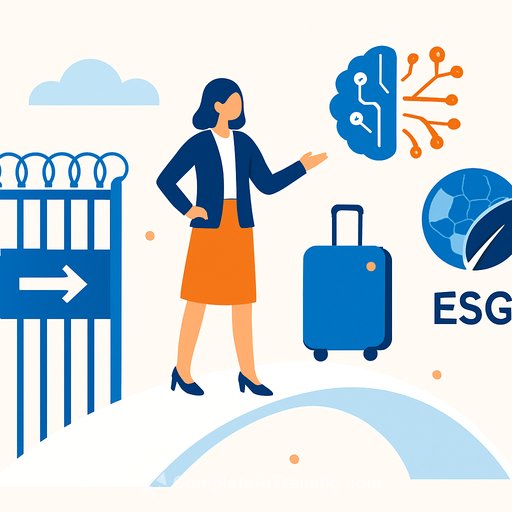
HR's Mandate Now: Build Resilience With Mobility, AI, and ESG
Location matters less than how people work together. What drives results is collaboration, idea flow, and continuous skill building-across borders, time zones, and cultures.
Three forces are pushing HR to the center of business: global talent mobility, AI embedded in daily work, and responsibility through ESG. Your job is no longer administrative. It's to create a workforce that adapts fast and sustains progress under pressure.
Global Mobility: From Borders to Bridges
Mobility today is about access-skills, perspectives, and potential-regardless of geography. When purpose is shared and teams are culturally agile, borders fade. Companies that lean into this can expand their talent pools by up to 340 percent and bring in the expertise that sparks better ideas.
Flexibility is expected. Candidates ask about remote and hybrid as a first-order filter, and many pass on roles that don't offer it. Flex-friendly mobility strategies win on attraction and retention.
Policy updates aren't enough. Equip people with cultural intelligence, digital fluency, and collaborative problem-solving. Distributed teams with these capabilities don't just function-they learn faster and produce stronger insights.
- Build location-flexible job architectures, pay bands, and compliance guardrails.
- Set clear norms for async work: core hours, response SLAs, handoff templates, and decision rights.
- Offer cross-cultural training, language support, and buddy systems for cross-border projects.
- Upgrade onboarding for remote hires and short-term cross-border assignments.
AI With a Human Core
AI has moved from pilots to operations. Generative and agentic tools cut busywork and surface insights, so HR and leaders can invest time in coaching, engagement, and capability building. The ROI is real-but the goal is better human judgment, not replacing it.
This shift demands new skills: ethics, data literacy, and comfort with tech-enabled workflows. Leading hybrid and AI-augmented teams takes empathy, transparency, and clear standards. Use data to inform decisions, never to replace discernment. Trust, psychological safety, and consistent leadership are non-negotiable.
- Prioritize HR use cases: talent sourcing, internal mobility, learning personalization, and workforce planning.
- Implement responsible AI guardrails: bias testing, human-in-the-loop reviews, and data governance aligned to the NIST AI Risk Management Framework.
- Upskill leaders and HR teams on prompts, analytics, and AI literacy. See the AI Learning Path for CHROs.
- Redesign roles so AI handles repeatable tasks while people handle coaching, decisions, and relationship work.
ESG: Put People and Culture at the Center
As mobility expands reach and AI increases scale, ESG provides the compass. Most large companies now report on ESG. HR turns the promise into practice through inclusive governance, ethical talent decisions, and preparation for green roles that enable long-term growth.
Future-ready workforces will blend sustainable operations, stakeholder engagement, and values-led leadership. Those skills protect the business and contribute to society.
- Link ESG priorities to performance and incentives for leaders and teams.
- Build a skills taxonomy for sustainability and "green" roles; partner with the business to forecast demand.
- Institutionalize fair hiring, pay equity audits, accessible work design, and transparent career paths.
- Use recognized standards to guide disclosures and metrics, such as the IFRS Sustainability (ISSB) standards.
Continuous Learning Is the Engine
Your relevance depends on how fast your people learn. Reskilling and upskilling aren't projects-they're the operating system.
- Adopt a skills-based approach to roles, pay, and internal mobility; use an internal talent marketplace.
- Deliver bite-sized learning inside the flow of work and measure skill gain, not seat time.
- Stand up manager-led practice labs for feedback, coaching, and scenario work.
- Recognize progress with badges and stretch assignments tied to real business problems.
What High-Performing HR Teams Do Next
- Weeks 1-2: Publish principles for flexibility, AI, and ESG. Set 3-5 outcome metrics (time-to-skill, internal fill rate, engagement, equity, compliance).
- 30 days: Pilot two AI use cases in HR with clear guardrails and ROI targets. Stand up a cross-functional AI review group.
- 60 days: Launch cross-border collaboration standards and a manager capability sprint (coaching, feedback, async leadership).
- 90 days: Roll out an ESG skills program and publish your responsible AI policy. Keep what works, retire what doesn't, scale the wins.
The Takeaway
Work is defined less by location and more by collective capability. HR leaders who connect mobility, AI, skills, and responsibility into one operating model will keep their organizations agile and resilient. The future of work is already here-lead it with clarity, intent, and purpose.
Your membership also unlocks: