AI Is Becoming the CX Operating System
AI isn't a future plan-it's the layer that now drives conversations, service flows, and customer insights. Industry leaders agree: the plumbing is mature, and the value is in the intelligence on top, as reported by CX Today.
For support teams, this means less guesswork, faster answers, and context that travels with the customer across every channel.
The Infrastructure Is Ready
Michael Tessler, co-founder of BroadSoft and a key figure in UCaaS, says voice, messaging, and meetings have hit maturity. The new frontier is the intelligence layer that sits above them.
His point is simple: reliable communications networks make real-time AI practical. "UC helped us digitize the conversation. AI will help us understand it." That combination-communications plus intelligence-lets teams analyze context, sentiment, behavior, and intent as they serve customers.
Unified CX Turns Data Into Real-Time Action
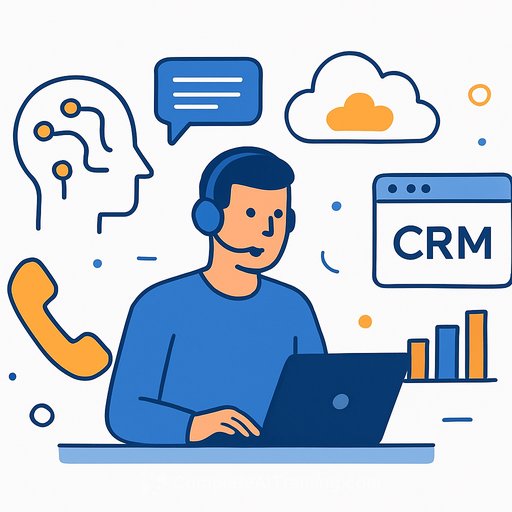
Nextiva CEO Tomas Gorny frames AI as the helping hand that connects communication, data, and context at the exact moment of interaction. He sees CX as a connected system: calls, messages, CRM, workflows, and history running through one intelligence layer.
The outcome is a "CX OS" that captures every signal, then delivers guidance to agents and customers in real time. You move from reactive support to anticipatory service.
AI Is Already Handling The Busywork
Ray Nolan, founder of eDesk, says AI is automating 70-80% of support tickets across channels-Amazon, TikTok, email, and more. For e-commerce and high-volume teams, that means routine tasks get handled automatically while humans focus on the edge cases.
Result: faster responses, lower cost per contact, and fewer context switches for agents.
What This Means For Customer Support Teams
Support is shifting from answering questions to managing outcomes. The teams that win will centralize context, automate the repeatable, and feed agents the right insight at the right second.
A Practical Playbook You Can Use Now
- Unify the data exhaust: Connect telephony, chat, email, social, CRM, order and billing systems. Resolve identities so the customer looks like one person everywhere.
- Map high-volume intents: Identify the top 20 reasons customers contact you. Automate the safe ones end-to-end; route the risky ones with full context to agents.
- Add real-time context to routing: Route by intent, value, sentiment, and backlog. Don't send a VIP cancellation request into a general queue.
- Agent assist by default: Suggested replies, knowledge snippets, objection handling, and live summaries in the console. Pair with QA scoring and coaching.
- Automation guardrails: Set thresholds where AI must defer (refunds over X, account security, legal). Always give customers a clear path to a human.
- Tight feedback loops: Let agents flag bad suggestions with one click. Retrain frequently. Treat data cleanliness as a weekly ritual.
- Compliance and safety: Audit logs, PII redaction, rate limits, and fallbacks. Track suggestion accuracy and escalation health.
- Work with AI-native BPOs: If you outsource, pick partners who bring unified CX platforms, shareable data models, and common KPIs. Agree on quality thresholds and governance upfront.
- Upskill your team: Teach prompt skills, data sensitivity, and AI QA. Make "AI + human" the default workflow, not a side project. See role-based AI courses.
Quick Wins You Can Ship This Quarter
- AI summaries for every call and ticket: Push structured notes into CRM automatically.
- Smart macros and suggested replies: Start with top five intents across email and chat.
- Search that actually finds answers: Plug AI search into your knowledge base and display confidence scores.
- Intent detection for triage: Label inbound contacts and route to the right path instantly.
- Proactive status updates: Trigger alerts for shipping delays, failed payments, or backorders to deflect contacts.
- Channel unification: Pull Amazon/TikTok/social DMs into a single workspace with shared context.
KPIs That Prove It's Working
- Containment rate: % of issues resolved without a human.
- Time to first action: How fast context reaches the agent or automation kicks in.
- AHT and FCR: Lower handle time, higher first-contact resolution.
- CSAT/CES by intent: Track quality where it matters, not just overall.
- Suggestion accuracy: % of AI prompts agents accept without heavy edits.
- Deflection savings: Cost avoided through proactive and automated resolutions.
Tooling Principles To Keep You Out Of Trouble
- Open APIs and data portability: No lock-in for your transcripts, knowledge, and labels.
- Latency budgets: Target sub-200ms for assistive features; anything slower hurts adoption.
- Security by default: PII redaction, role-based access, regional data controls.
- Transparency: Show customers when AI is responding and how to reach a human.
- Multilingual coverage: Don't ship AI that only works in one language if your customers don't.
Why Outsourcing Strategies Will Change
As AI becomes standard inside CX platforms, BPOs that integrate deeply with your data and workflows will outperform those that just supply labor. Expect contracts to include shared automation goals, model governance, and joint quality reviews.
The new baseline: faster, context-aware service at lower cost-with humans focused on tricky, emotional, or high-stakes issues.
Want More Context?
If you're new to the infrastructure side, a quick primer on UCaaS helps connect the dots between communications and AI. For risk and governance, review the NIST AI Risk Management Framework. For infrastructure and governance best practices, see the AI Learning Path for CIOs, and for practical implementation playbooks and rapid CX improvements, review the AI Learning Path for Project Managers.
Your membership also unlocks: