AI Is Rewriting Healthcare's Operating System
Healthcare evolves slowly by design. Lives are on the line, and risk tolerance is low. Still, AI is now good enough to reduce administrative drag, speed up research, and pressure-test decisions before they hit patients.
The upside is real: lower costs, tighter workflows, faster discovery. The key is pairing models with clinical judgment and clear guardrails.
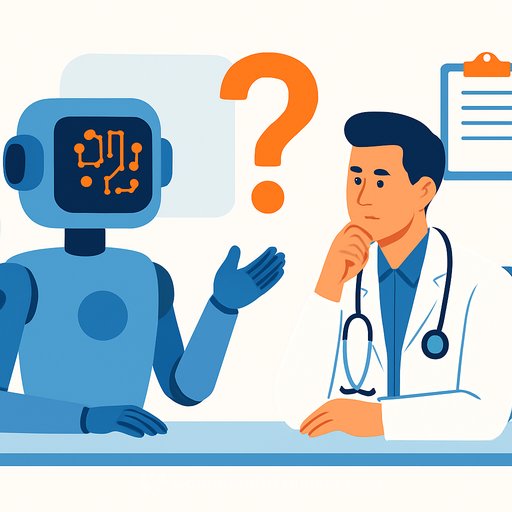
The Golden Rule: Human-led, AI-amplified
Keep clinicians and scientists in control. Use AI to surface options, not dictate them. Build processes where people approve, override, and learn from model outputs.
Stay aligned with current guidance and pathways for AI-enabled tools in care and devices. See the FDA's overview of AI/ML-enabled medical devices for context: FDA: AI/ML in Medical Devices.
Where AI Pays Off Now
- Operations: Prior auth support, denial prevention, scheduling, supply forecasts, and capacity planning. Expect fewer bottlenecks and cleaner revenue cycles.
- Clinical documentation: Ambient notes, structured summaries, and order suggestion drafts with clinician sign-off.
- Imaging and triage: Assistive reads, worklist prioritization, and standardized impressions under radiologist oversight.
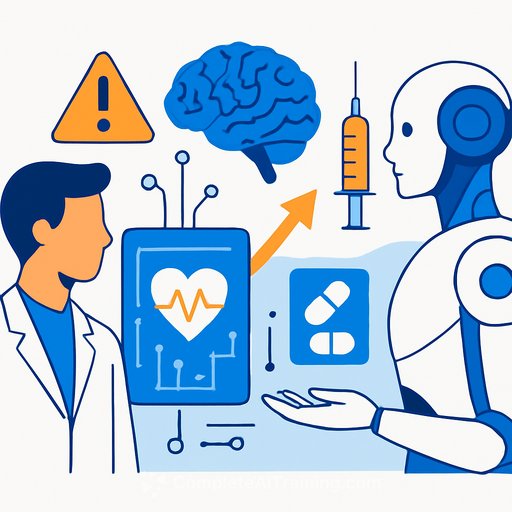
- Pharmacovigilance: Signal detection from literature, EHRs, and patient reports to flag issues earlier.
- Patient access: Intake automation, eligibility checks, and FAQs that route to the right human fast.
Drug Discovery and Development
AI shrinks the search space. Generative design proposes molecules, models predict ADMET, and active learning guides the next experiment. You still need assays, animal studies, and trials-just fewer blind alleys.
Expect value in virtual screening, target deconvolution, repurposing, and protocol optimization. Use stage gates with predefined go/no-go metrics to keep teams honest.
Genomics and Disease Association
Models can prioritize variants, map gene-disease links, and segment patients by predicted response. Treat findings as hypotheses, not facts. Validate with wet-lab or clinical evidence before decisions touch patient care.
Simulating Trial-and-Error Before It Reaches Patients
Digital twins and in silico arms can stress-test protocol choices, dosing strategies, and inclusion criteria. Synthetic control arms may cut cost and time, if regulators accept the design and validation is tight.
Document model lineage, data sources, and performance limits. If you can't explain it, you can't defend it.
The Bionic Organization
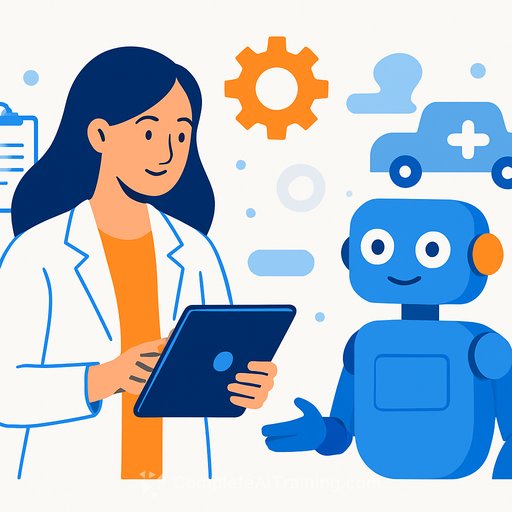
Think small teams, tight loops, and AI in the flow of work. Researchers scope the question, AI drafts options, humans refine, AI re-runs. The cycle compresses from weeks to hours.
Role clarity matters: clinical owners decide, QA verifies, data teams monitor drift, and compliance signs off on changes.
Guardrails You Need
- Governance: A cross-functional review board for model intake, change requests, and retirement.
- Data controls: De-identification, PHI access policies, and audit logs. Contractual limits for vendor data use.
- Validation: Prospective testing, bias checks by subgroup, and human-in-the-loop thresholds.
- Monitoring: Drift detection, incident response, and rollback plans.
- Security: Model and prompt injection defenses, safe connectors, and strict secret handling.
- Procurement: Outcome-based SLAs, evidence packages, and sandbox trials before scale.
A Simple 90-Day Plan
- Days 1-15: Map 3 high-friction workflows. Define one metric per workflow (e.g., denial rate, note time, turnaround time).
- Days 16-45: Run two controlled pilots with human review. Capture baseline vs. pilot outcomes.
- Days 46-75: Close gaps: prompts, guardrails, UI tweaks, exceptions. Write a one-page SOP per pilot.
- Days 76-90: Present ROI, risk profile, and a scaling plan. If results are soft, pivot or stop.
Metrics That Matter
- Clinical: note time per encounter, turnaround for imaging reports, patient wait times.
- Operational: prior auth cycle time, denial rate, scheduling lead time, bed turnover.
- R&D: qualified hits per cycle, time to candidate nomination, protocol amendment count, SAE signal detection lag.
- Quality/Risk: override rates, discrepancy rates, subgroup performance spread, audit issues per quarter.
Skills and Enablement
Train teams to write clear prompts, validate outputs, and escalate edge cases. Standardize templates and checklists so results are consistent across shifts and sites.
If you need a fast on-ramp for clinicians, data teams, or ops leaders, see practical courses and pathways here: AI Courses by Job and Latest AI Courses.
What to Watch Next
- Clearer rules on adaptive models and real-time updates in production.
- Lower compute cost and better small models you can run on-prem.
- Foundation models tuned on multimodal clinical data (text, images, waveforms) with traceable outputs.
- Standardized datasets and benchmarks that reflect real patient diversity.
AI won't replace clinical judgment. It will compress cycles, surface better options, and make the work less wasteful. Build the system now, while you can still choose how it works.
For ethical guardrails in clinical use, this is a helpful reference: WHO: Ethics and governance of AI for health.
Your membership also unlocks: