IBM rewrites entry-level roles as AI hiring surges: what HR and Product need to do now
IBM just signaled something big: entry-level tech jobs are being rebuilt around AI, customer engagement, product development and oversight. The company's chief HR officer put it plainly: "You have to rewrite every job."
If you hire, manage, or build software, this is your cue. Roles are shifting from task execution to orchestration-humans steering AI, shaping products, and owning outcomes.
What the market is telling you
- AI-related postings jumped 50%+ in January, with software developer roles requiring AI skills growing even faster (Experis (ManpowerGroup)).
- Overall IT postings rose 15%; software developer postings climbed 18% (Experis).
- AI Engineer roles grew 208% in 2025; Machine Learning Engineer up 52%; all top 50 tech titles saw 3%+ salary growth (Dice with Lightcast).
- Traditional roles contracted: Software Development Engineer (-16%), Java Developer (-4%), Business Systems Analyst (-10%) (Dice).
- Skills in demand: workflow management (+49%), Microsoft Azure (+23%), Docker (+29%), Python (+18%).
- Despite headlines, unemployment for core IT skills remains below the national average.
What this means for HR leaders
Job architectures built around legacy definitions are aging out. Rebuild roles around outcomes, systems thinking, and AI oversight rather than task lists that AI can automate.
- Rewrite JDs: shift from "build X" to "ship value with AI-assisted workflows." Make customer contact, product collaboration, and model supervision explicit.
- Update skill taxonomies: add workflow tools, prompt fluency, data quality checks, cloud deployment, and guardrail practices.
- Redesign interview loops: include scenario work with AI tools, data reasoning, and stakeholder communication.
- Rework early-career programs: apprenticeships > internships; pair juniors with AI-enabled seniors and clear learning plans.
- Expect wage pressure in ERP, cloud, data, cybersecurity, healthcare IT; add approval gates but don't stall critical hires tied to revenue, modernization, compliance, and resilience.
Need a starting point for re-architecting roles? See AI for Human Resources.
What this means for Product and Engineering
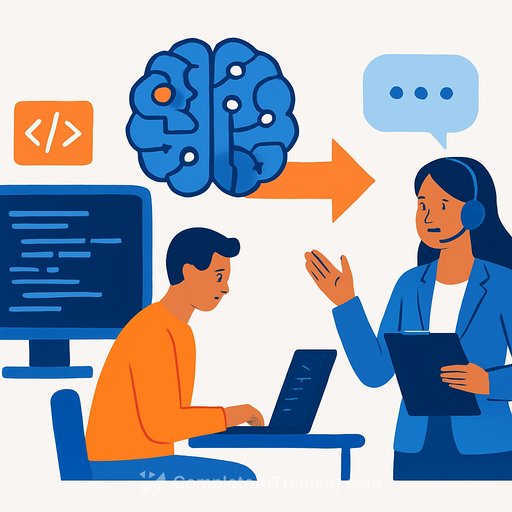
Your junior headcount won't look like 2023. Entry-level developers will spend less time hand-coding routine pieces and more time integrating services, validating AI outputs, and closing feedback loops with users.
- Define "AI-in-the-loop" workflows: who prompts, who verifies, who ships. Make data quality and model evaluation team responsibilities, not side quests.
- Prioritize skills with compounding effect: Python, Docker, Azure, workflow orchestration, and analytics for product decisions.
- Shift roadmaps to practical AI: replace exploration-only spikes with small deployments that improve a metric (conversion, cycle time, support deflection).
- Hire for multidisciplinary range: software + data + AI fluency beats narrow stacks that are shrinking in demand.
How to rewrite an entry-level JD (fast)
- Mission: "Increase customer value by shipping AI-assisted features and improving delivery speed."
- Core outcomes (first 90-180 days): ship two AI-assisted features; reduce manual handoffs; document and monitor model behavior with product and data partners.
- Skills: Python, Docker, Azure (or your cloud), workflow tools, SQL basics, prompt and evaluation techniques, stakeholder comms.
- AI oversight: define acceptance criteria for AI outputs; implement guardrails; log feedback; escalate risks.
- Collaboration: work with PM/Design on discovery; partner with Data/ML on data pipelines and evaluation; close the loop with Support/Sales.
- Growth plan: weekly mentored reps using AI tools; code reviews focusing on reasoning and verification, not just syntax.
Hiring process upgrades
- Scorecards: weight problem framing, data thinking, and collaboration as much as code fluency.
- Work sample: give a small spec; ask candidates to use an AI assistant, document prompts, validate outputs, and ship a minimal feature.
- Signals to watch: systems mindset, willingness to test and measure, ability to talk to users and translate needs.
Workforce planning under a "cooling but selective" market
Hiring hasn't stopped-it's just choosier. Timelines are stretching, and top multidisciplinary talent won't wait.
- Budget early for roles tied to revenue, modernization, compliance, and operational resilience.
- Stand up internal upskilling to fill AI-adjacent gaps faster than external hiring can.
- Build bench strength with apprenticeships and returnships; convert proven talent on milestones, not just timelines.
Skills to prioritize in 2026 postings
- Workflow management and process integration.
- Cloud infrastructure: Azure (or your equivalent).
- Containerization and tooling: Docker.
- Python and data fluency for AI-enabled work.
- Model evaluation, basic data quality checks, and responsible rollout habits.
Next steps you can execute this week
- Pick two entry-level roles and rewrite them around outcomes, workflows, and AI oversight.
- Add a 60-90 minute AI-in-the-loop exercise to your interview loop.
- Publish a skills map for junior hires: Python, Docker, Azure, workflow orchestration, evaluation basics.
- Choose one product area where AI can cut cycle time or increase user value-ship a small, measured win.
If you're building an internal path for new developers, share this with your team: AI Learning Path for Software Developers.
Your membership also unlocks: