Tech Innovation: How AI Is Transforming Finance
Published Jan 29, 2026 * 10 min read
AI isn't a buzzword in finance anymore - it's embedded in daily work, from forecasting and reporting to fraud detection and customer support. The payoff: better accuracy, faster decisions, and fewer manual tasks stealing your team's time. The challenge: using it responsibly, with guardrails that protect customers and the business. Learn practical applications on the AI for Finance resource hub.
Key points
- AI in finance spans machine learning, natural language processing, and predictive analytics-built to solve real problems.
- Modern AI reshapes decision-making by expanding the speed and scope of analysis.
- Responsible use matters: governance, data privacy, and fairness must come first.
- AI augments finance and support teams through automation, accuracy, and smarter workflows.
- Developing AI skills gives finance and support pros a career edge.
What AI Means in Finance
AI in finance uses technologies like machine learning (ML), natural language processing (NLP), and predictive analytics to turn data into decisions. These systems can scan large datasets, surface patterns, and recommend next steps-often in real time.
- Analyze high-volume data for actionable insights
- Run real-time calculations and performance tracking
- Forecast outcomes and model best/worst-case scenarios
- Automate repetitive workflows to reduce manual effort
- Personalize customer experiences and recommendations
Adoption is widespread. Many organizations use AI for reporting, accounting, tax, and risk. The common thread: continuous learning from data that strengthens decisions over time.
Where AI Delivers Value in Finance
Financial planning, forecasting, and analysis
Predictive models spot trends in historical data and project what may happen next. Leaders can pressure-test decisions (like investments or acquisitions) and flag risks earlier. Real-time indicators-cash flow, liquidity, resource allocation-become clearer and easier to act on.
AI also reduces waste. It identifies inefficiencies, automates handoffs, and frees analysts for deeper work instead of spreadsheet maintenance.
Risk management, fraud detection, and compliance
AI blends predictive analytics with pattern recognition to detect threats early-credit risk, market swings, underwriting errors, and more. Models trained on relevant data improve risk scoring and surface anomalies that need immediate attention.
Fraud detection systems learn from behavior and adapt quickly, reducing false positives and speeding investigations. On the compliance side, agent-style systems can review invoices or financial documents for accuracy and completeness, cutting review time and errors.
Customer and client experience
AI can generate personalized insights and responses based on behavior and history. Virtual assistants and chatbots-like Intuit Assist-give customers 24/7 support, natural-language answers, and guidance tied to their situation. That reduces wait times without adding support headcount.
Generative AI helps companies spot customer trends at scale, iterate on services, and strengthen loyalty with more relevant interactions.
How AI Changes Decision-Making
AI doesn't just support decisions-it changes how decisions are made. Instead of static rules, modern systems learn continuously, adapt to new data, and expand the scope of what teams can analyze.
- Automate workflows across finance operations
- Anticipate needs before issues surface
- Spot opportunities and risks faster
- Aggregate system-wide data into real-time insights
- Flag anomalies and propose next steps
AI can also reduce certain biases-if models are trained on diverse, relevant data. That requires careful curation, monitoring, and human oversight.
What This Means for Finance and Customer Support Roles
AI is changing roles, not erasing them. Some tasks disappear; higher-value work grows. New opportunities are opening across data science, ML, AI engineering, and AI product roles-while finance and support roles evolve.
For finance teams, AI trims manual processes and strengthens forecasting, close cycles, reconciliations, and variance analysis. For support teams, it boosts ticket deflection, speeds up triage, and improves first-contact resolution with better suggestions and context.
Quick wins for finance teams
- Automate reconciliations, variance analysis, and accruals
- Deploy predictive cash-flow and liquidity models
- Use anomaly detection for spend and revenue monitoring
- Add AI summaries to monthly reports for faster reviews
Quick wins for customer support teams
- Use AI to classify tickets by intent, sentiment, and urgency
- Deflect common requests with AI assistants and better knowledge suggestions
- Surface account context and insights to agents in real time
- Automate post-call summaries and next steps
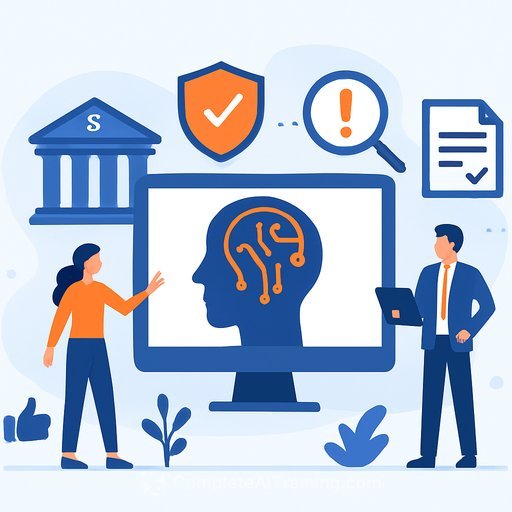
Data Privacy, Security, and Responsible AI
AI introduces real risks: biased outputs, misuse of sensitive data, and weak transparency. Finance and support leaders need clear governance, model documentation, and ongoing audits. Train on representative data, monitor drift, and set escalation paths for model failures.
- Bias and fairness: review datasets and outcomes for disparate impact
- Security: protect sensitive data end-to-end; apply least-privilege access
- Compliance: maintain records, human-in-the-loop controls, and clear model ownership
- Transparency: explain model behavior and provide human recourse
Helpful guidance: the NIST AI Risk Management Framework and the FTC's AI guidance.
Reactive, Generative, and Agentic AI
- Reactive AI: produces predictable outputs based on inputs. Useful for rules-like tasks and straightforward classifications.
- Generative AI: creates content (text, audio, images) and drafts analyses or responses based on prompts and context.
- Agentic AI: works toward goals with minimal oversight, coordinating steps, tools, and data sources to complete workflows.
Most teams mix these approaches. Example: use reactive models for transaction classification, generative models for narrative analysis, and agents for end-to-end workflows like invoice processing or dispute handling.
Outcomes You Can Expect
- Shorter close cycles and faster forecasting updates
- Better fraud detection with fewer false positives
- Higher CSAT from quicker, more accurate responses
- Clearer visibility into cash flow, unit economics, and risk
Many companies report strong ROI from finance AI initiatives. The common pattern: start small, validate results, then scale workflows that show measurable value.
Getting Started: A Simple Plan
30 days
- Pick 1-2 use cases with clear ROI (e.g., spend anomaly alerts, ticket routing)
- Map data sources, access controls, and human review steps
- Define success metrics: accuracy, time saved, error reduction
60 days
- Run a controlled pilot with real data and a small user group
- Collect feedback from finance analysts and support agents
- Tighten prompts, retrain models, and fix edge cases
90 days
- Operationalize: monitoring, alerts, audit trails, and ownership
- Document policies: data retention, model updates, and human override
- Scale to adjacent workflows with similar data and rules
Keep Your Skills Current
AI fluency is becoming part of the job for finance and support professionals. Focus on practical skills you can apply right away: prompt writing, data literacy, basic ML concepts, and workflow automation.
- Explore role-based learning paths: AI Learning Path for CFOs
- Explore practical, team-focused learning: AI Learning Path for Finance Managers
FAQs
Will AI replace human financial professionals?
No. AI is best at repetitive, rules-based work. Humans set goals, judge trade-offs, and handle nuance. The strongest teams combine both.
What regulations apply to AI in finance?
In the US, laws exist in areas like lending and consumer protection, and guidance continues to evolve. Companies should align with existing regulations, monitor new rules, and document their governance approach.
Is financial data safe with AI systems?
It can be-if you apply strict controls. Use encryption, data minimization, access controls, and monitoring. Keep humans in the loop for sensitive decisions and review model outputs regularly.
How can professionals keep up with AI's pace of change?
Make learning part of your weekly routine. Build skills in data analysis, basic ML, prompt writing, and automation. Apply them to one workflow at a time and measure impact.
Your membership also unlocks: