How smart are AI systems in managing cloud compliance
Machine identities now outnumber people in most cloud stacks. That shift changes how security and compliance get done. If you manage risk, budgets, or teams, this isn't a technical footnote-it's a priority.
This article breaks down Non-Human Identities (NHIs), why secrets security management matters, and where AI actually moves the needle for cloud compliance. Short, practical, and built for decision-making.
What NHIs and secrets really are
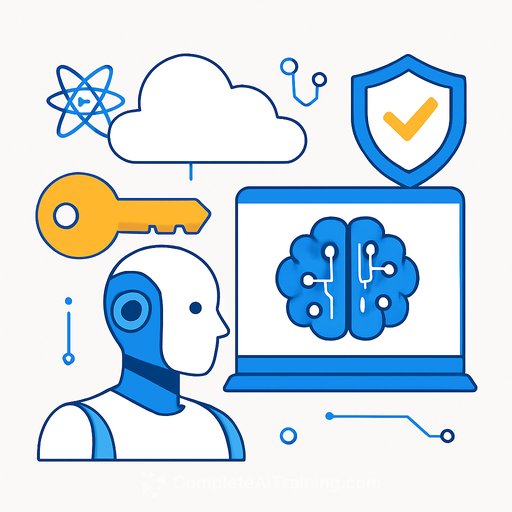
NHIs are digital workers. Each one pairs an identifier (a key, token, or cert) with permissions. Think passport plus entry stamps. They run jobs, pull data, and call services-without a person clicking anything.
The problem: they multiply fast, get forgotten, and live longer than they should. That creates blind spots, audit headaches, and breach risk.
The management gap (and how to close it)
Point tools like secret scanners catch exposed keys. Helpful, yes. Complete, no. You still need ownership, rotation, permission tuning, and clean decommissioning across cloud, CI/CD, and vendors.
A workable approach spans the full lifecycle:
- Discovery: Inventory every NHI across clouds, repos, CI/CD, and SaaS
- Classification: Label by sensitivity, environment, and owner
- Access: Enforce least privilege with time-bound and scoped permissions
- Secrets: Centralize storage, automate rotation, kill long-lived keys
- Monitoring: Baseline behavior, flag anomalies, trace usage to owners
- Decommission: Auto-expire, revoke on change, clean up artifacts
Context is the multiplier
Credentials are one layer; behavior is the tell. Who owns the identity? What systems does it touch? Is usage normal for this hour, repo, or subnet?
Context turns alerts into decisions. With it, you can block a suspicious call without halting a critical pipeline-and prove control during audits.
Where this matters most
- Financial services: Real-time tracing of service accounts that move money or access PII. Tight mapping to control families and audit trails.
- Healthcare: Enforced rotation, strong segmentation, and full lineage on machine access to PHI.
- DevOps: Automated secrets in CI/CD, short-lived credentials, faster releases without risky workarounds.
AI's role in cloud compliance
AI helps at scale where humans miss signals. It learns normal usage for each NHI, spots drift early, and triggers automated responses-quarantine, rotate, or revoke.
It also simplifies evidence. Continuous control tests, mapped to frameworks, with clean logs you can hand auditors without a war room.
From silos to one plan
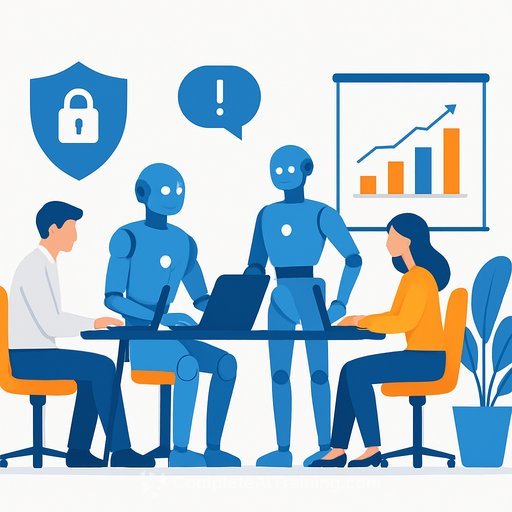
Security, DevOps, and data teams often work from different dashboards and priorities. NHIs cut across them all. Centralizing identity data and secrets policy gives everyone the same source of truth.
Assign owners, define SLAs, and wire alerts to the right queues. Fewer handoffs. Faster fixes.
An agile security model (that actually sticks)
Borrow the sprint mindset. Small control changes, frequent reviews, quick rollbacks if something breaks. Pair that with playbooks for incident response and disaster recovery tied to NHIs.
Your goal: ship security in increments, not giant policy drops that teams ignore.
The business case managers can stand behind
- Direct savings: Fewer manual checks, less custom glue code, less on-call firefighting
- Risk reduction: Lower breach probability and severity, smaller blast radius, proof for regulators
- Compliance efficiency: Continuous evidence instead of quarter-end scrambles
- Speed: Dev teams ship faster with safe defaults and pre-approved patterns
Track ROI with a simple model: avoided incident cost + hours saved + reduced audit prep time - platform and rollout spend.
Controls mapping (keep it simple)
- NIST CSF: Identify (asset inventory), Protect (least privilege, rotation), Detect (behavior analytics), Respond/Recover (playbooks and rollback)
- ISO 27001: Annex A controls on access, key management, supplier risk, and logging
- SOC 2: CC6/CC7 for access and monitoring, plus change management for CI/CD identities
For a shared language with auditors, the NIST Cybersecurity Framework is a safe anchor. Reference: NIST CSF.
Practical 30-60-90 plan
- First 30 days: Inventory NHIs and secrets. Tag owners. Flag long-lived keys. Set rotation targets.
- Days 31-60: Enforce least privilege on top 20% high-risk identities. Turn on auto-rotation for non-prod. Wire logs to your SIEM.
- Days 61-90: Baseline behavior. Enable anomaly alerts. Automate offboarding on repo/service decommission. Draft audit evidence pack.
KPIs that matter
- Orphaned NHIs: target near zero
- Secrets rotation coverage: 90%+ automated
- Mean time to revoke (MTTRv) on exposure: under 15 minutes
- Least-privilege compliance: 95% of NHIs meet role scopes
- False positive rate on anomaly alerts: under 10%
Common failure points to fix early
- Shared service accounts without owners
- Hardcoded secrets in CI/CD and IaC
- Long-lived access keys with admin rights
- 3rd-party integrations with unreviewed scopes
- Decommission lag-secrets and tokens left behind
AI pitfalls and guardrails
- Alert overload: Start with high-confidence detections, then expand
- Model drift: Retrain on fresh data; review thresholds monthly
- Explainability: Keep human-readable reasons in every alert for audit traceability
- Access boundaries: AI systems get the least access needed to analyze, nothing more
Looking ahead: crypto agility
Plan for post-quantum transitions with crypto agility: know where keys live, how they rotate, and how to swap algorithms without downtime. Keep an eye on standards from NIST's program on post-quantum cryptography: NIST PQC.
Tooling snapshot (use what you have first)
- Secrets managers: native cloud services or Vault, with short TTLs
- Cloud IAM: managed identities, scoped roles, just-in-time access
- Code & pipeline hygiene: prevent hardcoding, signed commits, secret scanning as a guardrail
- Telemetry: consolidate logs, tag every NHI to an owner and system
If you lead a team, here's the move
Set one owner for NHI and secrets policy. Fund lifecycle automation. Tie KPIs to bonuses. And review one dashboard weekly: coverage, risk, and time-to-fix.
Want your team sharper on AI and security ops? See the AI Learning Path for Network Engineers for practical, role-focused material.
Bottom line
AI makes cloud compliance more consistent and less manual-if you have clean identity data, tight controls, and clear ownership. NHIs are a core asset class now. Treat them with the same discipline you expect for finances and access to people.
Do that, and you cut risk, pass audits without the fire drill, and free teams to build.
Your membership also unlocks: