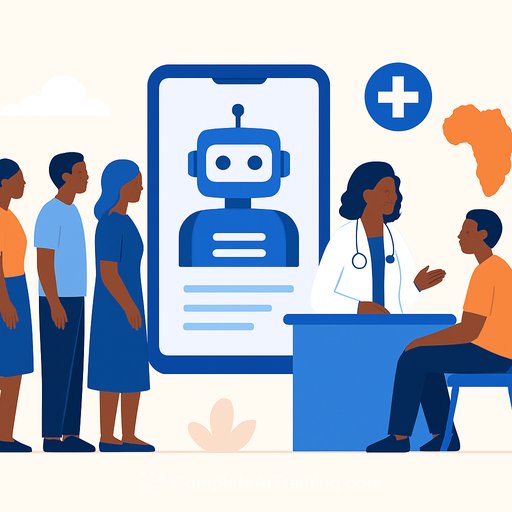
Primary healthcare of the future - putting people into the process through AI
Donor pullbacks and stop-start funding cycles have exposed a hard truth: we need primary healthcare (PHC) that works even when external support dips. That means services closer to where people live, simple digital self-care, and clinics focused on patients who truly need in-person time.
AI isn't the headline. It's the quiet helper. Used against real bottlenecks - staffing, queues, filing, refills - it can give health workers time back for the human work: trust, clinical judgement, and care.
What PHC is (and what it isn't)
Many people use "primary care" and "primary healthcare" as if they're the same. They aren't. PHC, per the World Health Organization, spans integrated services, multisector action, and empowered communities - not just clinic visits. It's where prevention, continuity, and community accountability meet.
For a clear reference on PHC's scope and principles, see the WHO overview: Primary Health Care.
Why the current PHC platform must adapt
Noncommunicable diseases keep rising while infectious diseases persist. New outbreaks will stress the same frontline. The first signals show up in PHC - that's where resilience must live.
Strengthening PHC isn't just bricks and mortar. Community systems, data loops, and simple, trusted tools matter as much as new buildings.
Take PHC beyond the clinic
People move through retailers, transport hubs, social grant queues, markets, and malls daily. Put basic, safe digital tools there - advice, screening, booking, and refills - and you reach millions before a waiting room fills up.
Do it in local languages, with offline options, and clear consent. Make it feel familiar, not foreign.
Where AI actually adds value across primary care
- First contact and access: Tele-triage, telemedicine, and WhatsApp/SMS booking that route urgent cases first and cut unnecessary visits.
- Continuity: Unique identifiers plus longitudinal records with consented reminders for appointments, refills, and key tests.
- Coordination and integration: Interoperable lab, pharmacy, and referral data to avoid duplicate tests and maintain care as people move.
- Comprehensive services: Embedded decision support for prevention, acute care, rehab, and palliation - the full PHC package.
- People-centred delivery: Co-designed tools, explainable outputs, offline-first where needed, and accessibility features so no group is left behind.
Mobile first, context first
Sub-Saharan Africa had over 500 million unique mobile subscribers in 2023 and is on track for far more by 2030. That's a massive channel for simple, safe health support.
Your phone can become your health helper - coach, reminder, and guide to the right level of care - in your language, with cultural nuance, and clear guardrails.
Digital self-care that lightens clinic load
Give people tools to help themselves safely. This increases agency and frees up clinical time for complex cases.
- HIV self-testing with auto-linkage to care, refill and side-effect bots, and proactive re-engagement.
- Home BP and glucose monitoring with clear escalation rules and fast callbacks for red flags.
- Contraception follow-ups and side-effect screening via SMS/WhatsApp.
- Antenatal prompts that nudge early booking, risk identification, and micronutrient adherence.
- Feedback channels so users report waiting times, stockouts, and service quality in real time.
- Community reporting for risks like unsafe water or food, feeding early surveillance.
Pair this with multi-month dispensing and community pick-ups so stable patients spend less time in queues.
Tools that help providers and managers
- Decision support: Point-of-care prompts aligned to national guidelines, with risk flags and early diagnosis aids.
- System integration: Linked lab, pharmacy, and referral records to cut duplication and keep care continuous across facilities and borders.
- Workforce planning: Predictive scheduling and deployment that match staff to demand across units and facilities.
- Data for action: Routine dashboards that highlight bottlenecks and trigger quick corrective steps.
Avoid the shiny-tools trap
Start with problems, not products. If a workflow tweak beats an algorithm, pick the tweak. Keep models simple unless complexity clearly earns its keep.
- Problem-first design and human-in-the-loop decisions.
- Equity and bias checks before and after deployment.
- Privacy-by-design and data minimisation.
- Offline-first usability in local languages.
- Open standards to avoid vendor lock-in (see HL7 FHIR).
- Pre/Post evaluation: wait times, file retrieval, ART pickup time, % on multi-month dispensing.
Practical metrics: time and touch
- Median file retrieval under 15 minutes.
- ART parcel collection under 30 minutes, as per guidelines.
- More stable PLHIV on 3-6 month refills and restoration of external pick-ups where feasible.
- Clear SOPs for abnormal result recall and rapid patient contact.
- Ongoing micro-learning for facility teams via WhatsApp to reinforce new workflows.
What South Africa should do next
- Use the national digital health strategy to define governance and ethical use of AI in PHC.
- Guarantee reliable connectivity for all facilities, with priority to rural clinics and hospitals.
- Deliver an interoperable EMR linked to lab and pharmacy systems with a single, universal patient identifier.
- Co-design tools with providers and users; pair roll-outs with structured change management.
- Train clinicians and patients with short, on-the-job modules (micro-learning via SMS/WhatsApp).
- Adopt a simple go/no-go checklist: problem-first, usability-first, equity-first, evidence-first, and realistic costs. Maintain a public register of algorithms in use.
Team skills: build readiness, then tools
Technology only sticks when teams know how to use it and why it matters. If you're leading a PHC team and need practical AI upskilling - workflows, prompts, safety, and governance - consider structured learning paths that match health roles.
AI courses by job role can help health managers and clinicians build the right skills without slowing operations.
Bottom line
AI and digital health should amplify the best of PHC, not replace people. Aim these tools at the friction points - waits, files, refills, staffing - and measure the basics. Do it in everyday spaces, in local languages, with trust baked in.
The result is simple: fewer queues and forms, more time for care - and a PHC system that's faster, fairer, and more human.
Your membership also unlocks: