Build a New Talent Architecture for the AI Era
AI isn't just changing the tasks on your org chart. It's rewriting who does the work, how teams assemble, and which capabilities matter. If you keep hiring for yesterday's roles and protecting rigid structures, AI will expose the gaps faster than you can fill them.
The shift is simple to say, harder to do: move from role-based thinking to skills-driven execution, and design for human-AI collaboration at the core of your people systems.
The Obsolescence of Traditional Talent Models
Functional silos and linear career ladders were built for stable job definitions. That world is gone. Marketing now needs data-savvy creatives who understand prompts and consumer psychology. Finance needs analysts who interrogate model outputs, not just build spreadsheets. Customer service needs conversation designers who train AI while handling nuanced escalations.
Static roles can't keep up with this pace. HR's job is to replace rigid hierarchies with fluid capability networks that shift as quickly as the tech does.
The Five Pillars of AI-Era Talent Architecture
1) Skills as the New Organizational Currency
Move from titles to capabilities. Don't hire a "Senior Marketing Manager." Map the stack you need: prompt engineering for genAI tools, data interpretation, AI ethics awareness, creative strategy, and channel fluency.
Build a living skills inventory that tracks current proficiency and adjacent skills. Stand up an internal talent marketplace that matches projects with capabilities in real time, cutting through departmental walls.
2) The Hybrid Human-AI Collaboration Layer
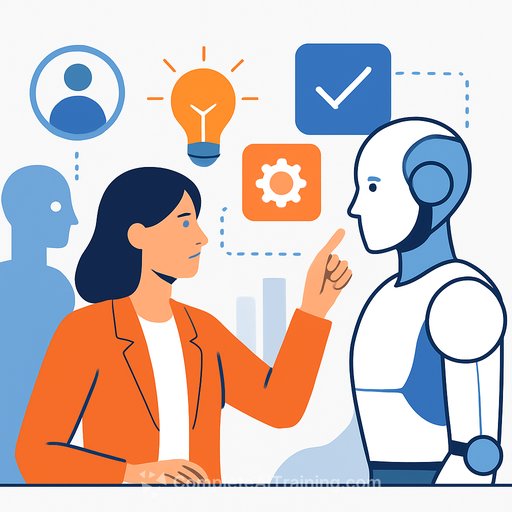
Stop treating AI as a tool on the side. Design workflows where humans and models amplify each other by default. Create roles that didn't exist five years ago and place them inside the business, not just in IT.
- AI Trainers: Improve model performance with feedback loops and edge case curation.
- Decision Architects: Define when AI recommends, when humans decide, and how escalation works.
- Ethics Monitors: Ensure systems align with values, compliance, and stakeholder expectations.
3) Continuous Learning as Infrastructure, Not Initiative
Skills now have short half-lives. Treat learning like always-on infrastructure embedded in the flow of work, not an annual event.
When an AI tool launches, push role-specific micro-learning the same day. Use performance analytics to surface skill gaps and auto-serve learning paths tied to real tasks and upcoming projects.
4) Organizational Fluidity Over Hierarchy
Pyramids optimize for control. AI environments need speed. Shift to network-based organizing where teams form and dissolve around specific opportunities and problems.
Run a dual operating system: a stable backbone for core operations and agile networks for AI-driven initiatives. Give employees a clear home base for belonging and development, with the freedom to plug their capabilities into high-impact work across the enterprise.
5) Human-Centric Roles and AI-Resistant Capabilities
As AI handles data-heavy tasks, advantage moves to what's deeply human: complex relationship building, ethical judgment under ambiguity, creative problem framing, and cross-cultural collaboration.
Make these explicit in your architecture. Build career paths that reward wisdom, context, and emotional intelligence alongside technical depth. The most valuable employees won't compete with AI-they'll know when to lean on it and when to override it.
Implementation: Turn Strategy into Operating Reality
- Rewrite job descriptions as capability profiles: Specify current skills plus adjacent capabilities that prepare talent for next-quarter demands.
- Adopt dynamic skills frameworks: Replace static requirements with proficiency levels, endorsements, and portfolio evidence.
- Redesign compensation and advancement: Reward verified skill acquisition, cross-functional impact, and deployment on priority projects-not time-in-seat.
- Invest in AI literacy for everyone: Baseline knowledge of capabilities, limits, and risks is business literacy. Start with use cases tied to each function.
- Build transparent skills visibility: Let employees see what skills power specific opportunities, assess themselves honestly, and access clear upskilling paths.
- Establish ethical guardrails: Implement governance, human oversight for consequential decisions, bias testing, and audit trails. Use benchmarks like the NIST AI Risk Management Framework.
For HR leaders shaping strategy and governance, see the AI Learning Path for CHROs. For hands-on implementation across recruiting, talent management, and analytics, the AI Learning Path for HR Managers can accelerate execution.
If you need data to align executives, the WEF Future of Jobs report outlines shifting skills demand and adoption timelines. Use it to prioritize your first wave of roles and capabilities.
The Competitive Imperative
Companies that keep hiring for static roles and bolt AI onto legacy structures will get outpaced by those that redesign their talent architecture end to end. The winners won't just have better models; they'll have systems where people and AI work seamlessly, where human strengths are amplified, and where teams reconfigure fast to seize opportunities.
Start small, move fast: pick one business unit, ship a skills inventory in 30 days, launch a pilot talent marketplace, wire your LXP to performance analytics, and define human-in-the-loop checkpoints. The question isn't if you need this architecture-it's whether you're building it fast enough.
Your membership also unlocks: