Conversational AI for Customer Experience: Intelligent Chatbots, Virtual Assistants, and Automated Service Resolution
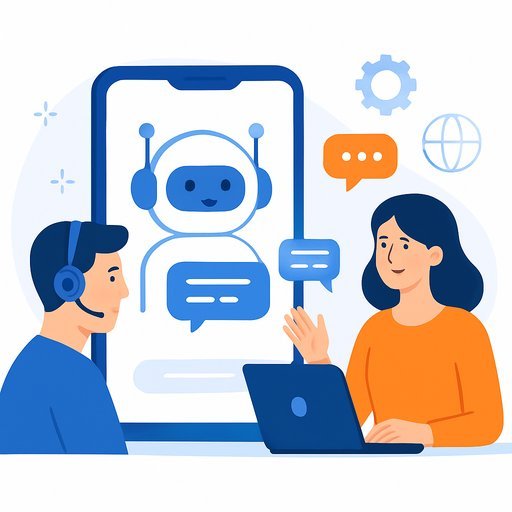
Support teams are moving from scripted bots to AI that can read intent, keep context, and resolve real issues without passing customers around. The payoff is tangible: 40-60% lower service costs, 35% better first-contact resolution, 25% higher CSAT on automated interactions, and 24/7 coverage with no wait times.
This isn't about replacing people. It's about removing repetitive work, clearing queues, and giving agents time for tricky, high-stakes cases. Below is a practical playbook to deploy, measure, and improve conversational AI across your support operation.
From Rule-Based Bots to LLM-Powered Assistants
First-gen chatbots matched keywords to scripts and broke the moment a customer stepped off the path. Second-gen systems added NLP to parse phrasing but still struggled to keep context over multiple turns.
Now, transformer-based large language models can keep long conversations coherent, generate helpful replies (not just pick templates), and mirror a customer's tone. The CSAT gap versus human agents has narrowed to within 5-10% for many use cases.
What This Means for Support Operations
- Higher containment: more issues resolved without human handoff.
- Better FCR and lower handle time through precise intent and smarter follow-ups.
- Unified journeys: move from product questions to pricing to scheduling in one continuous flow.
- Always-on coverage across regions and channels, without queue buildup.
NLU and Intent: Read What Customers Mean, Not Just What They Say
Modern NLU breaks a message into structure, entities (orders, dates, products), intent, and sentiment. It can spot compound intents like "I need to return this and when is the new model out?" and handle both in a single thread.
Context is the difference-maker. If a customer asks "What about the blue one?" the system links it to the product mentioned earlier. With profile data, it can also apply tiered treatment-expedited options for premium customers, for example.
Dialogue Management and Conversation Design
Reliable support uses a hybrid approach: rules for transactions (returns, refunds, authentication) plus generation for open questions (troubleshooting, explanations). The result is predictable execution with natural language where it matters.
Good conversation design shows empathy first, then moves into concise diagnostics and clear next steps. Tone should match your brand-formal for high-touch luxury, casual for lifestyle. Design once, measure, then refine.
Channel switching should be seamless. Start on web chat at lunch, continue on WhatsApp later-the context, diagnostics, and prior steps should carry over. Teams that nail this see 30% higher CSAT and 25% more completed conversations.
Knowledge and Response Quality
Great answers come from great knowledge. Blend structured data (catalogs, policies), unstructured content (articles, guides), and live data (orders, inventory). Retrieval-augmented generation lets the assistant pull the right snippets at runtime and respond with current facts.
Accuracy beats eloquence. Use grounding in verified sources, confidence scoring with human escalation at low confidence, and validation layers that check facts before replying. For background on RAG, see retrieval-augmented generation (RAG), and for model architecture, Transformers.
Proactive Support That Prevents Tickets
Don't wait for the customer to complain. Trigger conversations when signals show risk or opportunity: delayed shipments, renewal windows, onboarding milestones, or repeated product-page visits tied to support histories.
Proactive messages-done with consent and clear value-drive 3-5x higher engagement than passive widgets. Keep it helpful: surface status, suggest quick fixes, or offer to schedule a call when needed.
Your 90-Day Implementation Playbook
- Pick high-yield use cases: order status, returns, password/account help, basic troubleshooting, appointment changes.
- Map intents and outcomes: define success criteria, required data, edge cases, and escalation rules.
- Connect systems: CRM, order management, knowledge base, identity/auth. Read + write where safe to enable end-to-end resolution.
- Design flows: empathetic openings, concise prompts, smart confirmations, and clear wrap-ups with transcripts.
- Ground responses: implement RAG, citations or internal references, and confidence thresholds with human fallback.
- Train and test: use real transcripts for training; red-team for ambiguous phrasing, accents, slang, and multi-intent messages.
- Pilot and iterate: soft-launch on one channel and time window; review failures daily; ship fixes weekly.
Metrics That Matter
- First-contact resolution (FCR): target +20-35% improvement with mature flows.
- Containment rate: % of conversations resolved without human handoff.
- CSAT (bot vs. human): aim for within 5-10% of human scores.
- Average handle time (AHT): track both bot-only and hybrid handoffs.
- Time to resolution: end-to-end speed across channels.
- Escalation quality: did the agent get full context, steps tried, and customer sentiment?
- Model confidence and override rate: low confidence should trigger grounding, clarification, or handoff.
Governance, Safety, and Handoffs
- Privacy: redact PII in logs, enforce data retention, and respect channel-specific consent rules.
- Guardrails: block unsafe actions, limit scope by channel, and whitelist API actions.
- Auditability: store prompts, retrieved sources, and decisions for QA and compliance.
- Human-in-the-loop: clear, fast escalation with full transcript and next best actions suggested to agents.
- Feedback loops: train on thumbs-downs, escalations, and unresolved intents weekly.
What's Next: Multimodal, Voice, and Autonomous Actions
Multimodal support brings images and video into the same thread. A customer can share a photo of a damaged item and get instant verification plus a pre-filled return label.
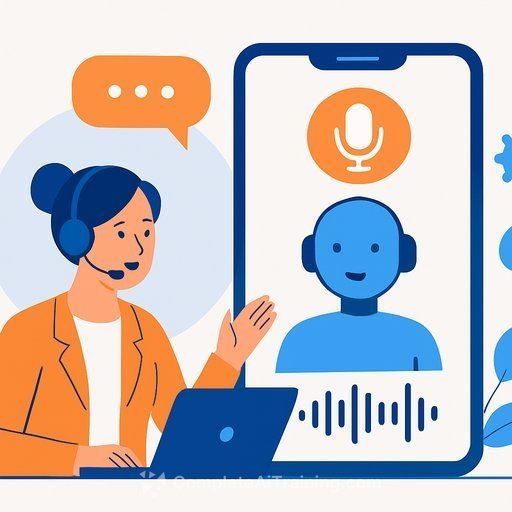
Voice-first assistants will handle calls, cars, and speakers where typing is a pain. Autonomous agents are starting to act on behalf of customers-process returns, modify subscriptions, schedule visits-inside the chat, with auditable approvals.
Start Small, Solve Real Problems, Then Scale
Pick one or two high-volume issues, wire up the data, and ship. Prove resolution at quality, expand channels, then add actions that close the loop without human effort.
If you're planning rollout or upskilling a team, this resource can help: AI Learning Path for Call Center Supervisors.
Your membership also unlocks: