AI's Real Impact on Supply Chains: Stronger Frontlines, Fewer Dashboards
- Frontline workers are becoming strategic assets. Their effectiveness determines throughput, service, and resilience.
- AI is shifting from reports to action-management by exception is replacing dashboard overload.
- Upskilling is the unlock. Without training and workflow integration, tech won't move the needle.
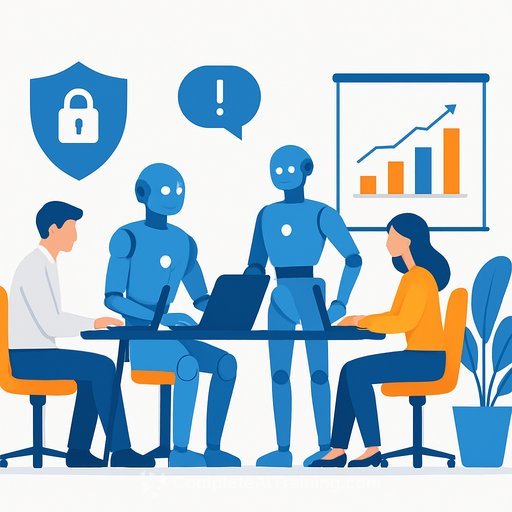
- Human-in-the-loop systems reduce friction, speed onboarding, and keep judgment where it belongs-with people.
For years, the conversation focused on automation and robotics. Today, the edge has moved to people. Warehouse associates, drivers, planners, and operators sit where labor shortages meet omnichannel pressure and rising operational complexity.
The takeaway for leaders: technology must serve the worker, not drown them in data. AI helps-when it narrows attention to what matters and guides the next best action.
From data overload to exception-based execution
Early digital programs pushed dashboards to managers and hoped for better decisions. The result was noise. The message from operations was clear: "Tell me only when something's off."
That's where AI fits. It learns normal patterns, flags anomalies, and routes them to the right person at the right moment. Less scrolling. More action. Faster recovery.
Technology alone won't lift productivity
Systems can see signals in real time. Results depend on whether people can act on them. The gap is skills, workflow fit, and clarity on "what now."
One example: Honeywell's Performance+ for Guided Work blends voice-directed tasks with analytics so supervisors can reassign labor mid-shift, fix bottlenecks, and close the loop without waiting for end-of-day reports. Hands stay free. Data gets captured at the point of work.
Why the frontline is now a core strategy
Turnover stays high. Seasonal hiring is constant. Skill variance is real. If you don't make the job simpler and the path to productivity shorter, you pay for it in delays, errors, and churn.
Voice-led workflows, multilingual speech recognition, and quick incident reporting reduce friction and keep the floor moving. That's execution advantage-not theory.
AI as an engine for upskilling
AI compresses time-to-productivity. New hires can approach the output of experienced staff when answers are embedded in the flow of work: "What do I do when I'm out of wrap at this station?" Ask. Get the procedure. Move on.
This isn't replacing judgment. It's capturing institutional knowledge and making it available on demand so people can do the job right the first time.
Close the loop or lose the value
Insight without action is waste. Closed-loop execution turns observations into tasks, prioritizes work, and gets confirmation-or escalation-fast.
Your autonomy level is a choice. Some teams keep human confirmation steps; others auto-assign low-risk work. Either way, clarity wins: workers know what needs attention, managers step in only where judgment is required.
What good looks like: a 90-day management plan
- Week 1-2: Map frontline workflows. Identify 5-10 common exceptions that stall work (out-of-stock at pack stations, damaged totes, missing equipment).
- Week 3-4: Pilot exception alerts. Start with two roles (picker, supervisor). Route anomalies to a single source of truth with clear next steps.
- Week 5-6: Layer voice guidance. Standardize procedures for the top tasks. Capture data at the moment of work (hands-free where possible).
- Week 7-8: Activate coaching prompts. Provide micro-instructions for new hires on day one. Reduce shadowing time.
- Week 9-10: Implement closed-loop tasks. Auto-generate work orders for routine fixes; require human review only for high-risk items.
- Week 11-12: Review metrics live during shifts. Adjust labor in real time. Kill reports that no one uses.
Metrics that matter
- Time-to-productivity for new hires (days to reach 90% of target)
- Exceptions detected and resolved in-shift (rate and median time)
- Reassignments made mid-shift (and their impact on throughput)
- Pick/pack accuracy and distance traveled per task
- Supervisor span of control (with no drop in output or quality)
- Frontline engagement and retention (30/90-day stick rate)
Industry context
Macro forces-AI, automation, workforce change, visibility demands, cybersecurity, and climate risk-are reshaping operating priorities. Execution excellence now sits next to visibility and resilience on the leadership agenda.
For a broader view on 2026 trends, see industry resources from ASCM.
Practical guardrails for leaders
- Design for exceptions first. Treat alerts and actions as the "product." Consider targeted playbook and workflow design training via AI Design Courses.
- Keep humans in the loop. AI recommends; people decide where risk is non-trivial.
- Train in the flow of work. Replace classroom time with on-the-job guidance.
- Measure during the shift. If you can't act on it now, question why you track it.
- Prioritize language accessibility. Support accents and multiple languages natively.
FAQs
Q: Why are frontline workers gaining strategic importance with AI?
A: They execute in real time where constraints bite. AI only delivers value if the people on the floor can act fast, accurately, and consistently.
Q: What is "management by exception" in operations?
A: Systems monitor what's normal, surface anomalies, and notify only when action is needed. That reduces noise and speeds response.
Q: How does AI support upskilling?
A: It embeds know-how into workflows, answers procedural questions on demand, and guides tasks step by step-shortening ramp time for new or temporary workers.
Q: Is AI replacing frontline roles?
A: No. The effective model is human-in-the-loop. AI detects, prioritizes, and suggests. People make calls where judgment and context matter.
Bottom line for management
Treat the frontline as a strategic lever. Use AI to cut noise, surface exceptions, and guide the next action. Pair it with training in the flow of work and closed-loop execution. In uncertain conditions with tight labor, this is durable advantage.
If you're updating training paths for managers and frontline roles, explore role-specific AI learning here: AI Productivity Courses.
Your membership also unlocks: