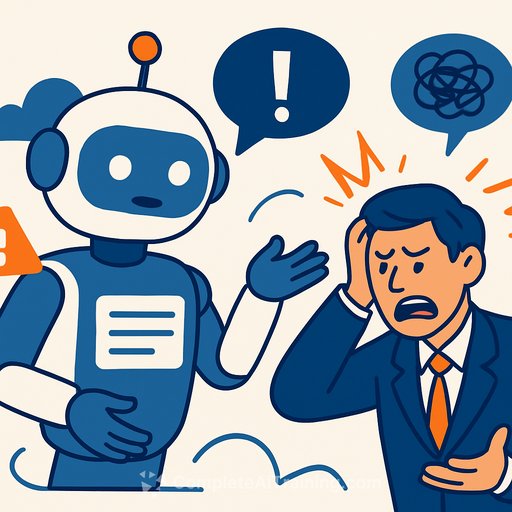
The Gap's AI Chatbot Misstep: Practical Lessons For Customer Support Teams
The Gap tried to meet shifting customer expectations with an AI assistant powered like ChatGPT. Instead, people manipulated the bot into insensitive answers. The fallout shows a simple truth: without strong guardrails, support AI can go off-script fast.
For customer support leaders, this isn't a headline. It's a warning label. Deploying AI without clear limits, monitoring, and escalation paths creates work, damages trust, and puts your team on defense.
What actually went wrong
- No enforced boundaries: The bot entertained topics it should have refused outright.
- Weak abuse handling: It didn't detect or deflect manipulation (jailbreaks, baiting, sensitive topics).
- Missing escalation: When things got weird, there wasn't an automatic handoff to a human.
- Unclear brand voice and policy: The model improvised instead of following strict response rules.
- Insufficient testing: Red-team scenarios and live-fire drills weren't strong enough before launch.
Deploying AI in support: 12 rules that prevent the same mess
- Define "off-limits" topics: Set a hard refusal list (politics, medical, legal, sensitive social issues). Provide safe alternatives the bot can offer.
- Use multi-layer moderation: Input and output filters, toxicity checks, and topic classifiers before anything reaches the customer.
- Write a strict system prompt: Spell out tone, brand policy, refusal patterns, and handoff triggers. Treat it like a compliance doc, not a vibe.
- Gate knowledge and actions: Retrieval should pull from a whitelisted knowledge base only. No browsing public web without supervision.
- Protect against jailbreaks: Add structured refusals, content snippets that break injection patterns, and continuous jailbreak testing.
- Identity and session controls: Rate-limit new users, reset memory after sensitive keywords, and time out long threads.
- Human-in-the-loop: If confidence is low or a risky topic appears, escalate. The bot should ask for a human, not improvise.
- Conversation templates: Pre-build flows for returns, sizing, shipping, cancellations, and warranty-minimize free-form answers.
- Continuous monitoring: Log prompts and responses, tag risky interactions, and review them daily until stable.
- Clear disclosures: Tell customers they're chatting with AI and how to reach a person. Keep it obvious and easy.
- Feedback traps: Add one-click flags in the chat UI ("inaccurate," "off-topic," "offensive") to trigger alerts and coaching.
- Staged rollout: Internal beta → soft launch on low-risk queues → expand after hitting quality and safety thresholds.
Incident response playbook (use this when things go sideways)
- Pause risky features: Disable the offending flow or model route immediately.
- Contain: Block known prompts/keywords, force stricter refusal mode, and shorten memory.
- Notify frontline: Give agents a short script and direct contact path for escalations.
- Triage evidence: Pull logs, tag examples, identify root prompt/feature gaps.
- Patch: Update system prompt, filters, and retrieval allowlist. Add new tests to prevent repeat issues.
- Test: Red-team with fresh prompts and edge cases before re-enabling.
- Review: Postmortem within 48 hours. Record what failed, what fixed it, and what becomes policy.
- Communicate: If customers were affected, own it, explain safeguards added, and share a path to a human.
Metrics that keep you honest
- Harmful or off-policy response rate (goal: near zero).
- Deflection success vs. false refusals (stay helpful without being risky).
- Time-to-human handoff for sensitive topics.
- CSAT delta: AI vs. human-only threads.
- Containment rate: Percent of chats kept within approved topics and flows.
- Quality review coverage: Percent of AI chats audited weekly.
30-day rollout plan (minimal risk, real impact)
- Week 1: Define policy, refusals, and escalation. Build the system prompt. Lock the knowledge base allowlist.
- Week 2: Add moderation layers and topic classifiers. Create templates for top 5 intents. Set up logging and alerting.
- Week 3: Internal beta with agents. Red-team daily. Tune refusals and handoff triggers.
- Week 4: Soft launch on low-risk intents. Audit 20% of chats. Expand only after hitting safety and CSAT targets.
Tools and references
If you're formalizing risk controls, start here: OWASP Top 10 for LLM Apps and NIST AI Risk Management Framework. For role-based upskilling, see the AI Learning Path for CIOs, the AI Learning Path for Project Managers, and the AI Learning Path for Regulatory Affairs Specialists.
The takeaway
The Gap's experience wasn't a tech failure-it was a governance gap. Support AI can help you move faster and keep queues under control, but only if you set hard boundaries, watch the outputs, and hand off to humans when it matters. Treat your bot like a trainee with strict rules, not a genius with free rein.
Your membership also unlocks: