
AI news ·
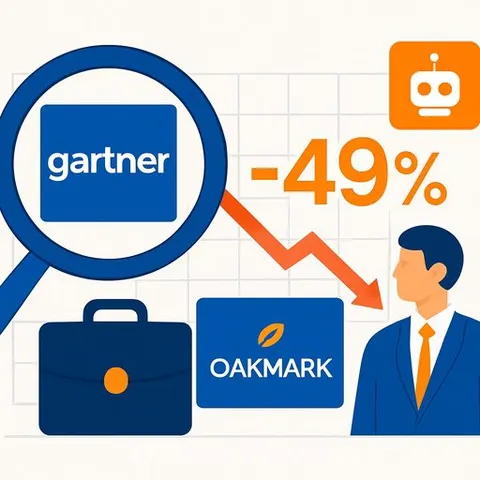
Gartner shares trade at possible 49% discount after Oakmark stake and AI event draw fresh attention
Gartner stock has dropped 61.3% over the past year, yet analysts peg fair value at $190.46 against a recent close of $155.53. The gap raises a pointed question: bargain or warning sign?
Gartner Stock Faces Valuation Question Amid Fund Interest and AI Finance Push
Gartner (NYSE: IT) has drawn fresh investor attention after Oakmark Select Fund disclosed a new position and the company promoted its AI-focused Finance Symposium/Xpo 2026 in London. The timing highlights the research firm's role in enterprise technology discussions, but the stock's recent performance tells a different story.
Share price momentum has weakened considerably. The stock fell 32.6% over 90 days and 61.3% over the past year, leaving analysts and investors to assess whether the decline reflects genuine mispricing or justified market skepticism.
The Bull Case: 18.3% Upside
The most widely followed valuation narrative puts fair value at $190.46 per share, compared to a recent close of $155.53. This implies the stock trades at a 48.8% discount to intrinsic value estimates.
The thesis rests on three pillars: rising enterprise demand for Gartner's proprietary insights as companies navigate AI adoption, digital transformation, and cybersecurity; recurring subscription revenue that supports margin expansion; and an earnings multiple that could expand as the company executes on growth.
Enterprise adoption of AI and complex IT strategies is accelerating across industries. Gartner's clients seek trusted guidance for mission-critical decisions, which could drive long-term revenue acceleration if the company maintains its research quality and client relationships.
Where the Story Could Break
Two risks could undermine this narrative. Generative AI tools could erode demand for paid research if companies find alternative ways to assess technology decisions. Prolonged corporate cost-cutting could also pressure contract growth and renewal rates.
The company's balance sheet and debt profile also warrant scrutiny, particularly if market sentiment shifts and investors demand higher returns for perceived risk.
The Valuation Puzzle
Gartner's P/E ratio of 14.4x sits near peer levels at 14x but well below the US IT industry average of 21.3x and the 27.5x multiple that fundamental analysis suggests is fair.
This gap signals either a margin of safety or a market unconvinced about earnings quality. The question for finance leaders evaluating Gartner as a vendor or investment is whether the discount reflects temporary weakness or structural headwinds.
For finance professionals tracking enterprise AI adoption and vendor performance, understanding AI for Finance trends and their impact on research and advisory services is essential. Those in financial leadership roles may find value in an AI Learning Path for CFOs to assess how these tools affect vendor selection and internal decision-making.
The numbers point to competing interpretations. Test your own thesis against the two primary opportunities-revenue acceleration and margin expansion-and the two key risks: demand dilution from AI tools and persistent corporate spending constraints.