Generative AI in Finance: The Ultimate Guide for Customer Support and Operations
Generative AI is moving from pilot projects into real workflows across banking and fintech. Teams are using it to cut friction in service, risk review, and internal documentation without changing how financial decisions are made.
In a global survey of 424 senior financial services leaders, 77% reported investing in data analytics and AI-driven insights. Only 11% have fully implemented generative AI, but another 43% are actively rolling it out. That shift signals real deployment, not just experiments.
Key takeaways
- Adoption is underway across customer service, risk, and internal operations.
- The biggest gains come from supporting people's work, not replacing human judgment.
- Customer experience improves when accuracy is high and human escalation is clear.
- Accuracy and regulatory compliance are the main barriers to scale.
- A strong framework is essential for responsible use.
What is generative AI in the finance industry?
Generative AI produces responses based on patterns learned from data. In financial services, it's most useful for language-heavy work: summarizing documents, interpreting information, and extracting insights from messy or scattered content.
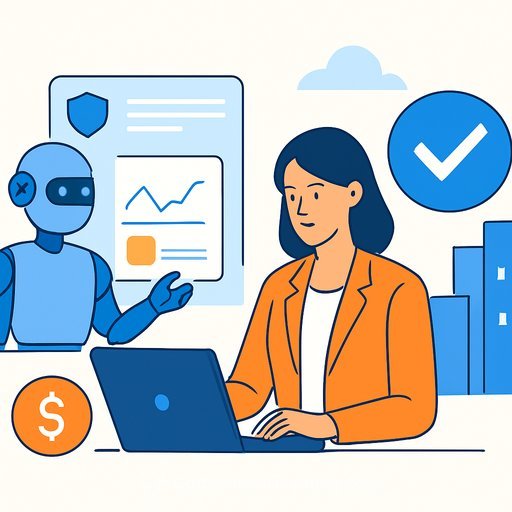
It typically sits alongside core systems. Agents, analysts, and compliance teams use it within existing platforms to reduce manual effort, while final decisions stay with people-especially for customer-impacting outcomes.
How generative AI works in financial environments
- Controlled data access: Models don't train on raw customer data. They retrieve approved information at query time to limit exposure.
- Workflow integration: Embedded into service desks, risk tools, and compliance workflows-not a standalone chatbox.
- Human-in-the-loop: Employees review outputs before they reach customers or influence decisions.
- Monitoring and auditability: Usage and quality are tracked to meet regulatory expectations.
- Gradual rollout: Start with low-risk internal use cases, then expand.
Everyday examples of generative AI in financial services
- Customer service: Draft responses, summarize prior interactions, and surface relevant account details for agents.
- Fraud and risk investigations: Summarize transaction patterns and alerts to support analyst review.
- Personalized insights: Translate activity and spending data into clear explanations customers can act on.
- Compliance support: Summarize regulatory updates and assist with policies, procedures, and guidance.
- Internal productivity: Reporting, knowledge search, documentation, and IT workflows.
Across these use cases, generative AI acts as an insights layer. People make the final call.
How generative AI affects customer experience
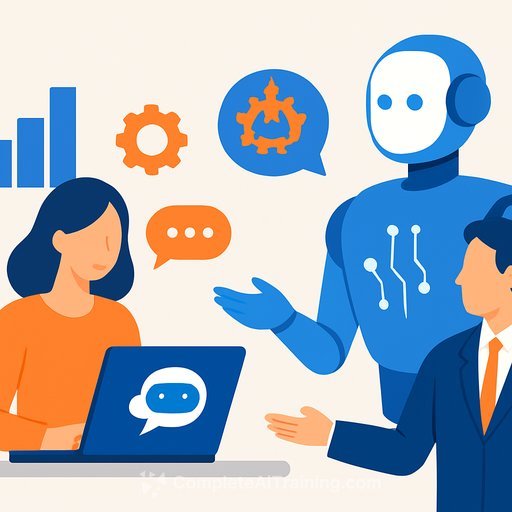
Done well, AI assistance speeds up responses, improves consistency, and makes complex topics easier to explain. Agents get context faster and draft clearer replies, which shortens resolution times.
Errors break trust quickly. Institutions often limit AI to drafting and summarization while keeping humans responsible for final communication. Clear disclosure and easy escalation to a person help customers feel confident.
Customer experience wins come from accuracy, transparency, and fast access to a human when needed.
Risks and limitations
- Accuracy and hallucinations: Confident but wrong answers cause confusion, compliance issues, and brand damage. Human review is essential.
- Data privacy and security: Sensitive information requires strict controls to prevent leakage and violations.
- Regulatory complexity: Auditing and explaining AI outputs requires documentation and oversight.
- Overreliance: Teams may trust AI too quickly. Policy and training keep controls intact.
Governance and oversight
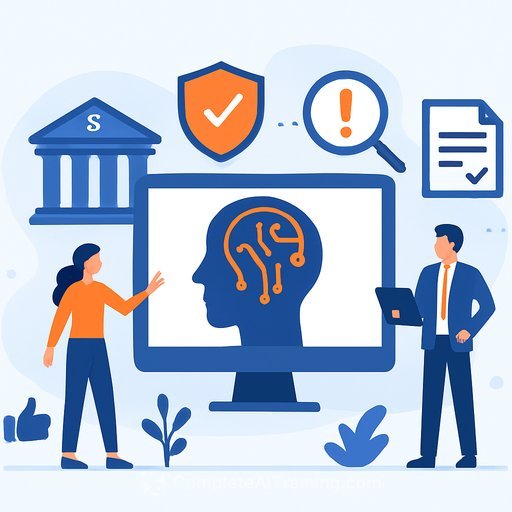
Effective oversight rests on three pillars: control, accountability, and transparency.
- Control: Define where AI can and cannot be used. Keep it out of high-impact determinations (credit, fraud actions) and use it for support tasks.
- Accountability: Humans review and approve outputs before anything affects customers or decisions.
- Transparency: Log usage, monitor output quality, and document data access for audits.
For structure, many teams reference frameworks such as the NIST AI Risk Management Framework and model risk guidance like the Fed's SR 11-7.
How to evaluate generative AI solutions
- Data handling and privacy: How data is accessed, stored, and protected; whether models train on customer data.
- Governance and controls: Human approval steps, usage restrictions, and policy enforcement.
- Transparency and explainability: Audit trails, source citations, and documentation quality.
- Integration: Fit with CRM, case management, risk tooling, and compliance systems.
- Security: Monitoring, incident response, and vendor security posture.
- Regulatory alignment: Support for evidence, reporting, and audits.
- Vendor accountability: Clear responsibility for model behavior, updates, and risk management.
Getting started: a practical path
- Pick low-risk internal use cases: document summarization, knowledge search, reporting assistance.
- Set guardrails first: acceptable use policies, human approval steps, logging, and QA checks.
- Involve compliance, security, legal, and operations early to align with existing controls.
- Measure outcomes: accuracy, time saved, escalation rates, customer sentiment.
- Scale gradually once performance is consistent and oversight is proven.
What's next for generative AI in financial services
Expect deeper use in decision support, not automated decisions. Internal productivity, customer support assistance, compliance documentation, and risk analysis will keep leading as controls mature.
Regulatory guidance will get more specific. Institutions will need to show how AI influences workflows and interactions, with clear accountability and auditability.
Over time, AI will feel like another layer in the tech stack-standardized, measured, and governed. Teams that invest early in process discipline will adapt faster as capabilities and rules evolve.
Examples of adoption across banking and fintech platforms
Mercury: For digital-first businesses
Focuses on automation, APIs, and integrations built for startups. AI-adjacent workflows (categorization, workflow assistance) reduce manual effort even when the label isn't "generative."
U.S. Bank: For enterprise and commercial operations
Publicly emphasizes AI to improve treasury, payments, and corporate banking efficiency. A measured approach that prioritizes analysis and client service under tight controls.
Chase: For business owners who want scale with governance
Invests in research and internal AI use to improve productivity and research support. Signals modernization with strong risk management.
Novo: For small businesses and entrepreneurs
Online banking built for simple financial operations with automation-friendly tools and integrations. AI supports streamlined workflows without replacing core decisions.
FAQs
Is generative AI safe to use in financial services?
Yes-when paired with strict data controls and human oversight. Most teams keep it in support roles like summarization, drafting, and analysis.
Can generative AI make lending or fraud decisions on its own?
Generally, no. High-impact actions require human approval. AI assists by organizing information and highlighting patterns.
How is generative AI different from traditional AI in banking?
Traditional AI uses rules or predictive models for specific tasks (fraud scoring, credit risk). Generative AI creates content and works well with unstructured data and knowledge tasks.
What are the biggest risks?
Inaccurate outputs, data privacy concerns, regulatory exposure, and overreliance. That's why governance, training, and review steps are non-negotiable.
Should institutions build or buy?
It depends on control needs and constraints. Some build for tight integration and oversight; others use vetted vendors that meet security and compliance standards.
How should teams get started?
Start small with internal use cases, set guardrails, measure results, then scale. Keep humans in the loop.
Level up your team's AI skill set
If you're building skills for leadership and finance teams, consider the AI Learning Path for CFOs, the AI Learning Path for Vice Presidents of Finance, or the AI Learning Path for Finance Managers. For practical tools and vendor comparisons, see AI tools for finance.
Your membership also unlocks: