
AI news ·
Generative AI shifts music and image creation from specialized skill to anyone's prompt
Suno users generated roughly 7 million AI songs per day in late 2025, and 97% of listeners can't tell them apart from human-made tracks. When anyone can create anything instantly, the scarce skill becomes judgment-not production.
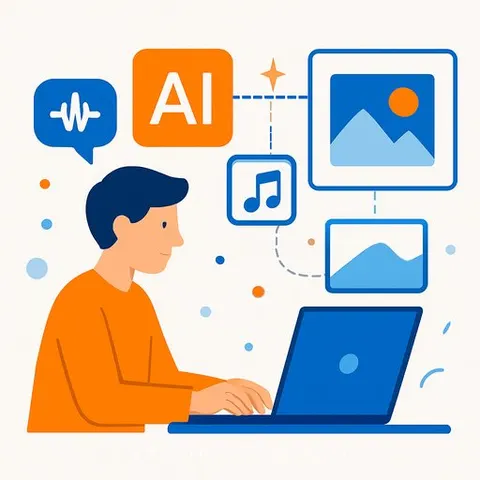
Anyone Can Create Anything Now. That Changes Everything for Creatives.
Generative AI has collapsed the gap between imagination and execution. In late 2025, users of Suno-an AI music platform-created roughly 7 million songs per day, a pace that generates the entire Spotify catalog every two weeks. A recent Deezer study found that 97 percent of listeners cannot distinguish AI-generated songs from human-made music.
This is not about distribution anymore. The wired generation disrupted gatekeepers like record labels and radio programmers by making music portable and shareable. Generative AI goes further: it disrupts creation itself.
The Shift From Scarcity to Abundance
Sixteen years ago, music production required specialized knowledge, equipment, and studio access. Today, anyone with a phone can generate any song they imagine using Suno or Udio. Some AI-generated songs have climbed the Billboard charts.
The same pattern holds across creative fields. An art professor using image generation tools created thousands of images until his imagination ran dry. Video creators use Midjourney to generate footage of any place or person. Podcast creators use Google's Notebook LM to produce radio-quality discussions from research documents.
Generative art tools now function like on-demand services for creative output. Production is no longer the bottleneck.
The New Constraint: Taste and Judgment
When production becomes effortless, what matters changes. A financial services firm using AI coding tools saw its output jump from 25,000 lines of code per month to 250,000 almost overnight. The result was not productivity gains-it was a backlog of 1 million lines waiting for review.
The hard part shifted from making to deciding. What code is correct? What image serves the project? Which song resonates with an audience?
This mirrors what happened with music streaming. It took years after Spotify's launch for critics to fully understand how on-demand playlists changed listening habits and artist economics. We're only three years into the ChatGPT era. The full impact of generative creation tools remains unclear.
Imagination as a Competitive Edge
Consider what a designer with taste and agency could do with current tools. Give them Gemini's image model, ChatGPT Pro, and Claude Code. They could generate visuals, write copy, and build websites-potentially moving from idea to product in days instead of months.
The constraint is not technical skill anymore. It's domain knowledge, taste, and the ability to evaluate what matters. These are human judgments that AI cannot make.
AI for creatives now functions like a personal studio, research team, and coding partner combined. The question is what you do with that capacity.
What Gets Lost When Creation Is Free
Abundance creates its own problem: signal versus noise. Millions of AI songs flood TikTok daily. Most disappear. Without the friction of production-the time, cost, and effort-how do creators develop judgment?
Deliberate practice typically requires thousands of hours of work. If generation is instant, how do creatives build the intuition that separates meaningful work from filler?
The answer may lie in curation and audience response. A song either resonates or it doesn't. An image either communicates or it fails. The algorithm and audience become the filter that scarcity once provided.
The Real AGI Question
Tech executives and researchers debate whether artificial general intelligence has arrived. Most definitions focus on task completion and model intelligence. A better measure might be what these tools enable humans to do.
Someone with ten thousand hours of deliberate practice in their field, combined with current AI tools, operates at a level that would have seemed impossible five years ago. That person can now generate, test, and iterate at speeds that compress years of work into months.
The question is not whether machines think like humans. It's whether humans with AI tools can imagine and build things that matter-and whether they can do it faster than anyone could before.