
AI news ·
German court rules Google is responsible for false AI search summaries
A German court ruled Google's AI Overviews are the company's own speech, making it liable for false claims. The decision, which orders Google to pay 80% of legal costs, could reshape AI liability debates worldwide.
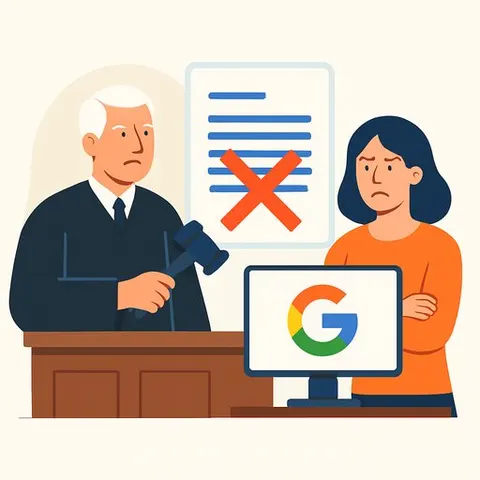
A German court has ruled that Google's AI-generated search summaries are the company's own speech, not a neutral reflection of third-party websites. The preliminary injunction, issued May 28 by the Regional Court of Munich, means Google is legally responsible when its AI Overviews produce false claims-a decision that could influence liability debates far beyond Europe.
What the court decided
The case involved two Munich publishers, Verlagshaus24 and GeraMond Verlag. Google's AI Overview falsely linked them to scams, subscription traps, and "dubious business practices." Those connections did not appear in the sources the AI cited. The system had confused the publishers with unrelated companies and presented the mix-up as fact.
The court reclassified the summaries as Google's own content. The ruling described them as "independent, new, and substantive statements" that Google generated itself. Since Google built the system and controls the algorithm, it owns what comes out of it. Google argued that users could click through to source links and verify the information themselves. The court rejected that reasoning, noting that if you make a false statement, you remain responsible even if others can fact-check you later. Pew Research data shows users click through to sources only 1% of the time when an AI Overview appears.
Google must stop spreading the false claims and pay 80% of the legal costs. A Google spokesperson told Android Authority the company is reviewing the decision and plans to appeal, adding that AI Overviews are "designed to reflect the information that exists on the web" and that the large majority of answers are accurate.
Why U.S. law hasn't caught up
Section 230 of the Communications Decency Act, passed in 1996, protects online platforms from being treated as the publisher of content others post. The law lets search engines and social networks avoid liability for user-generated material. Whether Section 230 covers what an AI tool generates on its own remains an open question that U.S. courts have not settled.
Even the law's authors say it doesn't stretch that far. Senator Ron Wyden and former Representative Chris Cox, who wrote Section 230, argued in a 2023 essay that it "does not protect anyone who creates or develops content." By their definition, a generative AI creates content.
The closest U.S. case went the other direction. Radio host Mark Walters sued OpenAI after ChatGPT falsely claimed he had embezzled money from a gun-rights group. In May 2025, Judge Tracie Cason of the Superior Court of Gwinnett County, Georgia, granted OpenAI summary judgment. But the ruling was narrow. The judge did not declare OpenAI automatically protected from its AI's mistakes. She dismissed the case on standard defamation grounds: the journalist who saw the false claim knew it was wrong, OpenAI's disclaimers flagged the risk, and Walters could not prove actual harm. No U.S. court has gone as far as the German one in treating AI output as the company's own words.
What this means when AI handles money decisions
The question stops being theoretical the moment someone uses AI for a financial decision. A TD Bank survey published in March found that 78% of Americans use AI tools. The share using AI to manage personal finances jumped from 10% a year earlier to 55%. Another 62% said they are comfortable using AI for budgeting.
Only 18% said they would trust AI to make a financial recommendation on its own. That caution is warranted. AI summaries and chatbots get things wrong, and when they do, the errors sound convincing. A wrong answer looks identical to a correct one. If an AI summary gives you the wrong tax deadline, the wrong fund fee, or tells you a company is legitimate when it is actually a scam, the loss is yours. No U.S. court has clearly said anyone else must cover it.
Why this matters for legal professionals
The Munich ruling draws a bright line that U.S. courts have so far avoided: when a company deploys a generative AI system, it owns the output. For lawyers advising clients who build or use these tools, the liability exposure is shifting. Section 230's shield looks increasingly thin when the machine, not a user, generates the content. Until a U.S. court addresses the question directly, clients operating in both jurisdictions face asymmetric risk. The German decision also provides a framework that plaintiffs' attorneys may cite in future defamation or consumer protection cases involving AI-generated financial information. Monitoring how the Google appeal unfolds will matter-not just for tech companies, but for any firm whose AI tool produces statements a user might rely on.