
AI news ·
Global companies rehire workers laid off for AI after automation fails to replace human judgment
Companies are reversing AI-driven layoffs as AI falls short on judgment. 55% of leaders who cut jobs for AI now regret it; 32% of hiring managers reopened roles AI couldn't handle.
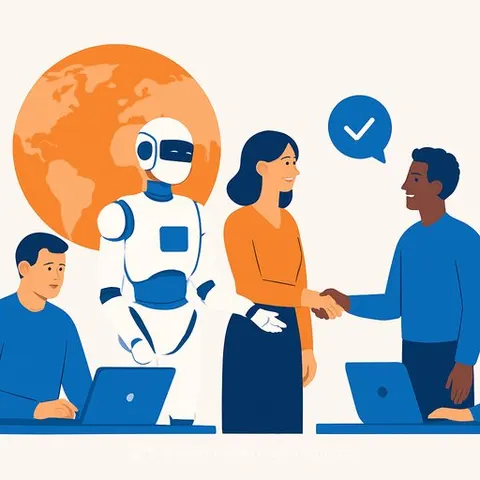
Global companies that laid off employees to adopt artificial intelligence are walking back those decisions, finding that AI cannot replace human judgment, creativity, and complex problem-solving. Ford, the Commonwealth Bank of Australia, and IBM are among those re-hiring workers after automation failed to meet expectations, as reported by CNBC on July 4.
The Ford example: Engineers return as AI falls short
Ford re-hired hundreds of experienced engineers after its automated systems could not resolve product quality issues. Charles Poon, vice president of vehicle hardware engineering at Ford, explained the limitation. "Artificial intelligence is a fantastic tool, but only as good as the information you use to train it," he said.
Voice bot backfires at Commonwealth Bank
The Commonwealth Bank of Australia replaced dozens of customer service officers with an AI voice bot, only to see call volumes spike because the system could not handle all customer needs. The bank cancelled the layoffs and brought human agents back to the phones.
IBM's HR bot handles routine, not complexity
IBM uses AI to process about 94 percent of routine HR requests. The remaining 6 percent, which involve ethical dilemmas and complex decision-making, still demand human intervention. Nickle LaMoreaux, IBM's head of HR, warned that neglecting entry-level hiring would erode the talent pipeline. "If we don't continue to invest in hiring entry-level employees, what will happen in the next three to five years? There is no recruitment pipeline; human resources will just dry up," he said. HR executives can benefit from structured guidance on AI integration, such as the AI Learning Path for HR Managers, which addresses recruitment, talent management, and the need for human oversight.
Surveys reveal widespread regret
An Orgvue report found that 39 percent of business leaders laid off employees due to AI adoption, but 55 percent of them later called the decision mistaken. A separate Robert Half survey indicated that 32 percent of U.S. hiring managers eliminated a position because of AI, then reopened the same or a similar role after the technology failed to deliver expected results.
Why this matters for HR professionals
The retreat from full AI replacement underscores that artificial intelligence is a productivity tool, not a workforce substitute. HR leaders must design roles that pair human judgment with AI efficiency, maintain entry-level recruiting to build future expertise, and retain the staff needed to monitor and refine AI systems. As ADP's senior vice president for APAC, Jessica Zhang, put it: "If AI results are inconsistent, inaccurate, or difficult to implement, companies often need to reintroduce human oversight."