Google Cloud launches agent-based AI for retail and restaurant customer experience
Here's the headline: Google Cloud introduced Gemini Enterprise for Customer Experience, an AI platform built to connect shopping and customer service so one agent can complete transactions and resolve issues end-to-end. This Gemini-based approach builds on advances in Generative AI and LLM.
Announced Jan. 8 at the NRF 2026 conference, the system uses agent-based AI to handle multi-step tasks with customer approval. Google says businesses can deploy it in days across web, mobile apps, and phone support. Early users include Kroger, Lowe's, Papa Johns, and Woolworths Group.
What it does-without the handoffs
Most retailers run product search, checkout, and support on separate systems. That's why customers repeat themselves across channels. This platform keeps context from product discovery through checkout and post-purchase issues like returns or refunds-so a single agent can complete the loop.
Google says it does not use customer data processed by the platform to train its AI models. Controls for privacy and regulatory needs are included.
How it works
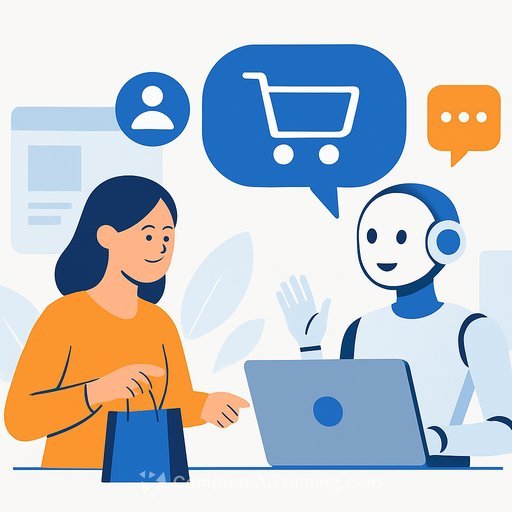
- A shopping agent connects chat and voice interfaces directly to backend systems-product catalogs, inventory, pricing, and order management-and is part of broader AI Agents & Automation that orchestrate cross-system workflows.
- It can manage complex requests (e.g., filter by size or technical requirements), add items to cart, and complete checkout with customer consent.
- Works across websites, mobile apps, and phone support, keeping context so customers don't start over on each channel.
Darshan Kantak, VP of applied AI at Google Cloud, said the goal is to close the long-standing gap between sales and service operations by unifying them under one agent.
Customer Experience Agent Studio
- Build and manage multiple AI agents from existing support transcripts and internal documents.
- Tools for performance analysis, quality scoring, and real-time assistance that supports your human agents.
Real use cases in the wild
- Kroger: Meal planning, basket building, and issue resolution across digital and in-store channels.
- Lowe's: Expanding its AI home improvement advisor with guidance tuned to each customer's home, location, and project needs.
- Papa Johns: First restaurant to deploy across channels-taking orders, recommending add-ons, and updating menus and pricing across locations.
- Woolworths Group: Early adopter exploring unified sales-service workflows.
For restaurants
The platform's food ordering agent supports ordering via mobile apps, websites, phone calls, kiosks, and in-car systems. That means one agent can take an order, apply promotions, resolve issues, and update store-level menus and pricing.
Why support leaders should care
- AI for Customer Support: One agent can guide a customer from product selection to resolution, reducing handoffs.
- Less repetition: Context persists across channels (chat, voice, app, site).
- Faster time-to-value: Google claims days-not months-to stand up a working pilot.
- Agent assist: Use the studio's real-time tools to reduce handle time without losing empathy.
Priority workflows to automate first
- Pre-purchase: Guided discovery, compatibility checks, real-time inventory, price matching rules.
- Purchase: Cart building, checkout with consent, promo validation, payment retries.
- Post-purchase: Order status, delivery changes, returns/refunds, warranty claims, subscription changes.
30-60 day pilot plan
- Pick 2-3 high-volume intents with clear policies (e.g., order status, exchanges, product fit).
- Connect product, order, and ticketing systems; define guardrails for consented actions (e.g., checkout, refunds).
- Import transcripts and SOPs into Customer Experience Agent Studio; set quality thresholds and escalation rules.
- Launch in one channel (web chat or phone IVR) and one region/store group.
- Measure, tune, then expand to additional channels.
Metrics to track from day one
- Containment/automation rate (by intent and channel)
- First contact resolution and escalation rate
- AHT and agent assist adoption
- Conversion rate, average order value, promo usage
- Refund/return accuracy and policy compliance
- CSAT and CES for automated vs. assisted paths
Governance and risk controls
- Define which actions require explicit consent (refund, reorder, payment).
- Set spending limits, SKU restrictions, and supervisor approvals for edge cases.
- Enable auditing: log prompts, actions taken, and outcomes for QA and compliance.
- Validate Google Cloud's data handling: no training on your customer data, plus regional and industry compliance needs.
Team impact
- Agents shift from repetitive lookups to handling edge cases and coaching AI with better prompts/policies.
- QA teams use quality scoring to target gaps and retrain the agent weekly.
- Ops leaders tune flows where containment hurts CSAT and add assisted handoffs.
Where to learn more
- Google Cloud Gemini overview
- National Retail Federation (NRF)
- AI courses by job role (Customer Support)
Bottom line
If your support, sales, and order systems live in silos, this platform is built to stitch them together so customers can get things done in one continuous flow. Start small, wire in your policies, measure aggressively, and scale what works.
Your membership also unlocks: