
AI news ·
Google Cloud partners with Philippine government to deploy AI agents and expand digital infrastructure
The Philippines will equip 50,000 government workers with Google Cloud AI tools to automate public services. It also adds AI cybersecurity monitoring for 56 agencies.
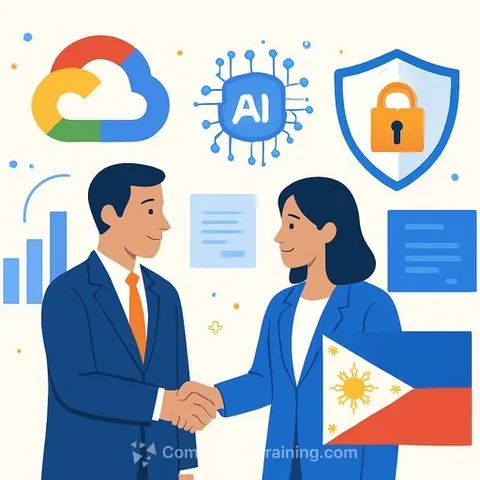
On June 21, the Philippines' Department of Information and Communications Technology (DICT) and Google Cloud launched a multi-year partnership to bring enterprise AI into public services. The "AI Agents for Public Sector" program will equip 50,000 government workers with Gemini Enterprise and Google Workspace tools, with plans to expand to 200,000. For a government workforce that handles millions of citizen interactions, the move signals a shift toward automated, language-aware support at scale.
AI agents for citizen services
The program deploys conversational AI agents that understand speech and text in local languages. Citizens can use these agents to navigate government procedures - from permits to benefits - without visiting an office or filling out complex forms. The agents run on Google's Gemini Enterprise, which public servants will also use to automate internal administrative tasks. The tools being rolled out are part of the same ecosystem covered in Google AI Courses designed for enterprise users. This kind of deployment reflects a growing trend in AI for Government adoption across Southeast Asia.
Cybersecurity and national defense
The DICT also partnered with Google Cloud to deploy Cybershield across government agencies. This platform provides AI-driven threat intelligence and centralized security monitoring. Currently, 56 agencies are integrated, with a target of 90 by June 2026. The system is designed to protect critical infrastructure and citizen data from cyber threats, creating a coordinated defense network across the public sector.
Infrastructure upgrades
The partnership includes integrating trans-Pacific subsea cables - the Taiwan-Philippines-US and Apricot systems - with local terrestrial networks. This aims to improve connectivity reliability, lower costs for local organizations, and expand high-speed internet access to public schools and community centers nationwide. The combined cable infrastructure is expected to strengthen the backbone for digital government services.
Why this matters for government professionals
When a national government commits to training 50,000 public servants on enterprise AI tools, it signals a shift in what frontline government work will look like. For government professionals in other countries, the Philippines' approach offers a concrete model: start with administrative automation, layer in citizen-facing AI agents, and back it with cybersecurity infrastructure. The scale of the rollout - eventually reaching 200,000 workers - also shows that AI adoption in government is no longer a pilot project but a workforce-wide initiative.