
AI news ·
Google DeepMind and Edison publish Nature papers on AI systems designed to automate scientific discovery
Google DeepMind and Edison Scientific published research in Nature describing AI systems that compress months of scientific work into hours. Both platforms automate hypothesis generation, experimental design, and data analysis for drug discovery.
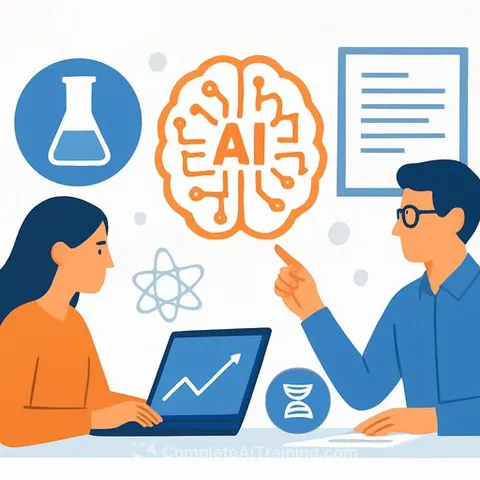
Google DeepMind and Edison Build AI Systems to Automate Scientific Discovery
Google DeepMind and Edison Scientific have published research describing AI systems designed to automate core steps of the scientific method-from hypothesis generation through experimental design to data analysis. Two papers published in Nature this month detail how these multi-agent platforms compress months or years of research work into hours or days.
The systems represent a shift in how AI might accelerate drug discovery and biomedical research, fields where traditional development timelines routinely exceed a decade.
DeepMind's Co-Scientist
DeepMind's platform, called Co-Scientist, uses Google's Gemini model and accepts natural language prompts to guide research. The system iteratively reasons through problems, gathering knowledge and improving outputs as it works.
Researchers can steer Co-Scientist by refining ideas or providing feedback through chat. The platform validated across three biomedical applications: drug repurposing for acute myeloid leukemia, target discovery for liver fibrosis, and analysis of antimicrobial resistance mechanisms.
Vivek Natarajan, research scientist at DeepMind, said the goal is to help scientists reach answers "from months and years to minutes and hours." He emphasized that the team is building in reliability and trustworthiness to support human-AI collaboration.
Edison's Robin and Kosmos
Edison, a spinout of the nonprofit FutureHouse, released Robin, which combines OpenAI o4-mini and Anthropic Claude 3.7 for biological discovery work.
Robin proposed repurposing Ripasudil, a glaucoma drug, to treat dry age-related macular degeneration through a novel mechanism. The system also identified KL001, a circadian clock modulator, as an unexpected treatment for the same condition. Edison experimentally validated both suggestions in patient-derived retinal cells.
Edison unveiled an updated system, Kosmos, in November. It can reason across 175 million full-text papers, clinical trials, and patents, and operates interactively while sending mid-run updates. The company says Kosmos performs hundreds of research tasks in parallel, compressing months of work into a single day.
Edison announced a collaboration with pharmaceutical company Incyte to deploy Kosmos across the company's discovery and development pipeline, focusing on continuous learning from translational and clinical data.
The Gap Between Theory and Practice
Michaela Hinks, founding member of technical staff at Edison, identified trust, validation, and end-to-end solutions as the main obstacles to adoption. "Most AI tools accelerate the cheaper and easier upstream work, but not the expensive and regulated downstream stages of scientific research," she said.
Robin's validation in patient-derived cells rather than standard immortalized cell lines distinguishes it as the first agentic AI system to generate and test a hypothesis with clinically actionable results.
Both systems emerged from research published as preprints in early 2025. The Nature publications mark a step toward an ecosystem of specialized AI agents for life science research, though whether these systems will fundamentally change the pace of discovery remains an open question.
Researchers interested in AI applications across scientific work may find value in exploring AI for Science & Research learning paths.